World Heritage Identification Number: 945
World Heritage since: 2004
Category: Cultural Heritage
WHE Type: Infrastructure & Industry
Transboundary Heritage: No
Endangered Heritage: No
Country: 🇮🇳 India
Continent: Asia
UNESCO World Region: Asia and the Pacific
Map
A Blend of Cultures: Chhatrapati Shivaji Terminus - A Unique Architectural Marvel
The Chhatrapati Shivaji Terminus (CST), previously known as Victoria Terminus (VT), stands tall as a testament to the harmonious fusion of Western and Eastern architectural styles. This grand edifice, located in Mumbai, India, was inscribed as a UNESCO World Heritage Site in 2004.
More to come…UNESCO Description of the World Heritage Site
The Chhatrapati Shivaji Terminus, formerly known as Victoria Terminus Station, in Mumbai, is an outstanding example of Victorian Gothic Revival architecture in India, blended with themes deriving from Indian traditional architecture. The building, designed by the British architect F. W. Stevens, became the symbol of Bombay as the ‘Gothic City’ and the major international mercantile port of India. The terminal was built over 10 years, starting in 1878, according to a High Victorian Gothic design based on late medieval Italian models. Its remarkable stone dome, turrets, pointed arches and eccentric ground plan are close to traditional Indian palace architecture. It is an outstanding example of the meeting of two cultures, as British architects worked with Indian craftsmen to include Indian architectural tradition and idioms thus forging a new style unique to Bombay.
UNESCO Justification of the World Heritage Site
Criterion (ii): Chhatrapati Shivaji Terminus (formerly Victoria Terminus) of Mumbai (formerly Bombay) exhibits an important interchange of influences from Victorian Italianate Gothic Revival architecture, and from Indian Traditional buildings. It became a symbol for Mumbai as a major mercantile port city on the Indian subcontinent within the British Commonwealth.
Criterion (iv): Chhatrapati Shivaji Terminus (formerly Victoria Terminus) is an outstanding example of late 19th century railway architecture in the British Commonwealth, characterized by Victorian Gothic Revival and traditional Indian Features, as well as its advanced structural and technical solutions.
Encyclopedia Record: Chhatrapati Shivaji Terminus
Chhatrapati Shivaji Terminus (CST), officially Chhatrapati Shivaji Maharaj Terminus (CSMT), and also known as Victoria Terminus (VT), is a historic railway terminus and UNESCO World Heritage Site in Mumbai (Bombay), Maharashtra, India.Additional Site Details
Area: 2.85 hectares
Number of Components: 1
(iv) — Outstanding example of a type of building or landscape
Coordinates: 18.9401222222 , 72.8362027777
Image
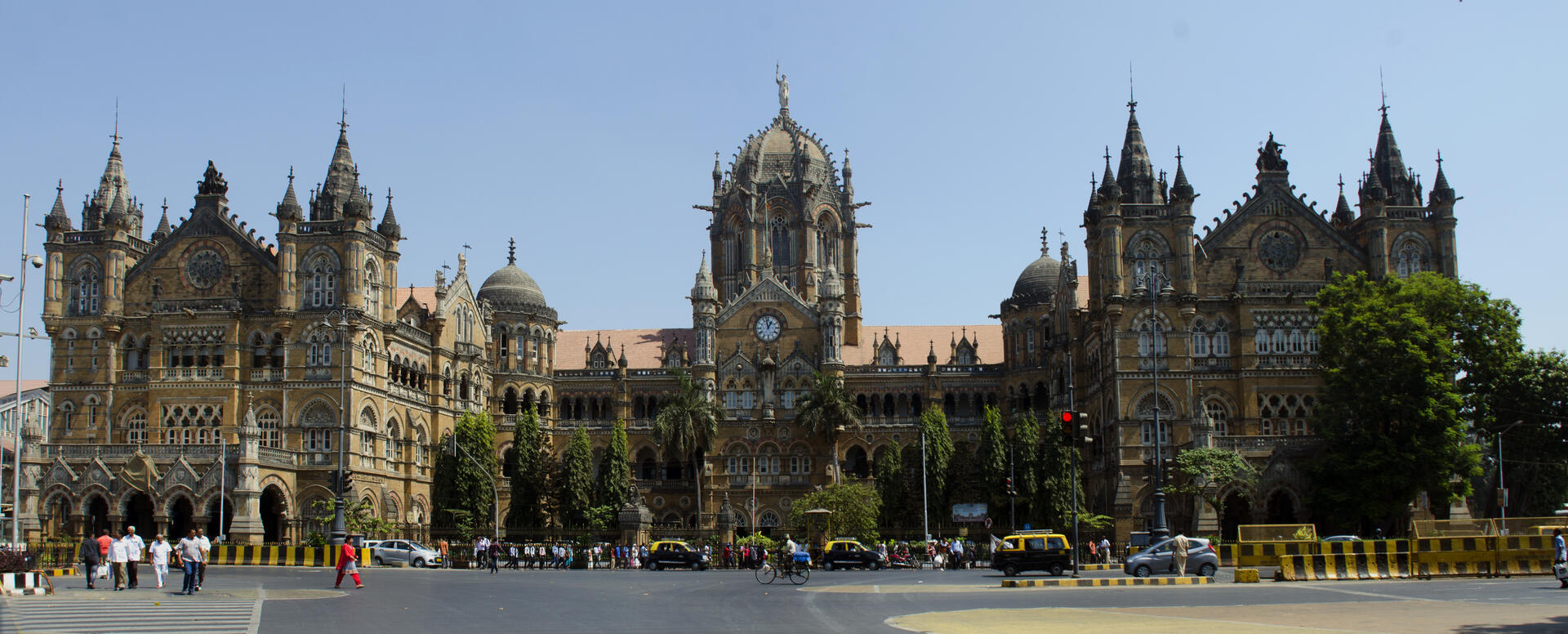
© Rangan Datta Wiki, CC BY-SA 4.0 Resized from original. (This derivative is under the same CC BY-SA license.)
World Heritage Research
Discover scientific research and academic studies that deepen our understanding of Chhatrapati Shivaji Terminus (formerly Victoria Terminus) from its history and significance to its conservation, management, and contemporary challenges.
-
Work Related Low Back Pain in Sedentary Railway Officials of the Age Group 30 to 60 Years at Chhatrapati Shivaji Maharaj Terminus Mumbai- A Survey Study
A significant prevalence of work-related low back pain (LBP) was identified among sedentary railway officials aged 30 to 60 years at Chhatrapati Shivaji Maharaj Terminus, Mumbai. The study found that 61% of the 100 participants reported LBP, with a notable gender disparity—44 males and 17 females—highlighting higher incidence in male officials. Prolonged sitting and desk work were primary contributors to discomfort. The research employed a cross-sectional survey using the Modified Oswestry Low Back Pain Disability Questionnaire to assess disability levels associated with LBP. While the study provides insights into ergonomic challenges faced by railway officials, its limitations include a gender imbalance, focus on a single station, and lack of detailed work load or doctor consultation data.
Sudiksha Dharmendra RathodIntern, Dr. Shweta Phadke, & DR. TEJAL PARDESH. (2023). Work Related Low Back Pain in Sedentary Railway Officials of the Age Group 30 to 60 Years at Chhatrapati Shivaji Maharaj Terminus Mumbai- A Survey Study. Zenodo. https://doi.org/10.5281/ZENODO.8021529
View Publication Record | Read Publication -
Assessment of Biofilm Inhabitants of Deteriorated Surfaces of Heritage Sites
A comparative analysis of bacterial biofilm inhabitants on deteriorated surfaces of two UNESCO World Heritage Sites—Chhatrapati Shivaji Maharaj Terminus (CSMT) and Ajanta Caves (AJC)—reveals distinct microbial communities and functional profiles. While both sites host common environmental bacteria like Pseudomonas and Bacillus, AJC exhibits significantly higher bacterial diversity than CSMT, which is better maintained. Metagenomic sequencing identified abundant sulfate reducers (15.4% in CSMT vs. 29.8% in AJC) and nitrate reducers (36.3% in CSMT vs. 25.1% in AJC), suggesting their role in surface deterioration. Biofilm-associated genes (alg1 and pelA) were detected, indicating the presence of biofilm-forming bacteria on heritage surfaces. This integrated approach offers a framework for tracking biofilm bacteria to assess risks and guide conservation strategies.
Yesankar, P. J., Pal, M., Salok, A., & Qureshi, A. (2022). Assessment of Biofilm Inhabitants of Deteriorated Surfaces of Heritage Sites. Geomicrobiology Journal, 39(10), 906–915. https://doi.org/10.1080/01490451.2022.2097342
View Publication Record | Read Publication