World Heritage Identification Number: 383
World Heritage since: 1987
Category: Cultural Heritage
WHE Type: Buildings & Architectural Ensembles
Transboundary Heritage: No
Endangered Heritage: No
Country: 🇪🇸 Spain
Continent: Europe
UNESCO World Region: Europe and North America
Map
The Architectural Triumvirate: Cathedral, Alcázar, and Archivo de Indias in Seville
The architectural ensemble of the Cathedral, Alcázar, and Archivo de Indias in Seville, Spain, forms a remarkable monumental complex that reflects the city's rich and layered cultural history. The three buildings were inscribed together on the UNESCO World Heritage List in 1987. Their architecture brings together Islamic, Gothic, Renaissance, Mudéjar, and Baroque traditions, offering an exceptional record of the civilizations and historical periods that shaped Seville.
The Cathedral of Saint Mary of the See, commonly known as Seville Cathedral, is a vast five-nave Gothic church built on the site of Seville's former Almohad mosque. In 1401, the cathedral chapter decided to undertake the construction of a monumental new Gothic cathedral, and the principal structure was completed in 1519. Seville Cathedral is described by the Cathedral itself as the largest Gothic cathedral in the world, while UNESCO describes it as the largest Gothic building in Europe. Its immense scale reflects the importance and resources of Seville during the late Middle Ages and the early modern period.
The cathedral retains important elements of the former mosque, most notably the Giralda, the Almohad minaret that was converted into a Christian bell tower, and the Patio de los Naranjos. Built in the late 12th century, the Giralda was given its Renaissance upper section in the 16th century under Hernán Ruiz II. These surviving elements provide a tangible link to Islamic Seville and illustrate the transformation of the city following the Christian conquest.
Inside the cathedral, numerous chapels and works of art reflect the religious and artistic development of Seville from the Middle Ages through the Renaissance and Baroque periods. Among the Renaissance additions is the Chapter House, associated with Hernán Ruiz II. The adjoining Church of the Sagrario contains an important Baroque altarpiece whose architectural structure was created by Francisco Dionisio de Ribas, with sculptures and reliefs by Pedro Roldán.
Adjacent to the cathedral stands the Real Alcázar, a royal palace whose origins predate the Christian conquest of Seville. Its earliest surviving nucleus dates to the 10th century, when Muslim rulers established a governmental complex on the site. The Alcázar was subsequently expanded under successive Islamic dynasties, including the Almohads. Following the Castilian conquest of Seville in 1248–49, it became a royal residence and was repeatedly enlarged and remodelled by Christian rulers.
The resulting complex embodies the meeting of Islamic and Christian architectural traditions. Among its most important later additions are the Gothic Palace associated with Alfonso X and the Mudéjar Palace of Pedro I, constructed in the 14th century. Particularly notable spaces include the Patio de las Doncellas, with its richly decorated galleries and gardens, and the Salón de Embajadores, an ornate ceremonial hall beneath a magnificent domed ceiling. The Alcázar continued to serve the Spanish monarchy, including during the reign of the Catholic Monarchs, Isabella I of Castile and Ferdinand II of Aragon.
The Alcázar also became closely associated with Seville's growing importance in Spain's overseas expansion. The Casa de Contratación, established in 1503, operated within the Alcázar and administered many aspects of trade and navigation between Spain and its American territories. Its activities helped establish Seville as the principal center of Spain's transatlantic commerce during the early modern period.
The third component of the ensemble is the Archivo General de Indias, housed in the historic Casa Lonja de Mercaderes near the cathedral and the Plaza del Triunfo. Construction of the building began in the late 16th century, during the reign of Philip II, according to plans by Juan de Herrera. Originally built to serve Seville's merchants, the Casa Lonja was transformed in 1785, during the reign of Charles III, into the Archivo General de Indias.
The archive was established to bring together documents relating to Spain's overseas territories that had previously been dispersed among several repositories. Today, it preserves an extraordinary collection documenting more than three centuries of Spanish activity and administration in the Americas and the Philippines. Its holdings include records concerning exploration, conquest, government, commerce, navigation, religion, and the social and economic history of Spain's overseas territories.
The three monuments are closely connected to Seville's role in Spain's expansion into the Americas. The Cathedral contains the monumental tomb of Christopher Columbus; the Alcázar housed the Casa de Contratación, which administered the Crown's trade and navigation with the Indies; and the Archivo General de Indias preserves the documentary record generated by these institutions and by the wider administration of Spain's overseas territories. Together, they reveal the close relationship between religious authority, royal power, commerce, exploration, and imperial administration in early modern Seville.
Together, the Cathedral, Alcázar, and Archivo de Indias form one of Seville's most significant historical and architectural ensembles. Their buildings and collections reveal successive layers of the city's past: the legacy of Islamic Seville, the transformation of the city following the Christian conquest, the enduring influence of Islamic and Mudéjar artistic traditions, and Seville's emergence as the principal center of Spain's transatlantic trade during the early modern period. The ensemble stands as an extraordinary testament to the civilizations of the Almohads and Christian Andalusia and to Seville's historic role as a major center of political, religious, commercial, and cultural exchange.
UNESCO Description of the World Heritage Site
Together these three buildings form a remarkable monumental complex in the heart of Seville. The cathedral and the Alcázar – dating from the Reconquest of 1248 to the 16th century and imbued with Moorish influences – are an exceptional testimony to the civilization of the Almohads as well as that of Christian Andalusia. The Giralda minaret is the masterpiece of Almohad architecture. It stands next to the cathedral with its five naves; the largest Gothic building in Europe, it houses the tomb of Christopher Columbus. The ancient Lonja, which became the Archivo de Indias, contains valuable documents from the archives of the colonies in the Americas.
UNESCO Justification of the World Heritage Site
Criterion (i): The Giralda constitutes a unique artistic achievement, a masterpiece of Almohad architecture. The immense Cathedral with five naves which replaced the mosque is the largest Gothic edifice in Europe. The elliptical space of the Cabildo, created by Hernán Ruiz, is one of the most beautiful architectural works of the Renaissance.
Criterion (ii): The Giralda influenced the construction of numerous towers in Spain, and, after the conquest, in the Americas.
Criterion (iii): The Cathedral - the largest Gothic temple in Europe - and the Alcázar of Seville bear exceptional testimony to the civilization of the Alhomads and to that of Christian Andalusia dating from the re-conquest of 1248 to the 16th century, which was thoroughly imbued with Moorish influences.
Criterion (vi): The Cathedral, the Alcázar and the Lonja are directly and tangibly associated with a universally important event: the discovery of the New World by Christopher Columbus in 1492/1493 and the colonization of Latin America. The tomb of Christopher Columbus is in the Cathedral. Plans were made in the Admirals' Hall (Sala de los Almirantes) for a number of history's greatest explorations, notably the circumnavigation of the globe by Magellan and Sebastián ElCano (1519-1522). In the Lonja are conserved the most precious documents from the archives of the colonies in the Americas.
Encyclopedia Record: Seville Cathedral
The Cathedral of Saint Mary of the See, better known as Seville Cathedral, is a Catholic cathedral in Seville, Andalusia, Spain. It was registered in 1987 by UNESCO as a World Heritage Site, along with the adjoining Alcázar palace complex and the General Archive of the Indies. It is one of the largest churches in the world and the largest Gothic cathedral.Additional Site Details
Area: 12 hectares
Number of Components: 3
(ii) — Significant interchange of human values
(iii) — Unique or exceptional testimony to a cultural tradition
(vi) — Directly associated with events or living traditions
Coordinates: 37.38384 , -5.99155
Image
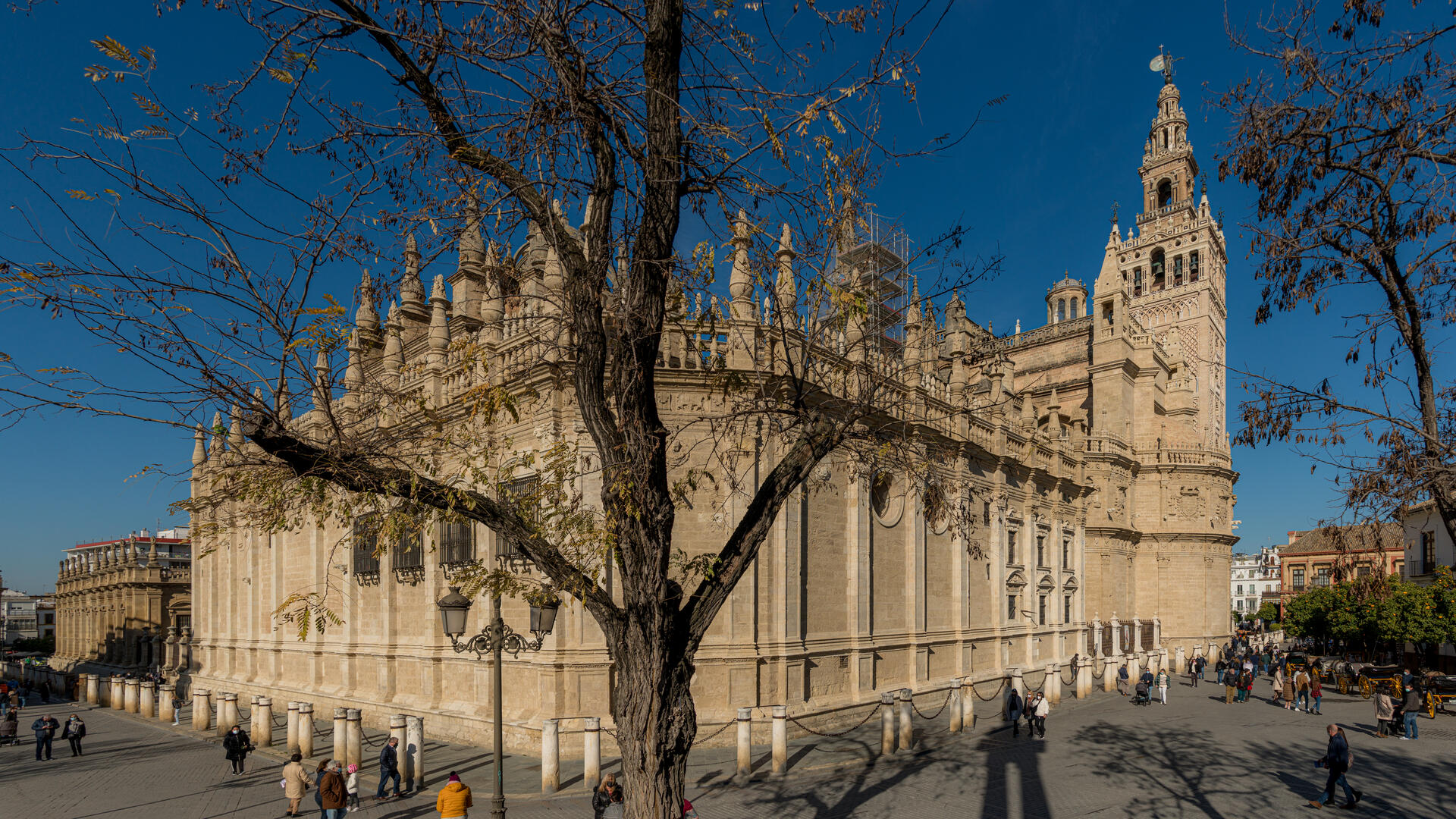
© Fernando, CC BY-SA 4.0 Resized from original. (This derivative is under the same CC BY-SA license.)