World Heritage Identification Number: 517
World Heritage since: 1989
Category: Cultural Heritage
WHE Type: Archaeological Sites
Transboundary Heritage: No
Endangered Heritage: No
Country: 🇬🇷 Greece
Continent: Europe
UNESCO World Region: Europe and North America
Map
The Archaeological Site of Olympia: A Sanctuary of Ancient Greek Religion and Sport
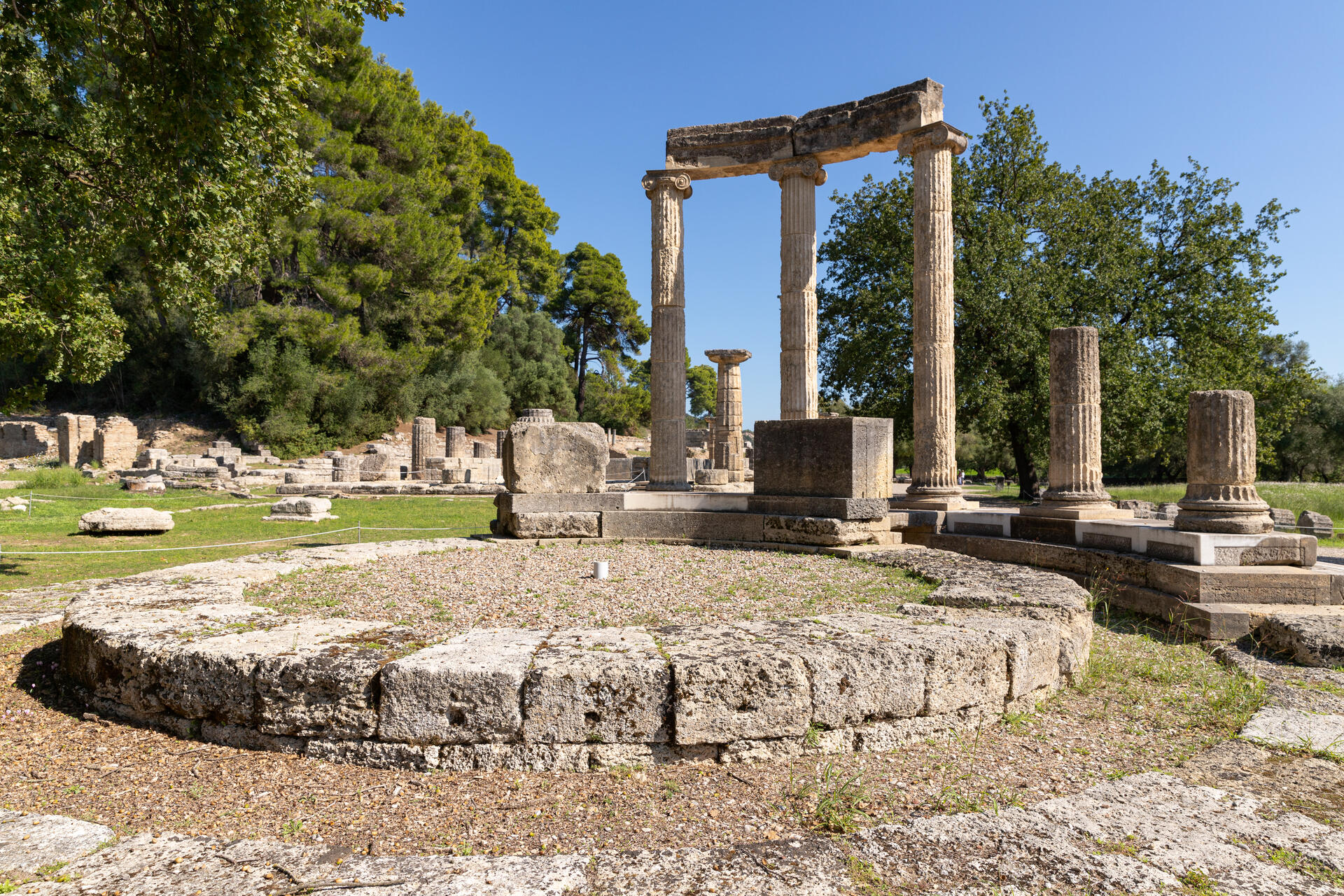
The Archaeological Site of Olympia, located in a verdant valley in the western part of the Peloponnese peninsula in Greece, is a testament to the rich cultural heritage of ancient Greece. This significant archaeological site, inscribed on the UNESCO World Heritage List in 1989, has been inhabited since prehistoric times but gained prominence in the 10th century BC when it became a center for the worship of Zeus.
Olympia's significance lies not only in its religious aspects but also in its role as the birthplace of the Olympic Games, a tradition that endured for over a millennium before being revived in modern times. The Altis, or sacred grove, within the site houses some of the most remarkable masterpieces from the ancient Greek world.
The Altis boasts several impressive temples, including the Temple of Hera, built around 590 BC as one of the oldest examples of Doric architecture, and the Temple of Zeus, begun in 470 BC, which housed the famous statue of Zeus by Phidias, one of the Seven Wonders of the Ancient World. This colossal chryselephantine statue, crafted from gold and ivory, was placed at the center of the temple and served both as a religious focal point and an artistic masterpiece that influenced generations of Greek sculpture and temple design. Although the statue no longer exists, its impact on art and culture continues to be felt today.
Beyond the temples, the site features the remnants of the sports structures erected for the Olympic Games, which were held every four years beginning in 776 BC. These include the Stadium, the Palaestra (wrestling school), and the Gymnasium. The original Olympic Games encompassed a variety of events, such as running, long jump, discus throw, javelin throw, and wrestling, reflecting the physical prowess and athleticism admired by the Greeks.
While only free Greek men were allowed to compete in the main Olympic events, Olympia also hosted the Heraia, a separate athletic festival dedicated to the goddess Hera. Held every four years, these games featured footraces for unmarried young women, providing them with their own arena to demonstrate speed and endurance, though their participation remained strictly separated from the men's competitions.
In addition to its religious and sporting significance, Olympia played a crucial role in the political and cultural life of ancient Greece, fostering unity through the Olympic Truce (Ekecheiria), a cessation of hostilities that allowed athletes and spectators to travel safely. The site also served as a meeting place for representatives from various city-states, fostering a sense of unity among the Greeks.
The decline of ancient Olympia was as dramatic as its rise. In 393 AD, the Roman Emperor Theodosius I, a Christian, banned all 'pagan' festivals, effectively ending the original Olympic Games after nearly 1,200 years. Shortly thereafter, the Temple of Zeus was destroyed by fire, and subsequent earthquakes and floods from the Alpheios and Kladeos rivers buried the site under layers of silt, preserving it until its rediscovery by archaeologists in the 18th and 19th centuries.
Today, the Archaeological Site of Olympia stands as a vital link to the past, offering insights into the religious, cultural, and athletic practices of ancient Greece. The tradition of the Olympic Flame, which is still lit at the Altar of Hera for every modern Olympiad, serves as a living reminder of the ideals of peace, competition, and excellence that the Olympic Games represent and that were born in this sacred valley.
UNESCO Description of the World Heritage Site
The site of Olympia, in a valley in the Peloponnesus, has been inhabited since prehistoric times. In the 10th century B.C., Olympia became a centre for the worship of Zeus. The Altis – the sanctuary to the gods – has one of the highest concentrations of masterpieces from the ancient Greek world. In addition to temples, there are the remains of all the sports structures erected for the Olympic Games, which were held in Olympia every four years beginning in 776 B.C.
UNESCO Justification of the World Heritage Site
Criterion (i): The sanctuary of the Altis contained one of the highest concentrations of masterpieces of the ancient Mediterranean world. Many have been lost, such as the Olympia Zeus, a gold-and-ivory cult statue which was probably destroyed by Pheidias between 438 and 430 BC and one of the seven wonders of the ancient world. Other masterpieces have survived: large votive archaic bronzes, pedimental sculptures and metopes from the temple of Zeus, and the famous complex of Hermes by Praxiteles. These are all major works of sculpture and key references in the history of art.
Criterion (ii): The influence of the monuments of Olympia has been considerable: the temple of Zeus, built in 470-457 BC, is a model of the great Doric temples constructed in the Peloponnese, as well as in southern Italy and in Sicily during the 5th century BC; the Nike by Paionios, sculptured circa 420 BC, so lastingly influenced iconographic allegories of victory that neoclassic art of the 19th century is still much indebted to it; the Olympian Palaestra with reference to the Roman period, a square and an open space for athletes’ training as well as a place for their mental and physical preparation before the Games, is undoubtedly the typological reference made by Vitruvius in “De Architectura”. Its value as a standard in architecture is in any case indisputable.
Criterion (iii): Olympia bears exceptional testimony to the ancient civilizations of Peloponnese, both in terms of duration and quality. The first human settlements date back to prehistoric times when the valley was occupied from 4000 to 1100 BC. Settlements and necropolises from the Bronze Age have been unearthed along the banks of the Alpheios river. The Middle Helladic and Mycenaean periods are represented at the site. Consecrated to Zeus, the Altis is a major sanctuary from the 10th century BC to the 4th century AD, corresponding to the zenith of Olympia, marked more specifically by celebration of the Olympic Games from 776 BC to 393 AD. A Christian settlement survived for a time at the site of the ruins of the great Pan-Hellenic sanctuary: discovery of the workshop of Pheidias under the remains of a Byzantine church is an outstanding indication of continuous human settlement, which was interrupted only in the 7th century AD, as a result of natural disasters.
Criterion (iv): Olympia is an outstanding example of a great Pan-Hellenic sanctuary of antiquity, with its multiple functions: religious, political and social. Ancient sanctuaries, such as the Pelopion and a row of Treasuries to the north at the foot of Kronion Hill, are present within the peribolus of the Altis, consecrated to the gods, alongside the principal temples of Zeus and Hera. All around the divine precinct are the structures used by the priests (Theokoleon) and the administration (Bouleuterion), as well as common buildings (Prytaneion), accommodation (Leonidaion and Roman hostel), residences for distinguished guests (Nero’s House), and all the sports structures used for the preparation and celebration of the Olympic Games: the stadium and the hippodrome to the east, and the thermal baths, the Palaestra and the Gymnasium to the south and west.
Criterion (vi): Olympia is directly and tangibly associated with an event of universal significance. The Olympic Games were celebrated regularly beginning in 776 BC. The Olympiad –the four-year period between two successive celebrations falling every fifth year- became a chronological measurement and system of dating used in the Greek world. However, the significance of the Olympic Games, where athletes benefitting from a three-month Sacred Truce came together from all the Greek cities of the Mediterranean world to compete, demonstrates above all the lofty ideals of Hellenic humanism: peaceful and loyal competition between free and equal men, who are prepared to surpass their physical strength in a supreme effort, with their only ambition being the symbolic reward of an olive wreath. The revival of the Olympic Games in 1896 through the efforts of Pierre de Coubertin illustrates the lasting nature of the ideal of peace, justice and progress, which is no doubt the most precious but also the most fragile feature of the world’s heritage.
Encyclopedia Record: Olympia, Greece
Olympia, officially Archaia Olympia, is a small town in Elis on the Peloponnese peninsula in Greece, famous for the nearby archaeological site of the same name. The site was a major Panhellenic religious sanctuary of ancient Greece, where the ancient Olympic Games were held every four years throughout classical antiquity, from the 8th century BC to the 4th century AD. They were restored on a global basis in 1894 in honor of the ideal of peaceful international contention for excellence.Additional Site Details
Area: 105.6 hectares
Number of Components: 1
(ii) — Significant interchange of human values
(iii) — Unique or exceptional testimony to a cultural tradition
(iv) — Outstanding example of a type of building or landscape
(vi) — Directly associated with events or living traditions
Coordinates: 37.64 , 21.634