
World Heritage Identification Number: 354
World Heritage since: 1995
Category: Natural Heritage
WHE Type: Natural Landscapes & Geographic Features
Transboundary Heritage: Yes
Endangered Heritage: No
Country: Canada, United States of America
Continent: Americas
UNESCO World Region: Europe and North America
Map
Waterton-Glacier International Peace Park: A Transboundary Testament to Peace and Nature Conservation
The Waterton-Glacier International Peace Park, established in 1932, stands as a testament to the enduring spirit of peace and cooperation between Canada and the United States. This unique transboundary park straddles the international border, uniting Waterton Lakes National Park in Alberta, Canada, and Glacier National Park in Montana, USA. The park’s designation as a UNESCO World Heritage Site, granted in 1995, underscores its exceptional natural beauty, biodiversity, and cultural significance.
Geographically, the park spans more than 4,556 square kilometers (over 1.1 million acres), encompassing a diverse range of ecosystems that include prairies, forests, alpine meadows, and glaciers. The park’s namesake features—Waterton Lake and Glacier National Park’s remaining glaciers—contribute to its breathtaking landscapes. Notably, the park is home to several well-known glaciers, including the iconic Grinnell Glacier, many of which have been shrinking rapidly due to climate change.
The park's rich biodiversity is another key attraction. Between 60 and 70 species of mammals inhabit the transboundary park, including grizzly bears, mountain goats, elk, moose, and wolves. Additionally, the park boasts an impressive array of birdlife, with over 260 bird species recorded within its boundaries. The park's flora is equally diverse, featuring coniferous forests dominated by lodgepole pine, whitebark pine, and Engelmann spruce.
The park’s cultural history is equally fascinating. Indigenous peoples, including the Blackfoot Confederacy (Siksikaitsitapi) and the Ktunaxa Nation, have inhabited the region for over 12,000 years, leaving behind a rich cultural legacy that includes traditional stories, sacred landscapes, and archaeological sites. European settlers arrived in the 19th century, establishing ranches and homesteads, some of which still exist today.
Today, the park serves as a sanctuary for nature lovers, adventurers, and those seeking solace in the wilderness. Activities within the park range from hiking and camping to wildlife viewing and photography. The park also offers educational programs and research opportunities, contributing to a deeper understanding of its ecosystems and conservation needs.
Altogether, the Waterton-Glacier International Peace Park embodies the harmonious coexistence of nature and human stewardship. Its transboundary status symbolizes the shared commitment of Canada and the United States to preserve this pristine wilderness for future generations. As a UNESCO World Heritage Site, it serves as a beacon of hope for global conservation efforts, reminding us of the importance of preserving our planet's natural wonders and fostering cross-border cooperation.
UNESCO Description of the World Heritage Site
In 1932 Waterton Lakes National Park (Alberta, Canada) was combined with the Glacier National Park (Montana, United States) to form the world's first International Peace Park. Situated on the border between the two countries and offering outstanding scenery, the park is exceptionally rich in plant and mammal species as well as prairie, forest, and alpine and glacial features.
UNESCO Justification of the World Heritage Site
Criterion (vii): Both national parks were originally designated by their respective nations because of their superlative mountain scenery, their high topographic relief, glacial landforms and abundant diversity of wildlife and wildflowers.
Criterion (ix): The property occupies a pivotal position in the Western Cordillera of North America, resulting in the evolution of plant communities and ecological complexes that occur nowhere else in the world. Maritime weather systems unimpeded by mountain ranges to the north and south allow plants and animals characteristic of the Pacific Northwest to extend to and across the continental divide in the park. To the east, prairie communities nestle against the mountains with no intervening foothills, producing an interface of prairie, montane and alpine communities. The International Peace Park includes the headwaters of three major watersheds, which drain through significantly different biomes to different oceans. The biogeographical significance of this tri-ocean divide is increased by the many vegetated connections between the headwaters. The net effect is to create a unique assemblage and high diversity of flora and fauna concentrated in a small area.
Encyclopedia Record: Waterton-Glacier International Peace Park
The Waterton-Glacier International Peace Park is the union of Waterton Lakes National Park in Canada and Glacier National Park in the United States. Both parks are declared Biosphere Reserves by UNESCO and their union as a World Heritage Site.Additional Site Details
Area: 457,614 hectares
Number of Components: 2
(ix) — Outstanding example representing ecological and biological processes
Coordinates: 48.99605556 , -113.9041667
IUCN World Heritage Outlook
The 2025 Conservation Outlook on Waterton-Glacier International Peace Park reports the following assessment:
Source: International Union for Conservation of Nature (IUCN) · View assessment
Image
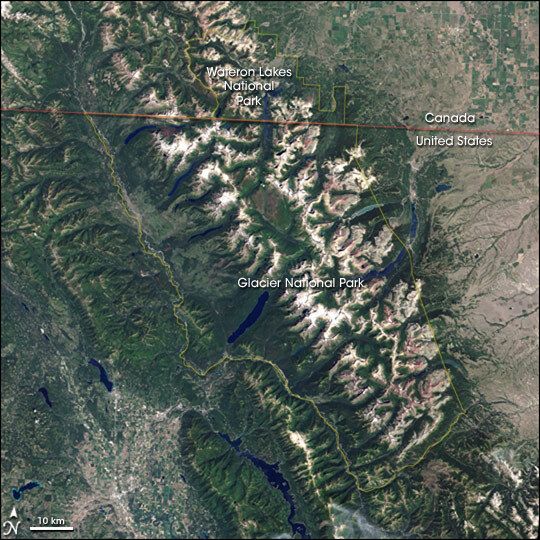
Jesse Allen, NASA Earth Observatory, using data obtained courtesy of the University of Maryland’s Global Land Cover Facility., Public domain