
World Heritage Identification Number: 1660
World Heritage since: 2023
Category: Cultural Heritage
WHE Type: Buildings & Architectural Ensembles
Transboundary Heritage: No
Endangered Heritage: No
Country: 🇩🇰 Denmark
Continent: Europe
UNESCO World Region: Europe and North America
Map
Viking-Age Ring Fortresses: Architectural Marvels and Testimonies to Power
The Viking-Age Ring Fortresses, inscribed on the UNESCO World Heritage List in 2023, represent a remarkable architectural achievement from the Viking Age. These five archaeological sites, situated in Denmark, showcase a uniform geometric design that was strategically placed along significant land and sea routes. The fortresses at Aggersborg, Fyrkat, Nonnebakken, Trelleborg, and Borgring offer a glimpse into the military prowess and centralized power of the Jelling Dynasty, while also providing insights into the socio-political transformations experienced by the Danish realm in the late 10th century.
More to come…UNESCO Description of the World Heritage Site
These five archaeological sites comprise a system of monumental ring-shaped Viking-Age fortresses sharing a uniform geometric design. Constructed between about 970 and 980 CE, the fortresses at Aggersborg, Fyrkat, Nonnebakken, Trelleborg and Borgring were positioned strategically near important land and sea routes, and each made use of the natural topography of their surrounding landscape for defensive purposes. They are an emblematic demonstration of the centralized power of the Jelling Dynasty, and a testimony to the socio-political transformations that the Danish realm underwent in the late 10th century.UNESCO Justification of the World Heritage Site
Criterion (iii): The monumental scale of the Viking-Age ring fortresses, built in a precise manner and within a single decade, signifies a high degree of centralised control and is evidence of King Harald’s ability to muster military power, resources and a local workforce to create a coherent system of surveillance and control over a vast territory. The ring fortresses testify to Harald’s state-building ambitions and can be seen as an outstanding testament of the process of state formation and an expression of a cultural shift in the geo-cultural context of Scandinavia and Northern Europe.
Criterion (iv): The chain of fortresses represents an outstanding example of monumental military architecture in Scandinavia and an exceptional integrated system within the wider context of the European Viking Age. The network demonstrates high technical values of construction and the exceptionality of a strictly ordered geometry in scalable form. The precise manner in which all five ring fortresses were built over a short period of time testifies to the existence of centralised power that was required to manage such a monumental infrastructure project involving resource-intensive engineering. Their strategic positioning linked to the control of major land and sea routes, and their territorial spread, hint at a unified system of governance over a vast area.
Encyclopedia Record: Viking ring fortress
A Viking ring fortress, Trelleborg-type fortress, or trelleborg, is a type of circular fort of a special design, built in Scandinavia during the Viking Age. These fortresses have a strictly circular shape, with roads and gates pointing in the four cardinal directions. Inside the fort, each quadrant has one, in a single case four, square blocks of longhouses, completing the geometric symmetry. There are a total of five confirmed Viking ring fortresses at present, located in Denmark. They have been dated to the reign of Harold Bluetooth of Denmark, with an estimated near contemporary time of construction c. 980. Their exact historical context is subject to debate. In 2023, the five Danish forts were inscribed on the UNESCO World Heritage List because of their unique architecture and testimony to the military power of the Jelling Dynasty.Additional Site Details
Area: 51 hectares
Number of Components: 5
(iv) — Outstanding example of a type of building or landscape
Coordinates: 56.9952777778 , 9.2547222222
Image
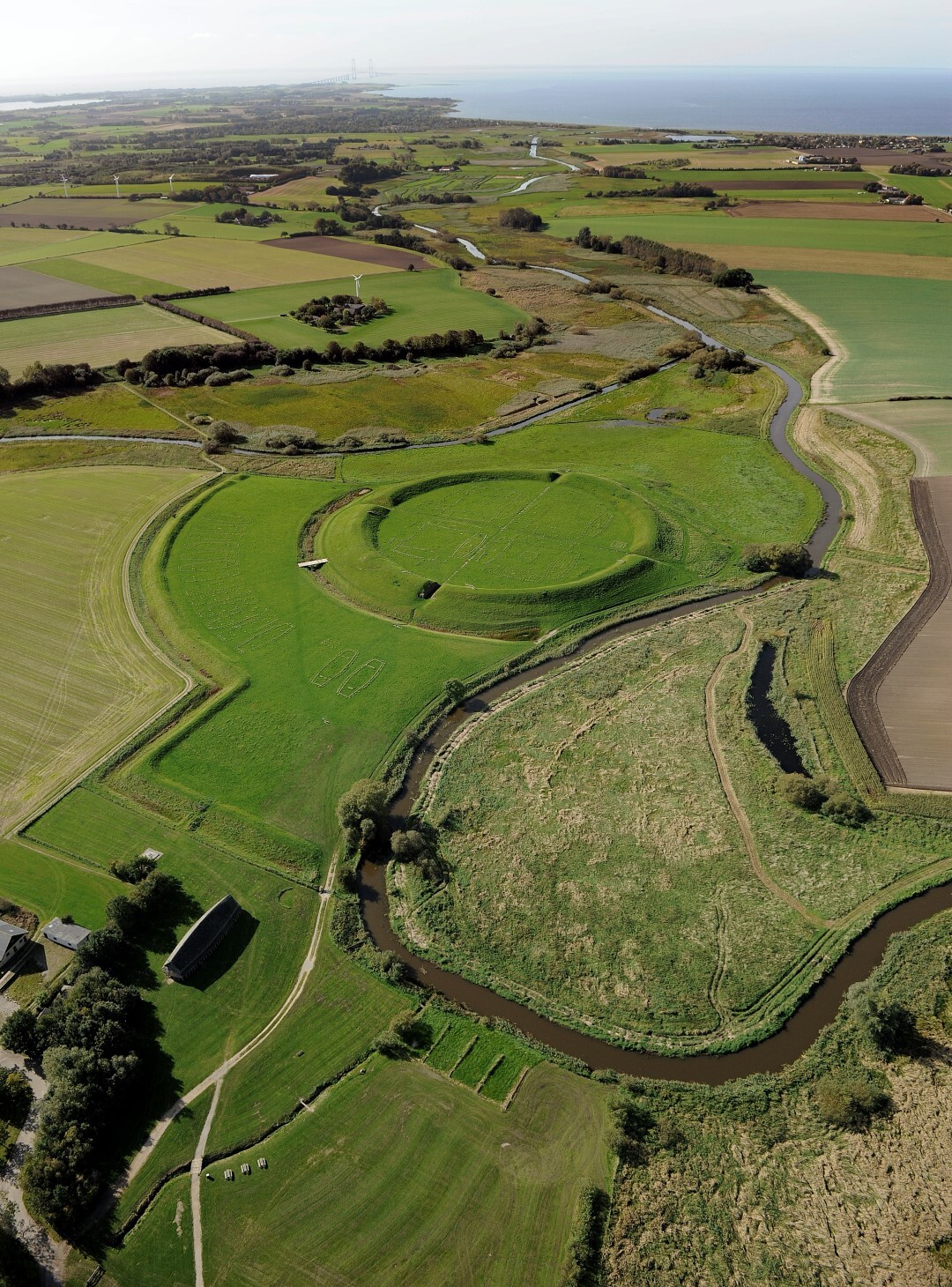
© Trelleborg, National Museum of Denmark. Used with permission.
World Heritage Research
Discover scientific research and academic studies that deepen our understanding of Viking-Age Ring Fortresses from its history and significance to its conservation, management, and contemporary challenges.
-
Trelleborg revisited
A re-analysis of artefacts from the Viking Age ring fortress Trelleborg, Denmark, reveals that the majority of finds were concentrated in pits and topsoil, reflecting distinct areas of activity such as textile work, antler working, and soapstone cooking vessel production. The study, based on digitised data from 1934-42 excavations, identified 3,267 artefacts but noted an under-representation of plain pottery and some iron items, suggesting potential discard practices. Spatial distribution analysis showed no clear association between activities and specific buildings, challenging the notion of a sudden, unprepared destruction of the fortress.
Sindbæk, S. M., & Larsen, M. F. T. (2025). Trelleborg revisited. Danish Journal of Archaeology, 14(1), 1–17. https://doi.org/10.7146/dja.v14i1.152953
View Publication Record | Read Publication -
Borgring. Uncovering the strategy for a Viking Age ring fortress in Denmark
Archaeological excavations and surveys at Borgring, Denmark, have uncovered the fifth Viking-Age ring fortress with Trelleborg-like geometry and construction, revealing a strategic network of fortifications. Unlike its counterparts, Borgring exhibits distinct features while maintaining key similarities in design and location. Radiocarbon dating (wiggle-matched 14C) confirms its chronological placement within the Viking Age. Artifacts, including beads, ornaments, and iron tools, provide insights into military activities and trade links with other fortress sites.
Christensen, J., Daly, A., Henriksen, P. S., Holm, N., Jessen, C., Jørgensen, S., Olesen, L., Olesen, J., Schultz, M. K., Sindbæk, S. M., & Ulriksen, J. (2021). Borgring. Uncovering the strategy for a Viking Age ring fortress in Denmark. Danish Journal of Archaeology, 10. https://doi.org/10.7146/dja.v10i0.121920
View Publication Record | Read Publication -
The lost landscape of Borgring
A recently identified Danish Viking Age ring fortress, Borgring, reveals significant insights into the strategic planning and resource investment of its builders. Geoarchaeological investigations demonstrate that the site was purposefully expanded to fit a pre-defined size, indicating a deliberate approach to positioning and construction. Contrary to expectations, navigability along a nearby stream was not a factor in its location or function, as access by larger vessels was impossible. This challenges previous assumptions about the functional interpretation of Danish Viking Age ring fortresses, suggesting that their strategic importance lay elsewhere.
Jessen, C., Henriksen, P. S., Hald, M. M., Sindbæk, S. M., & Ulriksen, J. (2021). The lost landscape of Borgring. Danish Journal of Archaeology, 10. https://doi.org/10.7146/dja.v10i0.121917
View Publication Record | Read Publication -
Turfs and timbers
Viking-Age ring fortresses, such as Borgring, were built using substantial amounts of turf and timber, requiring significant local resources. Despite being constructed in an open cultural landscape, the study reveals that sufficient oak—essential for timber construction—was accessible within a few kilometers of the fortress. Researchers estimated the resource area needed by analyzing pollen data from the REVEALS model, quantifying regional oak land cover. This finding challenges assumptions about the feasibility of such large-scale Viking Age constructions and underscores the efficiency of ancient resource management in Denmark.
Mortensen, M. F., Baittinger, C., Christensen, J., Nielsen, A. B., Nielsen, S., Pihl, A., Prøsch-Danielsen, L., Ravn, M., Sindbæk, S. M., & Ulriksen, J. (2021). Turfs and timbers. Danish Journal of Archaeology, 10. https://doi.org/10.7146/dja.v10i0.121918
View Publication Record | Read Publication -
‘The coldest case of all’
A devastating fire that ravaged the Viking-age ring fortress Borgring, Denmark, has been reconstructed through a groundbreaking collaboration between archaeologists and forensic investigators. The study applied modern forensic fire investigation techniques, adhering to Daubert standard criteria, to analyze traces of the blaze uncovered during excavations. This novel approach not only revised the understanding of the fortress's structure and the fire's development but also set a precedent for integrating forensic methods in archaeological research. Conversely, archaeological techniques demonstrated significant potential in modern fire scene analysis, highlighting their dual applicability.
Ljungkvist, E., Thomsen, B., Sindbæk, S. M., Christensen, J., Holm, N., Schultz, M. K., & Ulriksen, J. (2021). ‘The coldest case of all’. Danish Journal of Archaeology, 10. https://doi.org/10.7146/dja.v10i0.121916
View Publication Record | Read Publication -
Dominating the Landscape – the emblematic Setting of Borgring and the Viking Age Ring Fortresses of Denmark
A new theory proposes that Viking Age ring fortresses, including Borgring and other monumental structures from the reign of King Harald Bluetooth (c. AD 958–986/987), represent a manifestation of a new societal order following the king's conversion in AD 963. These structures were strategically positioned to dominate the landscape, impress locals, and assert royal power based on a novel ideology. The study compares Borgring with other ring fortresses and fortifications in Denmark to analyze their topographical placement, size, and symbolic significance. By examining these elements, researchers argue that the fortresses disrupted existing regional power structures while reinforcing the king's authority through visible reminders of his rule along key travel routes.
Ulriksen, J. M., Schultz, M. K., & Mortensen, M. F. (2020). Dominating the Landscape – the emblematic Setting of Borgring and the Viking Age Ring Fortresses of Denmark. Danish Journal of Archaeology, 9, 1–22. https://doi.org/10.7146/dja.v9i0.116110
View Publication Record | Read Publication -
Soil micromorphology at the Viking-Age ring-fortress of Borgring, Denmark: Analysis of samples from the East, North and South Gateways
Soil micromorphological analysis of the Viking-age ring-fortress Borgring, Denmark, reveals distinct microstratigraphic units at its gateways, indicating a sequence of human activity. The study identifies colluvial material mixed with anthropogenic waste predating rampart construction and the burning of wooden structures, suggesting rapid in-situ fires. A post-abandonment deposit shows minimal human influence, implying slow soil formation linked to animal and human presence after the fortress was deserted. This research provides new insights into Viking-era land use and environmental interactions through detailed examination of thin-section samples from the East, North, and South gateways.
Sulas, F., & Kristiansen, S. M. (2020). Soil micromorphology at the Viking-Age ring-fortress of Borgring, Denmark: Analysis of samples from the East, North and South Gateways (, Ed.). Aarhus University Library. https://doi.org/10.7146/aul.386
View Publication Record | Read Publication -
Revitalising the Danish Viking Age Ring Fortress Nonnebakken, Odense, Denmark
Recent research on the Viking-Age ring fortress Nonnebakken, located beneath Odense, Denmark, reveals its exceptional state of preservation, challenging long-held assumptions about its condition. Through excavations and non-destructive analysis, scientists have uncovered new insights into the fortress's significance within local, regional, and national landscapes. This study highlights strategies to enhance public awareness and ownership of Nonnebakken, aiming to revitalize its presence in local consciousness. By combining historical data with modern investigative techniques, the research offers a fresh perspective on this hidden gem of Viking heritage.
Runge, M. (2019). Revitalising the Danish Viking Age Ring Fortress Nonnebakken, Odense, Denmark. Landscapes, 20(2), 98–119. https://doi.org/10.1080/14662035.2020.1861726
View Publication Record | Read Publication -
Searching for Viking Age Fortresses with Automatic Landscape Classification and Feature Detection
Machine learning analysis of airborne laser scanning data has identified two promising Viking Age ring fortress sites in Denmark, along with two glacial landscape features initially mistaken for meteor craters. The study employed Hough circle transformations and template matching to detect over 200,000 circular features, which were then narrowed down using geometric properties and machine learning classification. Ground-truthing confirmed Borgø and Trælbanke as viable cultural heritage sites, warranting further archaeological investigation. This approach demonstrates significant potential for global applications in detecting cultural heritage, geomorphological features, and meteor impact craters where digital terrain models are available.
Stott, D., Kristiansen, S. M., & Sindbæk, S. M. (2019). Searching for Viking Age Fortresses with Automatic Landscape Classification and Feature Detection. Remote Sensing, 11(16), 1881. https://doi.org/10.3390/rs11161881
View Publication Record | Read Publication -
Aggersborg: The Viking-Age Settlement and Fortress, ed. Else Roesdahl, Søren M. Sindbæk, Anne Pedersen and David M. Wilson
Aggersborg, a Viking-Age ring fortress built around 970 AD, stands as one of Scandinavia's most impressive monuments from that era. Situated at a strategic crossroads on the Limfjord in northern Jutland, Denmark, its massive earth and timber circular rampart, measuring nine meters wide and enclosing an area 242 meters in diameter, was complemented by four gateways and surrounded by an eight-meter-wide berm and a deep ditch. Inside, the fortress featured axial roads dividing it into quadrants, each containing twelve identical timber houses arranged around small courtyards. Despite its grandeur, Aggersborg was abandoned within ten to fifteen years of construction, mirroring the fate of other similar fortresses across southern Scandinavia. This abrupt abandonment raises intriguing questions about the factors leading to such a rapid decline, offering valuable insights into Viking-Age societal dynamics and strategic planning.
Ashley, S. (2016). Aggersborg: The Viking-Age Settlement and Fortress, ed. Else Roesdahl, Søren M. Sindbæk, Anne Pedersen and David M. Wilson. The English Historical Review, 131(552), 1110–1112. https://doi.org/10.1093/ehr/cew194
View Publication Record | Read Publication -
Making Place for a Viking Fortress. An archaeological and geophysical reassessment of Aggersborg, Denmark
Aggersborg, Denmark's largest Viking-age ring fortress, may have replaced a significant earlier settlement with up to 350 sunken-featured buildings (SFBs), challenging previous understandings of its purpose and the broader 'Trelleborg' fortress group. A large-scale geophysical survey using magnetic gradiometry and ground-penetrating radar, combined with legacy excavation data, revealed previously unknown structures and clarified the extent of pre-fortress activity. This approach demonstrates how non-invasive methods can enhance interpretations of scheduled monuments, offering new insights into Viking-age political and tactical landscapes.
Brown, H., Goodchild, H., & Sindbæk, S. (2014). Making Place for a Viking Fortress. An archaeological and geophysical reassessment of Aggersborg, Denmark. Internet Archaeology, (36). https://doi.org/10.11141/ia.36.2
View Publication Record | Read Publication -
The Late Viking-Age Royal Constructions at Jelling, central Jutland, Denmark.
Recent extensive excavations and re-evaluation of data from the Jelling royal complex in central Jutland, Denmark, have revealed new structural elements that significantly alter our understanding of its history. These discoveries include a 12.5-hectare palisade enclosure and buildings comparable to those found at King Harald Bluetooth's Trelleborg ring fortresses. This challenges previous interpretations of the site's character and provides fresh insights into the transformation processes in 10th-century South Scandinavia, shedding light on the role of Jelling and its kings during this pivotal period.
Holst, M. K., Jessen, M. D., Andersen, S. W., & Pedersen, A. (2013). The Late Viking-Age Royal Constructions at Jelling, central Jutland, Denmark. Praehistorische Zeitschrift, 87(2). https://doi.org/10.1515/pz-2012-0022
View Publication Record | Read Publication
