World Heritage Identification Number: 1650
World Heritage since: 2021
Category: Cultural Heritage
WHE Type: Buildings & Architectural Ensembles
Transboundary Heritage: No
Endangered Heritage: No
Country: 🇮🇹 Italy
Continent: Europe
UNESCO World Region: Europe and North America
Map
The Architectural Marvel of the Porticoes of Bologna: A Walk Through History and Culture
The Porticoes of Bologna, inscribed as a UNESCO World Heritage Site in 2021, stand as a testament to the rich history, culture, and architectural prowess of this Italian city. Stretching over 62 kilometers, these porticoes serve as a unique blend of art, functionality, and social interaction, making them a significant part of Bologna's urban identity.
More to come…UNESCO Description of the World Heritage Site
The serial property comprises twelve component parts consisting of ensembles of porticoes and their surrounding built areas, located within the Municipality of Bologna from the 12th century to the present. These portico ensembles are considered to be the most representative among city’s porticoes, which cover a total stretch of 62 km. Some of the porticoes are built of wood, others of stone or brick, as well as reinforced concrete, covering roads, squares, paths and walkways, either on one or both sides of a street. The property includes porticoed buildings that do not form a structural continuum with other buildings and therefore are not part of a comprehensive covered walkway or passage. The porticoes are appreciated as sheltered walkways and prime locations for merchant activities. In the 20th century, the use of concrete allowed the replacement of the traditional vaulted arcades with new building possibilities and a new architectural language for the porticoes emerged, as exemplified in the Barca district. Together, the selected porticoes reflect different typologies, urban and social functions and chronological phases. Defined as private property for public use, the porticoes have become an expression and element of Bologna’s urban identity.
UNESCO Justification of the World Heritage Site
Criterion (iv): The series of Bologna’s porticoes represents in an exemplary manner an architectural typology of ancient origin and wide diffusion, never abandoned until today, but in continuous change through precise historical periods of the town’s transformation. The series was selected in the context of the wider porticoed system that permeates the old historical city. The property represents a variety of porticoed building typologies which characterized the houses of the working class, the aristocratic residences, the public and the religious buildings. Historical and contemporary construction employ a wide range of building materials, technologies and styles, as a result of the progressive city’s expansion and mutations since the 12th century.
Encyclopedia Record: Porticoes of Bologna
The porticoes of Bologna are an important cultural and architectural heritage of Bologna, Italy and represent a symbol of the city together with the numerous towers. No other city in the world has as many porticoes as Bologna: all together, they cover more than 38 kilometres (24 mi) only in the historic centre, but can reach up to 53 kilometres (33 mi) if those outside the medieval city walls are also considered.Additional Site Details
Area: 52.18 hectares
Number of Components: 12
Coordinates: 44.4913888889 , 11.3327777778
Image
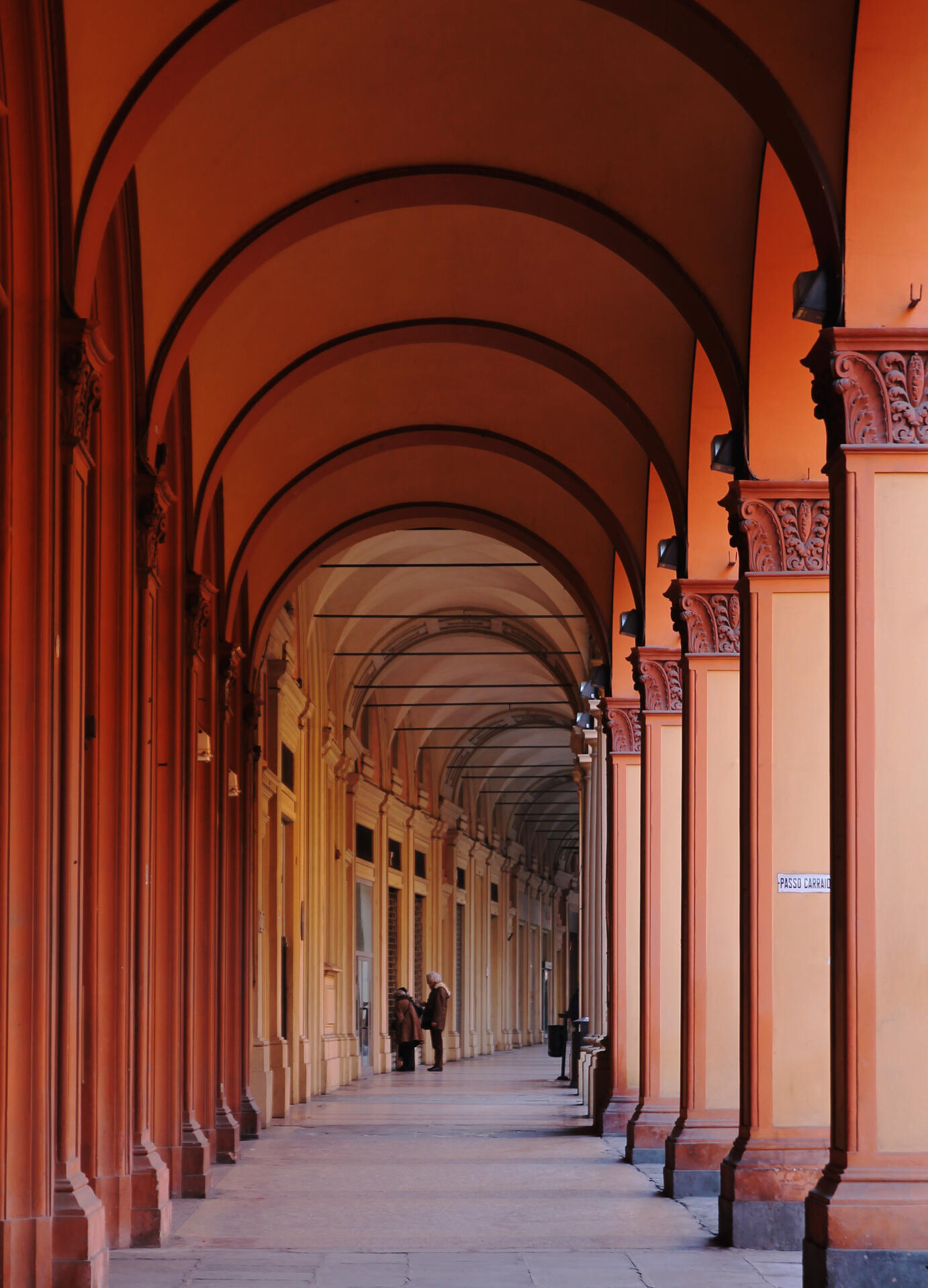
© Matteo Santori, CC BY-SA 4.0 Resized from original. (This derivative is under the same CC BY-SA license.)
World Heritage Research
Discover scientific research and academic studies that deepen our understanding of The Porticoes of Bologna from its history and significance to its conservation, management, and contemporary challenges.
-
Heritage as threshold: an autoethnographic exploration of the porticoes of Bologna (Italy)
This study introduces the concept of 'heritage as threshold,' arguing that Bologna's UNESCO-listed porticoes represent a unique case where heritage transcends static boundaries, embodying dynamic transitions between official discourses and everyday experiences. The research employs autoethnography, with the author's embodied exploration of the porticoes revealing their spatiality as zones of interaction rather than fixed limits. This challenges traditional 'authorized heritage discourse,' which often relies on sedentary certainties. Additionally, the study links this spatial interpretation to the process of heritage-making, demonstrating how narratives evolve through the interweaving of perspectives—a process inherently tied to thresholds. The porticoes thus serve as a microcosm for broader debates on cultural heritage, highlighting its fluid and relational nature.
Bonfiglioli, S. (2024). Heritage as threshold: an autoethnographic exploration of the porticoes of Bologna (Italy). Cultural Geographies, 32(2), 225–243. https://doi.org/10.1177/14744740241269141
View Publication Record | Read Publication -
The Porticoes of Bologna and contemporary architecture. A proposal for a Minor Boundary Modification towards Kenzo Tange
The Porticoes of Bologna, recognized for their adaptability and historical significance, have been included in the UNESCO World Heritage List. This inclusion highlights their role in mediating public and private space since the 12th century and their continued relevance through technological advancements and contemporary urban development. A notable example is the Barca district portico by Giuseppe Vaccaro, which bridges tradition and modernity. The study proposes a Minor Boundary Modification to include Kenzo Tange's arcades at the Fiera District, arguing for their historical and urban significance. This proposal aims to reflect on recent interpretations of the asset and its contemporary relevance.
Pretelli, M., & Tolic, I. (2023). The Porticoes of Bologna and contemporary architecture. A proposal for a Minor Boundary Modification towards Kenzo Tange. Restauro Archeologico, 30(1). https://doi.org/10.36253/rar-14282
View Publication Record | Read Publication -
Bologna and its porticoes: a thousand years’ pursuit of the “common good”
Bologna's porticoes, a unique urban feature dating back over a thousand years, stand as a testament to the city's commitment to 'common good' through innovative property law systems. Unlike many medieval European cities where such structures were lost to time, Bologna's porticoes have endured due to a combination of legal frameworks and social factors that ensured their preservation. This study reveals how these wooden porticoes evolved alongside urban development, reflecting the political, economic, and cultural dynamics of the city. By analyzing historical records and architectural developments, researchers Bocchi and Smurra highlight the resilience of Bologna's porticoes as both a practical solution for market areas and a symbol of civic identity.
Bocchi, F., & Smurra, R. (2020). Bologna and its porticoes: a thousand years’ pursuit of the “common good”. Quart, (3(57)), 87–104. https://doi.org/10.19195/quart.2020.3.78060
View Publication Record | Read Publication -
3D Documentation of 40 Kilometers of Historical Porticoes – The Challenge
Terrestrial photogrammetry emerged as the optimal method for 3D documentation of Bologna's 40-kilometer historical porticoes, offering unmatched flexibility and productivity. This approach generates high-precision colored point clouds and textured 3D meshes, crucial for the porticoes' potential UNESCO World Heritage Site (WHS) candidacy. The study evaluated multiple surveying techniques, ultimately selecting photogrammetry for its ability to deliver detailed digital products accessible online. These 3D models serve as complementary documentation, bridging historical preservation with modern digital archiving.
Remondino, F., Gaiani, M., Apollonio, F., Ballabeni, A., Ballabeni, M., & Morabito, D. (2016). 3D DOCUMENTATION OF 40 KILOMETERS OF HISTORICAL PORTICOES – THE CHALLENGE. The International Archives of the Photogrammetry, Remote Sensing and Spatial Information Sciences, XLI-B5, 711–718. https://doi.org/10.5194/isprs-archives-xli-b5-711-2016
View Publication Record | Read Publication -
Structural Strengthening of the Portico of the Santa Maria Dei Servi Church in Bologna
A critical analysis of the Portico of Santa Maria Dei Servi in Bologna reveals that traffic-induced vibrations significantly contribute to its structural deterioration, necessitating urgent strengthening interventions. The study identifies key vulnerabilities and prioritizes conservation strategies while emphasizing the importance of compatibility with historical structures. To quantify this impact, researchers from the Italian National Institute of Geophysics and Volcanology (INGV) conducted noise measurements to assess stress levels on the portico's columns. This approach underscores the need for targeted interventions that balance preservation integrity with modern engineering solutions, ensuring the long-term stability of one of Bologna's most culturally significant architectural elements.
Baraccani, S., Palermo, M., Gasparini, G., Silvestri, S., Trombetti, T., & Dallavalle, G. (2016). Structural Strengthening of the Portico of the Santa Maria Dei Servi Church in Bologna. Applied Mechanics and Materials, 847, 354–360. https://doi.org/10.4028/www.scientific.net/amm.847.354
View Publication Record | Read Publication -
Semantic description of three-dimensional models of Bologna porches
A novel method for the semantic cataloguing of Bologna's porticoes has been developed, integrating historical, material, formal, dimensional, and theoretical data into 3D models. This approach allows for detailed segmentation and visualization of the arcades' architecture, supporting their potential nomination as a UNESCO World Heritage Site. The study addresses challenges in surveying, numerical modeling, and semantic analysis, providing a structured framework to make complex architectural information accessible and communicable.
Ballabeni, M., Fallavollita, F., Foschi, R., & Perugini, G. (2015). Semantic description of three-dimensional models of Bologna porches [JD]. SCIRES-IT, 5(1). https://doi.org/10.2423/i22394303v5n1p31
View Publication Record | Read Publication -
Bologna porticoes project: A 3D repository for WHL UNESCO nomination
A high-quality, uniform 3D digital repository of Bologna's porticoes system—spanning over 40 km—was developed to support UNESCO World Heritage Site nomination. This innovative platform integrates historical, architectural, and management data through a controlled, low-cost photo-modeling process, enabling spatial and temporal navigation for citizens, tourists, and scholars. The system facilitates cross-media applications like mobile apps and augmented reality while fostering public engagement via social media. By centralizing diverse datasets into an interactive 3D interface, the project not only preserves Bologna's architectural heritage but also underscores its cultural and social significance as a communal space.
Apollonio, F. I., Gaiani, M., Fallavollita, F., Ballabeni, M., Zun, Z., Guidazzoli, A., Baglivo, A., Chiara, M., Felicori, M., & Virgolin, L. (2013). Bologna porticoes project: A 3D repository for WHL UNESCO nomination. 2013 Digital Heritage International Congress (DigitalHeritage), 563–570. https://doi.org/10.1109/digitalheritage.2013.6743797
View Publication Record | Read Publication