World Heritage Identification Number: 1590
World Heritage since: 2019
Category: Cultural Heritage
WHE Type: Religious Sites & Sacred Architecture
Transboundary Heritage: No
Endangered Heritage: No
Country: 🇵🇹 Portugal
Continent: Europe
UNESCO World Region: Europe and North America
Map
Sacred Journey Through Time: Exploring the Sanctuary of Bom Jesus do Monte in Braga
The Sanctuary of Bom Jesus do Monte, nestled on the verdant slopes of Mount Espinho overlooking the ancient city of Braga in northern Portugal, stands as a testament to the enduring power of faith and the indelible imprint of human creativity. Inscribed as a UNESCO World Heritage Site in 2019, this cultural landscape offers visitors a unique opportunity to immerse themselves in the rich tapestry of history, art, and spirituality that has shaped Europe for centuries.
More to come…UNESCO Description of the World Heritage Site
Located on the slopes of Mount Espinho, overlooking the city of Braga in the north of Portugal, this cultural landscape evokes Christian Jerusalem, recreating a sacred mount crowned with a church. The sanctuary was developed over a period of more than 600 years, primarily in a Baroque style, and illustrates a European tradition of creating Sacri Monti (sacred mountains), promoted by the Catholic Church at the Council of Trent in the 16th century, in reaction to the Protestant Reformation. The Bom Jesus ensemble is centred on a Via Crucis that leads up the western slope of the mount. It includes a series of chapels that house sculptures evoking the Passion of Christ, as well as fountains, allegorical sculptures and formal gardens. The Via Crucis culminates at the church, which was built between 1784 and 1811. The granite buildings have whitewashed plaster façades, framed by exposed stonework. The celebrated Stairway of the Five Senses, with its walls, steps, fountains, statues and other ornamental elements, is the most emblematic Baroque work within the property. They are framed by lush woodland and embraced by a picturesque park that, masterfully set on the rugged hill, highly contributes to the landscape value of the ensemble.
UNESCO Justification of the World Heritage Site
Criterion (iv): The sanctuary of Bom Jesus do Monte is an extraordinary example of a sacred mount with an unprecedented monumentality determined by a complete and elaborate narrative of the Passion of Christ of great importance to the history of humanity. It embodies traits that identify roman Catholicism, such as externalization of celebration, community sense, theatricality, and life as a permanent and inexhaustible journey. The sanctuary stands out due to its impact and affirmation in the landscape, the architectural and decorative originality of its stairways, the strong sensations generated when visiting it, specific to its baroque character. The unity of the sanctuary within its enclosure is a distinctive factor that generates tremendous formal and functional harmony. It is a masterpiece resulting from creative genius, integrating a set of monumental stairways, displaying models of design, taste and aesthetic preferences of each period of construction, integrated in an ensemble of great unity and harmony constituting a cultural landscape. The unity of the architectural ensemble and its high artistic quality result from its overall design and organization, structure and composition, as well as from the predominant use of granite, which endows the sanctuary with a significant sculptural and plastic dimension. Retaining and dividing walls, stairways, buildings, fountains, pavements, ornaments and an impressive and unprecedented set of statues are all made of granite, resulting in a work of high construction quality. The contrast between the whitewashed granite, on the one hand, and the surrounding lush green park and wood, on the other, decisively contributes to the sanctuary’s baroque character. The property reflects also a concentration of technical ingenuity (hydraulics, supports for the terrain, built structures, mechanics) and of artistic expression (architecture, sculpture, painting).
Encyclopedia Record: Sanctuary of Bom Jesus do Monte
The Sanctuary of Bom Jesus do Monte is a Portuguese Catholic shrine in Tenões, outside the city of Braga, in northern Portugal. Its name means Good Jesus of the Mount.Additional Site Details
Area: 26 hectares
Number of Components: 1
Coordinates: 41.5549444444 , -8.3770277778
Image
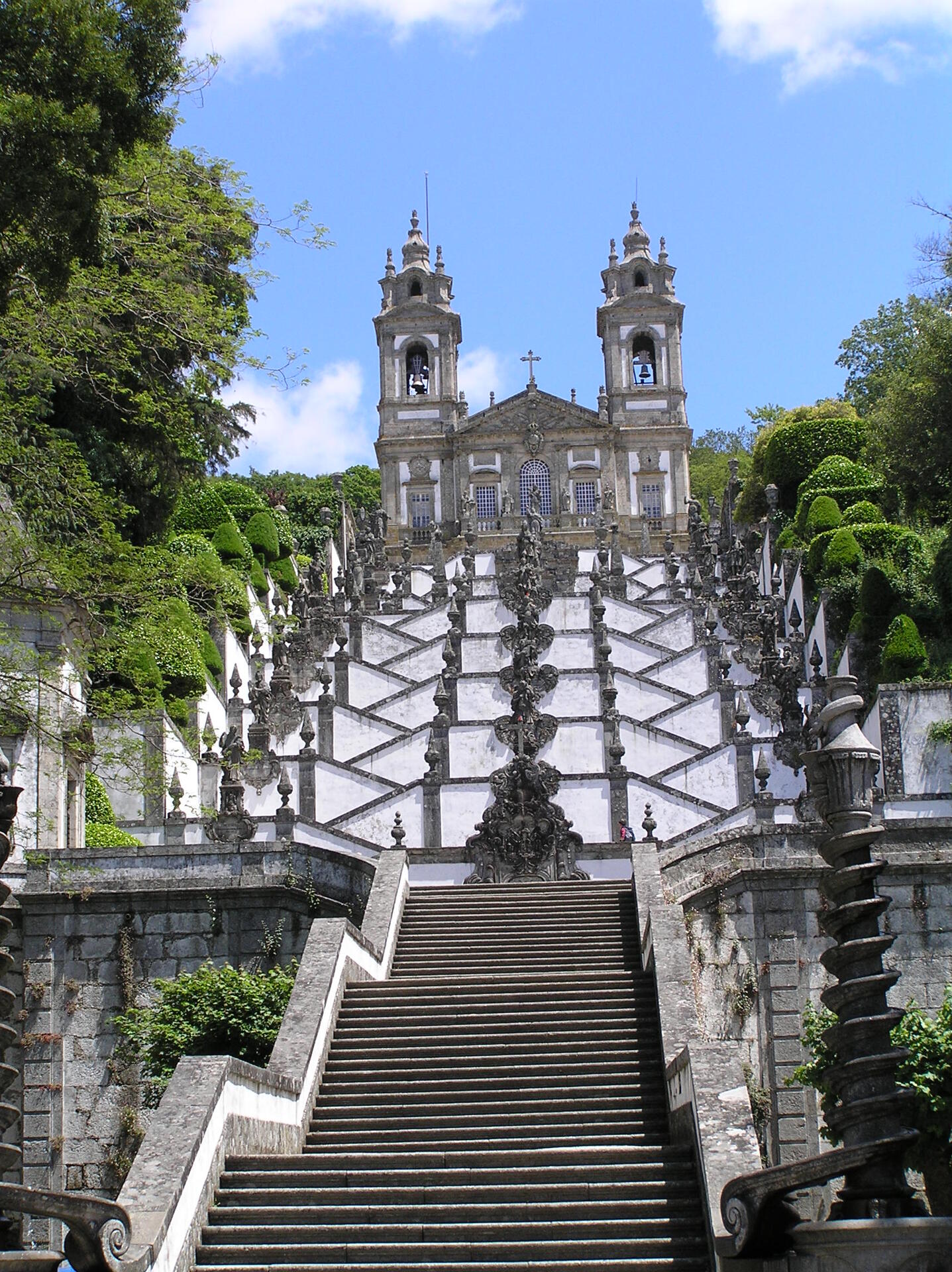
Botafogo, Public domain
World Heritage Research
Discover scientific research and academic studies that deepen our understanding of Sanctuary of Bom Jesus do Monte in Braga from its history and significance to its conservation, management, and contemporary challenges.
-
Religious iconography and topography in the garden art of Early Modern Europe. Sources, interpretation, cultural context.
Early Modern European gardens, particularly those of the Renaissance, Mannerism, and Baroque periods, were rich with moral themes and Christian symbols that shaped their design. This study identifies two distinct garden types: architectural (e.g., Bom Jesus do Monte in Braga) and landscaping (e.g., Bomarzo). It explores how these gardens served as symbolic barriers against Protestant lands and delves into the interplay between garden descriptions, such as Francesco de’ Vieri’s 1587 treatise on Pratolino, and inscriptions like those in Valsanzibio. The research integrates firsthand observations from fieldwork, supported by photographs, to analyze how moral programs in gardens can be studied within the broader context of religious history and ideas. Translations into Russian were provided by B. Sokolov.
Sokolov, B. M. (2024). Religious iconography and topography in the garden art of Early Modern Europe. Sources, interpretation, cultural context. Journal of Visual Theology, 6(1), 129–149. https://doi.org/10.34680/vistheo-2024-6-1-129-149
View Publication Record | Read Publication -
Bom Jesus do Monte, Sameiroy el patrimonio histórico - arqueológico en Braga (Norte de Portugal)
A notable anthropological analysis reveals the deep symbolic significance of Bom Jesus do Monte and Sameiro, two prominent Baroque sanctuaries perched on hills overlooking Braga, Portugal. These sites, rooted in a landscape with prehistoric sacred associations—particularly linked to Celtic traditions—embody a continuity from ancient to modern religious heritage. The study contextualizes these sanctuaries within the broader tradition of 'monte' (mountain) sanctuaries in northern Portugal, highlighting their architectural and cultural importance as part of Braga's rich historical and archaeological legacy. By examining their symbolic dimensions and historical evolution, the research underscores how these sites reflect the intersection of religious practice, landscape reverence, and regional identity.
Ceruti, M. C. (2024). Bom Jesus do Monte, Sameiro and the historical and archaeological heritage in braga (North of Portugal). Teoría Y Práctica de La Arqueología Histórica Latinoamericana, 19(1). https://doi.org/10.35305/tpahl.v19i1.233
View Publication Record | Read Publication -
A Presença de Emílio Biel no Santuário do Bom Jesus do Monte
Historical analysis reveals the significant role of Emílio Biel as a photographer at the Sanctuary of Bom Jesus do Monte in Braga between 1879 and 1880. Through meticulous examination of archival records, including contracts, payment orders, bills of exchange, prints, and photographic views from the Inventory of the Confraternity of Bom Jesus do Monte, researchers uncovered primary sources that illuminate the cultural and artistic context of this period. The study highlights the strict contractual terms imposed on Biel by the Brotherhood's Bureau and provides valuable iconographic evidence for the history of art, offering insights into the unique features and cultural significance of the Sanctuary during this time.
Vasconcellos, A. (2024). A Presença de Emílio Biel no Santuário do Bom Jesus do Monte. Revelar: Revista de Estudos Da Fotografia E Imagem, 7, 21–49. https://doi.org/10.21747/17775302/rev7_8a1
View Publication Record | Read Publication -
O Elevador dos Guindais: acelerador de mobilidade, exemplo de visão e de conforto
The Elevador dos Guindais, inaugurated in Porto in 1882, stands as the first funicular in the Iberian Peninsula and a pioneering example of urban mobility infrastructure. Despite its short operational lifespan—closing just one day after its second anniversary—it left a significant mark on Porto's transportation history and architectural heritage. The study highlights its role in shaping urban mobility, contrasting it with the more enduring Elevador do Bom Jesus do Monte in Braga, also designed by Raoul Mesnier du Ponsard. While the Guindais funicular succumbed to time and compulsory closure, its legacy persists as a symbol of innovation and comfort in early urban transportation systems. The research underscores the broader impact of such infrastructures on city development, blending technical achievement with cultural significance.
Murtinho, V., Maia, J.,. (2024). O Elevador dos Guindais: acelerador de mobilidade, exemplo de visão e de conforto. Metálica, (75), 14–20. https://doi.org/10.30779/cmm_metalica_75_03
View Publication Record | Read Publication -
Sincretismo religioso judaico-cristão e greco-romano no Bom Jesus do SacroMonte bracarense (Braga – Portugal)
Research reveals a significant religious syncretism at the Sanctuary of Bom Jesus do Monte in Braga, Portugal, where Jewish-Christian and Greco-Roman symbols were artistically integrated into Baroque art during the 18th century. Initially rooted in 14th-century devotion, the site transitioned under Portuguese rule, particularly during King João V's reign (1707–1750). The study demonstrates how inscriptions originally linking figures like Solomon and Isaías to Jewish or Greco-Roman contexts were reinterpreted to align with Christian narratives of Christ's crucifixion. This transformation reflects a dynamic process of cultural and religious assimilation over centuries, analyzed through the lens of Baroque substitution in the Sacro-Monte's Via Crucis.
Lino, A. (2019). Sincretismo religioso judaico-cristão e greco-romano no Bom Jesus do SacroMonte bracarense (Braga – Portugal). Revista Lusófona De Ciência Das Religiões, v. 21 n. 1 (2018): Revista Lusófona de Ciência das Religiões. https://doi.org/10.60543/RLCR.V21I1.6666
View Publication Record | Read Publication -
A Simbólica do Gosto no Escadório dos Sentidos do Bom Jesus do Monte – Braga
The Stairway of the Senses in the Sanctuary of Bom Jesus do Monte, Braga, holds significant symbolic meaning within its monumental Via Crucis. This study reveals that the terrace's symbolism, particularly through its sensory elements, contributes to a deeper understanding of the site's broader religious and cultural narrative. By analyzing signs displayed at the Terrace of the Taste, researchers deciphered a layered message that integrates sensory perception with spiritual reflection. The approach involved close examination of textual and visual cues, contextualized within the architectural and historical framework of the Bom Jesus do Monte. This work sheds light on the often-overlooked symbolic dimensions of this UNESCO World Heritage Site, offering new insights into its cultural and religious significance.
Sousa, R. (2018). A Simbólica do Gosto no Escadório dos Sentidos do Bom Jesus do Monte – Braga. Mesas Luso-Brasileiras: Alimentação, Saúde & Cultura. Vol. I, 233–254. https://doi.org/10.14195/978-989-26-1721-3_10
View Publication Record | Read Publication -
As simbologias religiosas dos Santuários do Bom Jesus do Monte de Braga e do Bom Jesus de Matosinhos, em Congonhas
A comparative analysis of the religious symbolism in two prominent Portuguese sanctuaries—Bom Jesus do Monte in Braga and Bom Jesus de Matosinhos in Congonhas—reveals a shared iconographic language rooted in Baroque aesthetics, blending Christian devotion with architectural grandeur. The study identifies recurring motifs such as staircases, chapels, and sculptural elements that serve as visual narratives of faith, pilgrimage, and spiritual elevation. Through iconographic and semiotic analysis, the research deciphers how these symbols function as tools for religious communication, reinforcing themes of penitence, divine intervention, and cosmic order. The approach combines archival research with spatial analysis, examining architectural plans, inscriptions, and visual motifs to uncover their theological significance.
Marcia Toscan. (2014). As simbologias religiosas dos Santuários do Bom Jesus do Monte de Braga e do Bom Jesus de Matosinhos, em Congonhas. Revista Confluências Culturais, 3(1), 158–159. https://doi.org/10.21726/rcc.v3i1.507
View Publication Record | Read Publication