World Heritage Identification Number: 818
World Heritage since: 1997
Category: Cultural Heritage
WHE Type: Buildings & Architectural Ensembles
Transboundary Heritage: No
Endangered Heritage: No
Country: 🇳🇱 Netherlands (Kingdom of the)
Continent: Europe
UNESCO World Region: Europe and North America
Map
The Mill Network at Kinderdijk-Elshout: A Testament to Dutch Water Management
The Mill Network at Kinderdijk-Elshout, inscribed as a UNESCO World Heritage Site in 1997, stands as a testament to the ingenuity and resilience of the Dutch people in their ongoing battle against water. Located in the Alblasserwaard polder, in the province of South Holland, this collection of 19 windmills offers a unique glimpse into the history and evolution of water management techniques in the Netherlands.
More to come…UNESCO Description of the World Heritage Site
The outstanding contribution made by the people of the Netherlands to the technology of handling water is admirably demonstrated by the installations in the Kinderdijk-Elshout area. Construction of hydraulic works for the drainage of land for agriculture and settlement began in the Middle Ages and have continued uninterruptedly to the present day. The site illustrates all the typical features associated with this technology – dykes, reservoirs, pumping stations, administrative buildings and a series of beautifully preserved windmills.
UNESCO Justification of the World Heritage Site
Criterion (i): The Mill Network at Kinderdijk-Elshout is an outstanding human-made landscape that bears powerful testimony to human ingenuity and fortitude over nearly a millennium in draining and protecting an area by the development and application of hydraulic technology.
Criterion (ii): The Mill Network at Kinderdijk-Elshout with its historic polder areas, high and low-lying drainage channels, mills and millraces, pumping stations, outlet sluices and Water Board Assembly Houses is an outstanding example of the development of Dutch drainage techniques which were copied and adapted in many parts of the world.
Criterion (iv): The Mill Network at Kinderdijk-Elshout is an extremely ingenious hydraulic system which still functions today and which throughout the ages made it possible to settle and cultivate a large area of peat land. It is nationally and internationally the only example on this scale, making it a unique and outstanding example of an architectural ensemble as well as a cultural landscape which typifies the Netherlands and illustrates a significant stage in human history.
Encyclopedia Record: Kinderdijk windmills
The Kinderdijk windmills are a group of 19 monumental windmills in the Alblasserwaard polder, in the province of South Holland, Netherlands. Most of the mills are part of the village of Kinderdijk in the municipality of Molenlanden, and one mill, De Blokker, is part of the municipality of Alblasserdam. Built in 1738 and 1740, to keep water out of the polder, it is the largest concentration of old windmills in the Netherlands and one of the best-known Dutch tourist sites. The mills are listed as national monuments and the entire area is a protected village view since 1993. They have been a UNESCO World Heritage Site since 1997, and as such are officially named as the Mill Network at Kinderdijk-Elshout.Additional Site Details
Area: 322 hectares
Number of Components: 1
(ii) — Significant interchange of human values
(iv) — Outstanding example of a type of building or landscape
Coordinates: 51.8825 , 4.649444444
Image
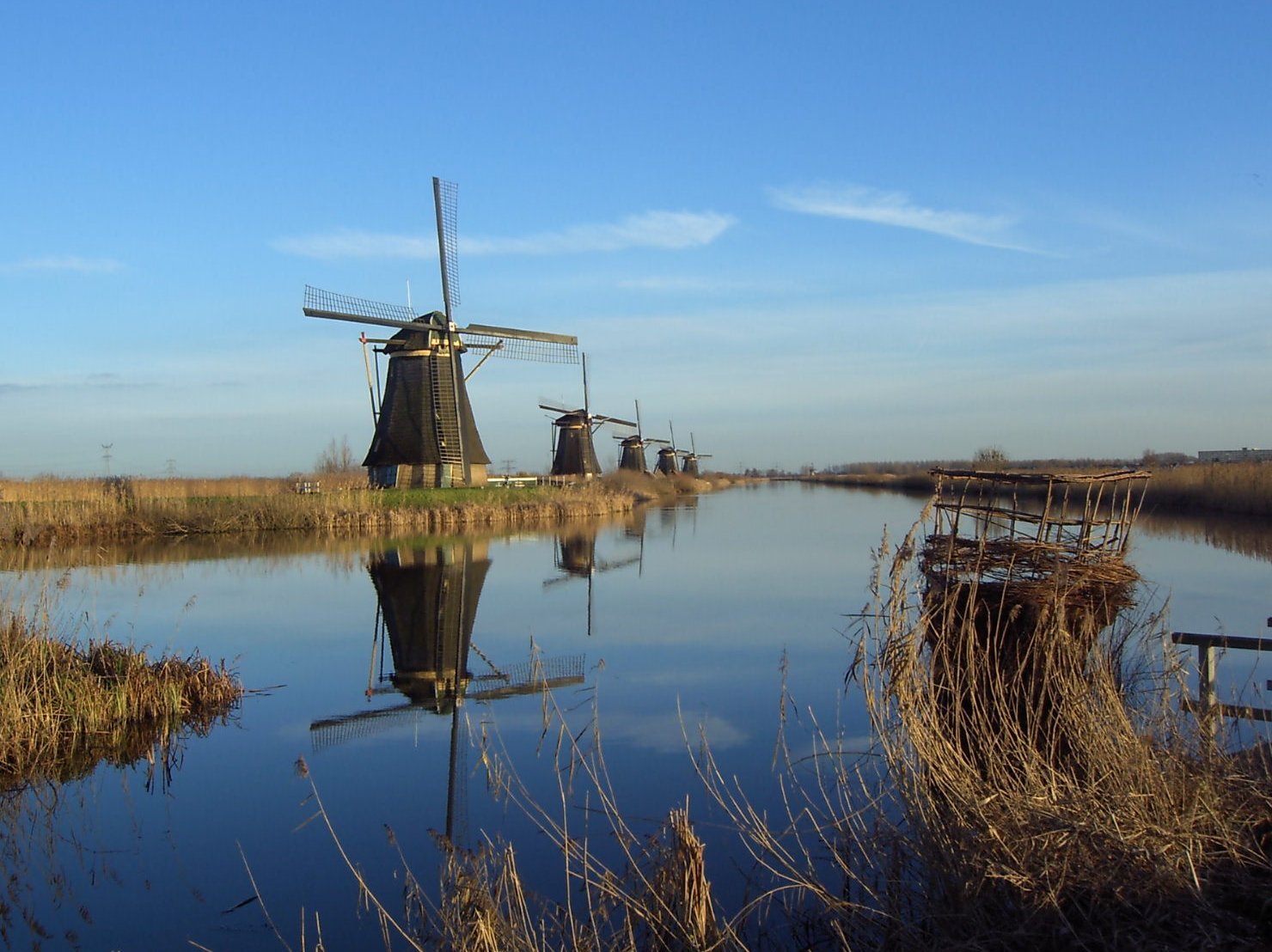
© Lucas Hirschegger, CC BY-SA 3.0 Resized from original. (This derivative is under the same CC BY-SA license.)
World Heritage Research
Discover scientific research and academic studies that deepen our understanding of Mill Network at Kinderdijk-Elshout from its history and significance to its conservation, management, and contemporary challenges.
-
Watermills as Cultural-Natural Ecosystems: Tangible and Intangible Heritage for Sustainable Water and Energy Management in a Changing Climate
Historic watermills, such as those found at the UNESCO World Heritage Site Kinderdijk-Elshout, are not just remnants of past technologies but dynamic socio-ecological systems that integrate hydrology, craftsmanship, landscape processes, and community knowledge. These mills play crucial ecological roles by regulating water flow, managing sediment, supporting biodiversity, and generating low-impact energy, serving as models for modern nature-based solutions. Recent research demonstrates that active or revived milling practices enhance landscape resilience, while abandoned mills deteriorate rapidly under climate stress, exacerbating environmental risks. This study highlights the potential of watermills to contribute to sustainable water and energy management in a changing climate, bridging tangible and intangible heritage for long-term ecological and social benefits.
Grano, M. C. (2026). Watermills as Cultural-Natural Ecosystems: Tangible and Intangible Heritage for Sustainable Water and Energy Management in a Changing Climate. Blue Papers, 4(2). https://doi.org/10.58981/bluepapers.2025.2.11
View Publication Record | Read Publication -
Water Management for Sustainable Development of World Heritage Properties
Water management is critical for the sustainable preservation of UNESCO World Heritage Sites, yet it remains underaddressed in current management plans despite growing water-related threats such as floods and droughts. This study highlights that only 10% of World Heritage properties explicitly integrate water management into their conservation strategies, leaving them vulnerable to climate-induced risks. Using three German case studies—including the Mill Network at Kinderdijk-Elshout—the research demonstrates how water-related challenges can undermine the Outstanding Universal Value of sites. It advocates for improved data sharing and interdisciplinary collaboration between heritage properties and their surroundings to mitigate these threats effectively.
Mager, T. (2024). Water Management for Sustainable Development of World Heritage Properties. Blue Papers, 3(2). https://doi.org/10.58981/bluepapers.2024.2.01
View Publication Record | Read Publication