World Heritage Identification Number: 763
World Heritage since: 1996
Category: Cultural Heritage
WHE Type: Cultural Landscapes
Transboundary Heritage: No
Endangered Heritage: No
Country: 🇨🇿 Czechia
Continent: Europe
UNESCO World Region: Europe and North America
Map
The Transformation of Southern Moravia: A Glimpse into the Lednice-Valtice Cultural Landscape
The Lednice-Valtice Cultural Landscape, inscribed as a UNESCO World Heritage Site in 1996, offers a unique blend of architectural styles and landscape design that spans over four centuries. Situated in the South Moravian Region of the Czech Republic, this expansive cultural-natural landscape complex covers approximately 283.09 square kilometers, making it one of the largest artificial landscapes in Europe. Comprising the municipalities of Lednice, Valtice, and Hlohovec, as well as the rural area of Břeclav, the Lednice-Valtice Cultural Landscape presents a fascinating testament to the visionary endeavors of the ruling dukes of Liechtenstein.
More to come…UNESCO Description of the World Heritage Site
Between the 17th and 20th centuries, the ruling dukes of Liechtenstein transformed their domains in southern Moravia into a striking landscape. It married Baroque architecture (mainly the work of Johann Bernhard Fischer von Erlach) and the classical and neo-Gothic style of the castles of Lednice and Valtice with countryside fashioned according to English romantic principles of landscape architecture. At 200 km2 , it is one of the largest artificial landscapes in Europe.
UNESCO Justification of the World Heritage Site
Criterion (i): The Lednice-Valtice Cultural Landscape is an outstanding artistic creation that succeeds in bringing together in harmony cultural monuments from successive periods and both indigenous and exotic natural elements to create an outstanding work of human creativity.
Criterion (ii): By combining the Baroque, Classical and Neo-Gothic architectural styles and by transforming the landscape according to the English romantic principles, Lednice-Valtice estate served as a model throughout the Danube region.
Criterion (iv): The Lednice-Valtice Cultural Landscape is an outstanding example of a cultural landscape designed and created intentionally by a single family during the century of Enlightenment, the Romantic period and later on.
Encyclopedia Record: Lednice–Valtice Cultural Landscape
The Lednice–Valtice Cultural Landscape is a cultural-natural landscape complex of 283.09 square kilometres (109.30 sq mi) in the South Moravian Region of the Czech Republic. It comprises the municipalities of Lednice, Valtice and Hlohovec, and the rural area of Břeclav.Additional Site Details
Area: 14,320 hectares
Number of Components: 1
(ii) — Significant interchange of human values
(iv) — Outstanding example of a type of building or landscape
Coordinates: 48.77583 , 16.775
Image
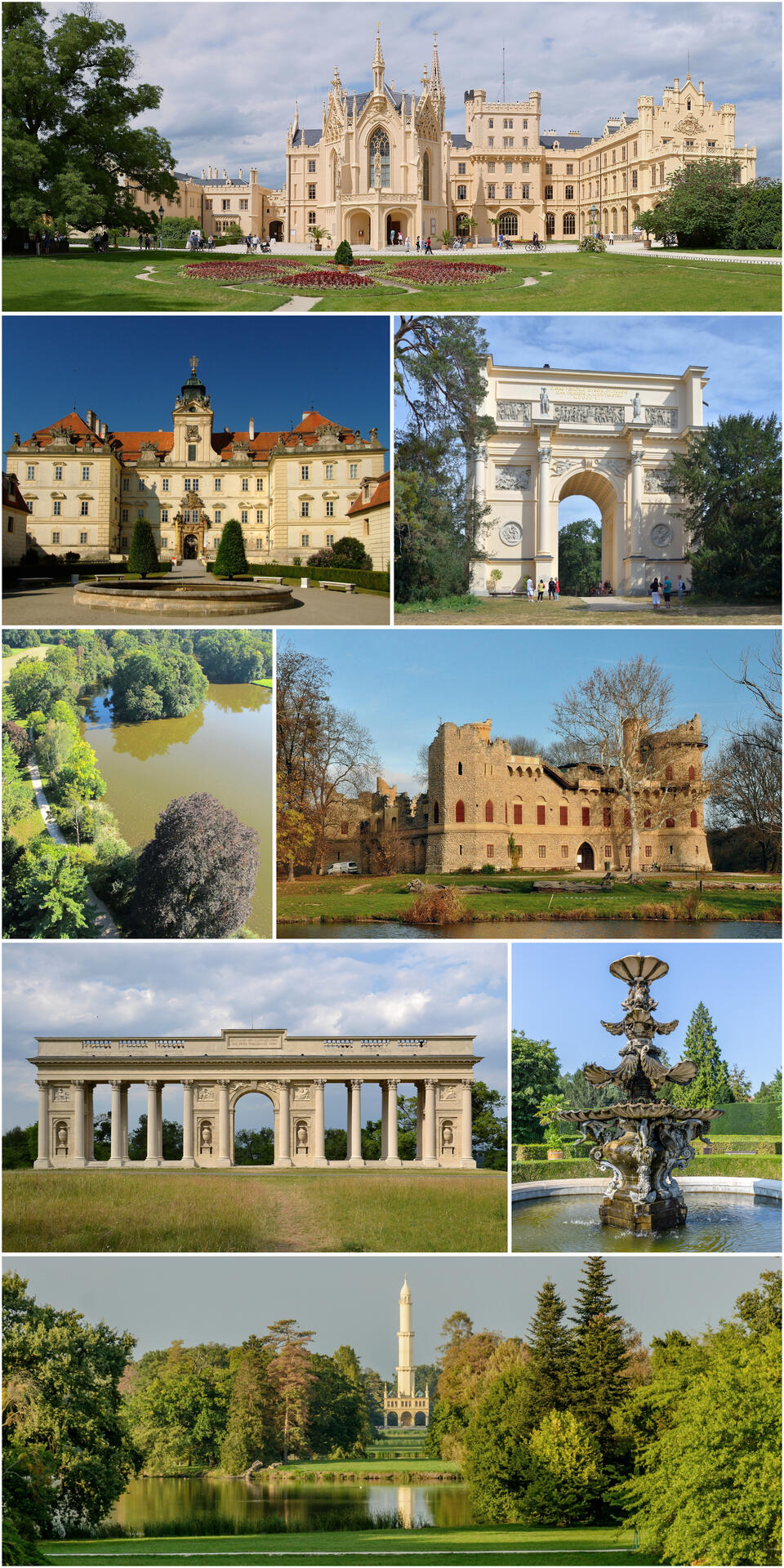
©
- Lednice (Eisgrub) - zámek.JPG: Marcin Szala
- Před zámkem Valtice.JPG: Me116
- Chrám_Diany_-_Rendez-vous_03.jpg: Herzi Pinki
- Kolonáda na Rajstně (Reistenkolonnade) - by Pudelek.JPG: Marcin Szala
- Lednické_rybníky_(10).jpg: Huhulenik
- Venetian_fountain,_Lednice,_Czech_Republic_10.jpg: Michal Klajban
- Lednice, Hansenburg (37914722044).jpg: Herbert Frank (Flickr)
- Minaret_in_Lednice_27.jpg: Henry Kellner
World Heritage Research
Discover scientific research and academic studies that deepen our understanding of Lednice-Valtice Cultural Landscape from its history and significance to its conservation, management, and contemporary challenges.
-
Annual Dynamics of Mycobiota in Symptomatic Century-Old Trees of Aesculus hippocastanum, Fagus sylvatica, Populus alba, and Quercus robur
Aging trees within the UNESCO World Heritage Site Lednice-Valtice Cultural Landscape exhibit dynamic and host-dependent mycobiota, challenging assumptions of static or neutral fungal communities. Research on century-old horse chestnut (Aesculus hippocastanum), copper beech (Fagus sylvatica ‘Atropunicea’), poplar (Populus alba), and oak (Quercus robur) revealed significant temporal shifts in fungal diversity and composition, with Fagus sylvatica showing the most pronounced decline in richness. Saprotrophic fungi dominated across all hosts, indicating active wood degradation. The study employed ITS2 high-throughput sequencing to profile fungal assemblages from 40 wood cores collected in 2023 and 2024, highlighting host-specific patterns and potential implications for tree decline in managed historical landscapes.
Spetik, M., Frejlichova, L., Cechova, J., Bulir, P., Miksova, L., Stefl, L., Simek, P., & Eichmeier, A. (2026). Annual Dynamics of Mycobiota in Symptomatic Century-Old Trees of Aesculus hippocastanum, Fagus sylvatica, Populus alba, and Quercus robur. Journal of Fungi, 12(1), 50. https://doi.org/10.3390/jof12010050
View Publication Record | Read Publication -
Annual Dynamics of Mycobiota in Symptomatic Century-Old Trees of Aesculus hippocastanum, Fagus sylvatica, Populus alba, and Quercus robur
Aging trees within the UNESCO World Heritage Site of Lednice-Valtice Cultural Landscape exhibit dynamic and host-dependent fungal communities that significantly influence their decline. The study, conducted on century-old horse chestnut, Copper beech, poplar, and oak trees, revealed that fungal diversity and composition vary both among tree species and over time. Notably, Copper beech showed the most pronounced annual decline in fungal richness (-83%), while horse chestnut and poplar displayed significant increases (+65% and +42%, respectively). Ascomycota dominated across all hosts (72–89% of reads), with Basidiomycota contributing 8–24%. The research used ITS2 high-throughput sequencing to profile fungal assemblages, demonstrating that the wood mycobiome is neither static nor functionally neutral but actively shapes tree decline trajectories in managed historical park landscapes.
Spetik, M., Frejlichova, L., Cechová, J., Bulir, P., Miksova, L., Stefl, L., Simek, P., & Eichmeier, A. (2025). Annual Dynamics of Mycobiota in Symptomatic Century-Old Trees of Aesculus hippocastanum, Fagus sylvatica, Populus alba, and Quercus robur https://doi.org/10.20944/preprints202511.0150.v1
View Publication Record | Read Publication -
Identification and Evaluation of Cultural Ecosystem Service Resources in the Territory of the Local Action Group Lednice–Valtice Area
A high potential for cultural ecosystem services (CES) has been identified in the Lednice-Valtice Cultural Landscape, attracting millions of visitors annually. The study used the Consolidated Layer of Ecosystems (CLE) to map 27 ecosystem categories and assessed their importance through expert estimation, grouping CES classes into four common characteristics. While some areas are more popular, sustainable management is crucial for protecting these resources and integrating them into regional strategies. This research highlights the landscape's significance as a UNESCO World Heritage Site and underscores the need for balanced tourism planning to preserve its ecological and cultural value.
Zourková, I., Hromková, L., Schneider, J., & Fialová, J. (2024). Identification and Evaluation of Cultural Ecosystem Service Resources in the Territory of the Local Action Group Lednice–Valtice Area. Sustainability, 17(1), 13. https://doi.org/10.3390/su17010013
View Publication Record | Read Publication -
Cooperation between the National Heritage Institute and the AOPK ČR in the protection of natural and cultural heritage
A renewed collaboration between the National Heritage Institute (NPI) and the Agency for Protection of Nature and Landscape of the Czech Republic (AOPK ČR) has significantly strengthened the protection of both cultural heritage and natural landscapes in the Lednice-Valtice Cultural Landscape. This partnership, formalized over a decade ago through a cooperative agreement, facilitates regular expert meetings, consultations, and joint methodological reviews to ensure coordinated conservation efforts. The study highlights that while institutional separation had previously weakened inter-disciplinary cooperation, structured collaboration has now reinvigorated shared goals in preserving the region's unique values—balancing cultural heritage with ecological integrity.
Kučová, V., Pešout, P., & Tomášek, M. (2023). Cooperation between the National Heritage Institute and the AOPK ČR in the protection of natural and cultural heritage. Zprávy Památkové Péče, 82(4), 487–495. https://doi.org/10.56112/zpp.2022.4.01
View Publication Record | Read Publication -
Impact of Covid-19 Pandemic on Tourist Behavior: A Case Study on South Moravia
The COVID-19 pandemic has significantly reshaped tourist behavior, with rural areas emerging as preferred destinations over urban ones. A study of 1026 visitors to the Lednice-Valtice Cultural Landscape in South Moravia revealed that tourists now favor shorter, more spontaneous trips to rural regions, which offer a balance between rural charm and proximity to cities. This shift benefits domestic tourism and presents opportunities for service providers and destination managers to enhance quality. The research analyzed three visitor segments—groups with children, couples, and others—to provide insights into evolving consumer behavior in post-pandemic tourism.
Makáň, L., Ryglová, K., Rašovská, I., Štumpf, P., & Šácha, J. (2023). Impact of Covid-19 Pandemic on Tourist Behavior: A Case Study on South Moravia. European Countryside, 15(2), 281–296. https://doi.org/10.2478/euco-2023-0015
View Publication Record | Read Publication -
The Impacts of COVID-19 on the Visitor Attendance of Cultural and Natural Heritage: A Case Study of the South Moravian Region
A significant decline and subsequent recovery in visitor attendance at cultural and natural heritage sites in the South Moravian Region, including UNESCO World Heritage Site Lednice-Valtice Cultural Landscape, were observed following the COVID-19 pandemic. The study, analyzing empirical data from 2019 to 2022, found that visitor numbers plummeted by nearly half in 2020, with cultural monuments experiencing a 25% drop compared to pre-pandemic levels. However, natural areas without access restrictions saw a 20% increase during the same period, while those with restricted access declined by over 40%. By 2022, attendance rebounded to 90% of pre-2019 levels, reflecting a recovery in tourism despite lingering pandemic impacts. The research highlights the vulnerability of heritage sites to global crises and the resilience of regional tourism ecosystems.
Tuzová, K., Vaishar, A., Šťastná, M., & Urbanová, M. (2023). The Impacts of COVID-19 on the Visitor Attendance of Cultural and Natural Heritage: A Case Study of the South Moravian Region. Sustainability, 15(19), 14081. https://doi.org/10.3390/su151914081
View Publication Record | Read Publication -
Kulturní a vědecký transfer mezi českými zeměmi a Evropou na příkladu našich nejstarších krajinářských parků a jejich tvůrců
This study reveals the significant cultural and scientific exchanges between the Czech lands and Europe during the late 18th and early 19th centuries, particularly through the lens of the region's earliest landscape parks. It highlights how foreign influences—spanning literature, philosophy, fine arts, and natural sciences—shaped the creation of these parks, with notable contributions from Britain, the Holy Roman Empire, and France. The research approach combines historical analysis of travel trends, literary influences, and philosophical ideas to demonstrate how these elements facilitated the transfer of landscape design theories. By focusing on the roles of key figures and their interactions with European trends, the study offers a nuanced understanding of how global cultural exchanges influenced local landscape architecture in the Czech lands.
Binder, F. (2023). Kulturní a vědecký transfer mezi českými zeměmi a Evropou na příkladu našich nejstarších krajinářských parků a jejich tvůrců. Historia Aperta, (48), 28–53. https://doi.org/10.26806/hisape.n48.2
View Publication Record | Read Publication