World Heritage Identification Number: 892
World Heritage since: 1999
Category: Natural Heritage
WHE Type: Natural Landscapes & Geographic Features
Transboundary Heritage: No
Endangered Heritage: No
Country: 🇧🇷 Brazil
Continent: Americas
UNESCO World Region: Latin America and the Caribbean
Map
Discovery Coast Atlantic Forest Reserves: A Biodiverse Haven Along Brazil's Eastern Seaboard
The Discovery Coast Atlantic Forest Reserves, inscribed as a UNESCO World Heritage Site in 1999, encompasses eight distinct protected areas spanning approximately 112,000 hectares across the Brazilian states of Bahia and Espírito Santo. This expansive network of reserves serves as a vital sanctuary for one of the world's most biodiverse ecosystems – the Atlantic Forest.
More to come…UNESCO Description of the World Heritage Site
The Discovery Coast Atlantic Forest Reserves, in the states of Bahia and Espírito Santo, consist of eight separate protected areas containing 112,000 ha of Atlantic forest and associated shrub (restingas). The rainforests of Brazil’s Atlantic coast are the world’s richest in terms of biodiversity. The site contains a distinct range of species with a high level of endemism and reveals a pattern of evolution that is not only of great scientific interest but is also of importance for conservation.
UNESCO Justification of the World Heritage Site
Criterion (ix): It is acknowledged that the ongoing processes in the evolution of this exceptionally diverse region are the result of the mix of regional endemic species of the Atlantic Forest with elements of the Amazon ecosystem, particularly observed among the species of plants and birds. In the past, corridors existed between these two major ecosystems. They were subsequently interrupted, which probably contributed to the great wealth of flora found there with many endemic and rare species, sometimes limited to fragments. The eight protected areas that make up the site preserve barely modified ancient environments and original natural ecological processes -- a forest archipelago that reveals an evolutionary structure of great interest to science and conservation.
Criterion (x): The Discovery Coast Atlantic Forest Reserves represent one of the richest tropical forest regions in the world in terms of biodiversity. It contains around 20% of the world's flora, including 627 species of endangered plants. In some areas more than 450 species of trees over an area equivalent to a football field have been identified. The fauna of the region is represented by 261 species of mammals including 21 marsupials (of which 15% are endemic and 15% threatened), 620 birds (19% at risk), 280 amphibians and 200 reptiles. In total 185 species (of which 100 endemic) are threatened with extinction, including 73 species of mammals of which 21 are primates. Among the 118 species of endangered birds, 49 are endemic. All 16 species of amphibians that are threatened are endemic. Of the 13 species of reptiles that are threatened, 10 are endemic.
Encyclopedia Record: Atlantic Forest
The Atlantic Forest is a moist broadleaf forest that extends along the Atlantic coast of Brazil from Rio Grande do Norte state in the northeast to Rio Grande do Sul state in the south and inland as far as Paraguay and the Misiones Province of Argentina, where it is known as the Missionary rainforest.Additional Site Details
Area: 111,930 hectares
Number of Components: 8
(x) — Contains most important habitats for biodiversity
Coordinates: -16.5 , -39.25
IUCN World Heritage Outlook
The 2025 Conservation Outlook on Discovery Coast Atlantic Forest Reserves reports the following assessment:
Source: International Union for Conservation of Nature (IUCN) · View assessment
Image
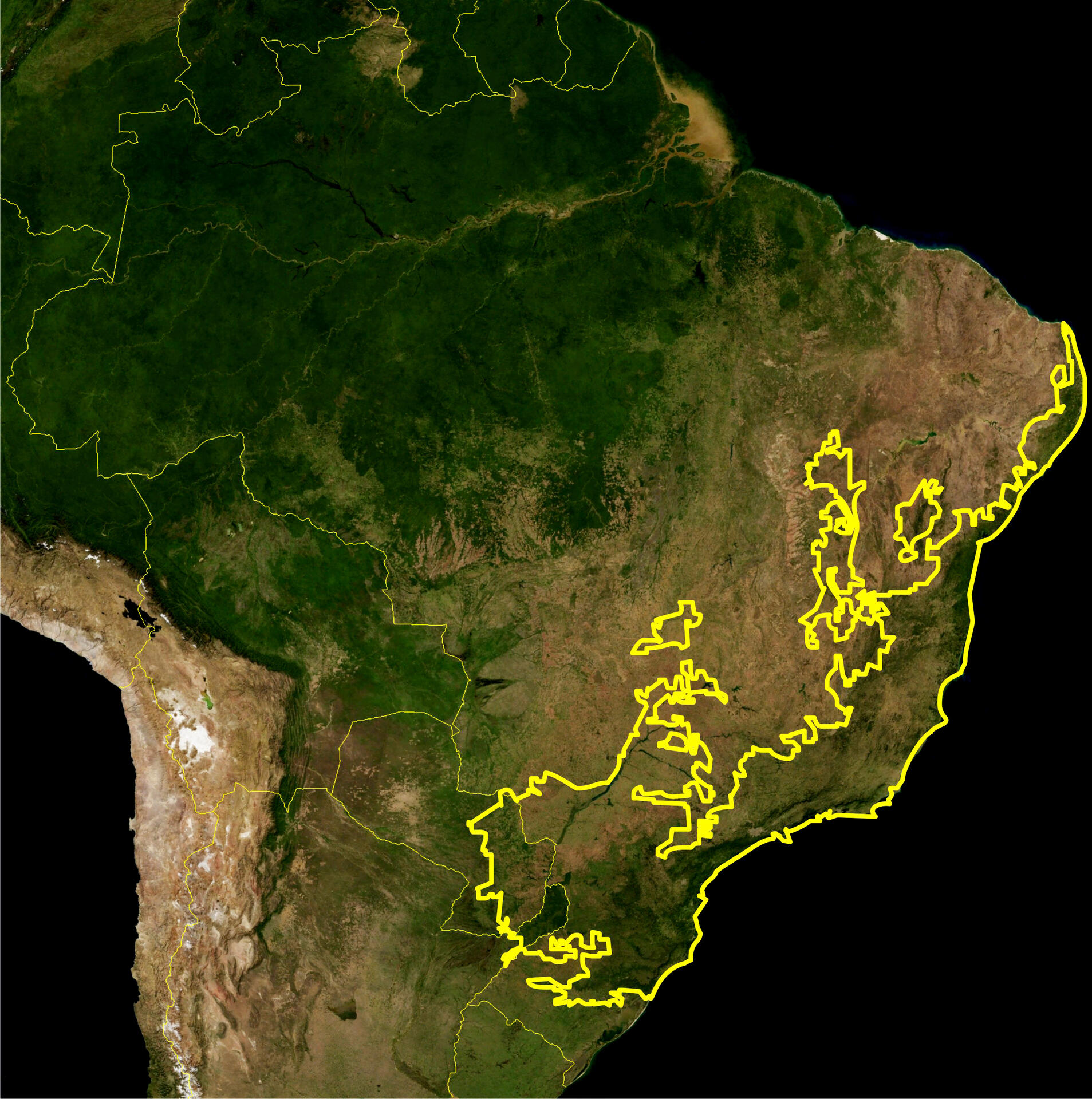
NASA and Miguelrangeljr, Public domain
World Heritage Research
Discover scientific research and academic studies that deepen our understanding of Discovery Coast Atlantic Forest Reserves from its history and significance to its conservation, management, and contemporary challenges.
-
Relationship between Hg accumulation and diet in bats from Atlantic forest reserves
A study on bats from the Atlantic Forest reserves reveals that insectivorous bats exhibit higher mercury (Hg) accumulation and δ¹⁵N values, indicating their susceptibility to Hg contamination through invertebrate consumption. The research analyzed 100 road-killed bats collected between 2012 and 2017, finding mean Hg concentrations of 5.6 mg/kg, with 23% exceeding the sub-clinical threshold linked to neurological effects. Hg levels varied significantly across feeding guilds, following the order carnivorous > insectivorous > omnivorous > nectarivorous > frugivorous. Stable isotope analysis (δ¹³C and δ¹⁵N) further highlighted dietary and habitat differences among guilds. The findings underscore bats' role as sentinels for Hg monitoring, particularly in tropical ecosystems facing anthropogenic pressures.
Santos Vergilio, C. d., de Aguiar, D. B., Damásio, L., Lacerda, D., Gatts, P. V., de Sá Mendonça, E., de Almeida, M. G., Araújo, B. F., Banhos, A., & de Rezende, C. E. (2026). Relationship between Hg accumulation and diet in bats from Atlantic forest reserves. Ecotoxicology, 35(4). https://doi.org/10.1007/s10646-026-03067-y
View Publication Record | Read Publication -
Ruellia capixaba (Acanthaceae, Acanthoideae), a new scandent species from espírito santo state, with taxonomic updates for other Ruellia of the Atlantic Forest of Brazil
Researchers have identified and described Ruellia capixaba, a new scandent species of the genus Ruellia (Acanthaceae) endemic to the Atlantic Forest in Espírito Santo, Brazil. This discovery adds to the 24 known Ruellia species in the Atlantic Forest, a critical biodiversity hotspot threatened by deforestation. The study also introduces Ruellia fatimae, a red-flowered scandent species previously misclassified under Stephanophysum, and lectotypifies Ruellia furcata. Additionally, an identification key for scandent Ruellia species in the Brazilian Atlantic Forest is provided. The research leverages taxonomic analysis to clarify species boundaries, contributing to the understanding of plant diversity in this vulnerable ecosystem.
Zavatin, D. A., Freitas, J., de Lírio, E. J., Faller, V. S., Prado, J., Kameyama, C., & Fernandes, U. G. (2026). Ruellia capixaba (Acanthaceae, Acanthoideae), a new scandent species from espírito santo state, with taxonomic updates for other Ruellia of the Atlantic Forest of Brazil. Brittonia, 78(3), 340–351. https://doi.org/10.1007/s12228-026-09877-y
View Publication Record | Read Publication -
Unveiling the diversity of avastroviruses in tropical wild birds from the Atlantic Forest, Brazil
A novel avastrovirus strain, Passerine Avastrovirus (PasAstV M1580), has been identified in wild birds from the Atlantic Forest of Brazil, expanding the known diversity within the Avastrovirus genus. This discovery was made during a study investigating Reovirales-related viruses using next-generation sequencing (NGS) on fecal samples from 417 wild birds representing 89 species. Conventional RT-PCR detected avastroviruses in 7.67% of samples, with repeated detections in recaptured individuals, suggesting persistent infection or shedding. Genomic analysis revealed that PasAstV M1580 exhibits low amino acid identity (25.18% to 33.23%) compared to prototype strains, indicating it may represent a novel species within the genus. This study highlights the unexplored diversity of avastroviruses in tropical wild bird populations and provides insights into their ecological dynamics.
Haisi, A., Schunck, F., de Azevedo, L. S., Cunha, M. S., de Almeida, R. G., Silva, V. C. M., Luchs, A., & Araújo Junior, J. P. (2026). Unveiling the diversity of avastroviruses in tropical wild birds from the Atlantic Forest, Brazil. Scientific Reports. https://doi.org/10.1038/s41598-026-74409-3
View Publication Record | Read Publication -
Description of pistillate flowers and conservation status of two species of Mollinedia (Monimiaceae, Laurales) from the Brazilian Atlantic forest
Scientists have made a significant discovery by describing the pistillate (female) flowers of two rare and endangered species of Mollinedia (Monimiaceae), complementing their previous descriptions based solely on staminate (male) flowers. This advancement enhances taxonomic understanding of Mollinedia dolichotricha and Mollinedia ruschii, both endemic to Brazil’s Atlantic Forest. The study also reassessed their conservation status—M. dolichotricha as 'Endangered' (EN) and M. ruschii as 'Critically Endangered' (CR)—due to new threats identified during field surveys. Highlighting the need for urgent conservation action, the research provides detailed descriptions, photographs, and recommendations to protect these vulnerable species amid ongoing habitat loss.
Alvarenga Zavatin, D., Guimarães Barbosa, L., Da Rosa, P., Freitas, J., & John De Lírio, E. (2025). Description of pistillate flowers and conservation status of two species of Mollinedia (Monimiaceae, Laurales) from the Brazilian Atlantic forest. Nordic Journal of Botany, 2025(10). Portico. https://doi.org/10.1002/njb.04778
View Publication Record | Read Publication -
Vascular plants of Reserva Biológica do Tinguá, Rio de Janeiro, Brazil: leveraging herbarium databases to address knowledge gaps in the Atlantic Forest
A comprehensive inventory of the Reserva Biológica do Tinguá, Brazil—a critical Atlantic Forest reserve—reveals 1,301 vascular plant species, with over half (52.2%) endemic to the region. Among these, 97 are nationally threatened, including five Critically Endangered and 86 endemic species facing conservation risks. The study leveraged herbarium databases to compile an updated floristic list, addressing knowledge gaps in one of the world's most biodiverse yet urban-pressured ecosystems. Such data is vital for informing conservation strategies amid challenges like pollution and resource extraction in densely populated areas.
Bochorny, T., Quinet, A., Castello, A. C., Alves-Araújo, A., Costa, A., Peixoto, A., Sakuragui, C., Fraga, C., Dalastra, C., Zavatin, D., Gonzaga, D., Ramos, E., Jacques, E., Guimaraes, E., Lírio, E., Marcusso, G., Sommer, G., Queiroz, G., Lima, H., et al. (2025). Vascular plants of Reserva Biológica do Tinguá, Rio de Janeiro, Brazil: leveraging herbarium databases to address knowledge gaps in the Atlantic Forest. Biodiversity Data Journal, 13. https://doi.org/10.3897/bdj.13.e157961
View Publication Record | Read Publication -
Conservation of Atlantic Forest fragments: is the iconic brazilwood Paubrasilia echinata adequately protected in south-east Brazil?
The iconic Brazilwood tree, Paubrasilia echinata, endemic to Brazil's Atlantic Forest and listed as Endangered by the IUCN, faces significant threats from habitat loss and overexploitation. A new study identifies five genetic lineages of this species, with one—arruda-RJ—being particularly vulnerable in Rio de Janeiro due to urbanization. Researchers analyzed 164 occurrence records from 2004–2024, classifying 43 forest fragments containing the arruda-RJ lineage as high, medium, or low priority for conservation. The study highlights that most fragments are small with uneven population structures and that northern regions, with more protected areas, hold the greatest genetic diversity. It proposes targeted conservation actions for eight high-priority fragments to safeguard this lineage, aligning with global biodiversity goals.
Rosa, P., Antas, N. G., Freitas, J., Nic Lughadha, E., Fuller, T., Lira, C. F., Sá, C. F. C., Bohrer, C. B. d. A., Lewis, G. P., Dantas, H. G. R., & Lima, H. C. d. (2025). Conservation of Atlantic Forest fragments: is the iconic brazilwood Paubrasilia echinata adequately protected in south-east Brazil? Oryx, 59(6), 755–764. https://doi.org/10.1017/s0030605325102020
View Publication Record | Read Publication -
Butterflies of two atlantic forest conservation units from Paraíba state, northeast of Brazil
A comprehensive inventory of butterfly species in two Atlantic Forest Conservation Units in Paraíba, Brazil, revealed 212 species, including seven new records for northeast Brazil and 48 for the state. The study, conducted over multiple expeditions from 2013 to 2015 with additional sampling in 2021, employed Van Someren-Rydon traps and entomological nets. Hesperiidae was the most diverse family, followed by Nymphalidae and Riodinidae. Notably, the Critically Endangered subspecies Morpho menelaus eberti was recorded, underscoring the importance of protecting these forest remnants for biodiversity conservation. The findings highlight the need for targeted management and monitoring actions to safeguard butterflies and other invertebrates in the region.
Gualberto, E. P., Medeiros, A. D. d., & Kerpel, S. M. (2024). Butterflies of two atlantic forest conservation units from Paraíba state, northeast of Brazil. EntomoBrasilis, 17, e1068. https://doi.org/10.12741/ebrasilis.v17.e1068
View Publication Record | Read Publication