World Heritage Identification Number: 640
World Heritage since: 1992
Category: Natural Heritage
WHE Type: Protected Areas & National Parks
Transboundary Heritage: No
Endangered Heritage: No
Country: 🇨🇳 China
Continent: Asia
UNESCO World Region: Asia and the Pacific
Map
Exploring the Stunning Landscape of Wulingyuan Scenic and Historic Interest Area
The Wulingyuan Scenic and Historic Interest Area, located in the Wulingyuan District of Hunan Province, China, is a breathtaking UNESCO World Heritage Site that has captivated visitors since its inscription in 1992. This expansive region, covering over 26,000 hectares, showcases a unique and awe-inspiring landscape characterized by towering quartzite sandstone pillars and peaks, deep ravines, and cascading waterfalls.
More to come…UNESCO Description of the World Heritage Site
A spectacular area stretching over more than 26,000 ha in China's Hunan Province, the site is dominated by more than 3,000 narrow sandstone pillars and peaks, many over 200 m high. Between the peaks lie ravines and gorges with streams, pools and waterfalls, some 40 caves, and two large natural bridges. In addition to the striking beauty of the landscape, the region is also noted for the fact that it is home to a number of endangered plant and animal species.
UNESCO Justification of the World Heritage Site
Criterion (vii): The huge number of sandstone columns and peaks—more than 3,000—are spectacular. These, coupled with other land forms (natural bridges, ravines, waterfalls, streams, pools and caves) and dense broadleaf forest, present an aesthetically beautiful landscape enhanced by the mists and clouds which frequently shroud the site. There are more than 40 caves and two huge natural stone bridges, one of which rises 357 m above the valley floor. At time of evaluation it was also noted that with additional information there could also be justification for inscribing this property under criterion (x), as the site provides important habitat for a number of threatened plant and animal species such as dhole, Asiatic black bear and Chinese water deer.
Encyclopedia Record: Wulingyuan
Wulingyuan is a scenic and historical site in the Wulingyuan District of South Central China's Hunan Province. It was inscribed as a UNESCO World Heritage Site in 1992. It is noted for more than 3,000 quartzite sandstone pillars and peaks across most of the site, many over 200 metres (660 ft) in height, along with many ravines and gorges with picturesque streams, pools, lakes, rivers, and waterfalls. It features 40 caves, many with large calcite deposits and a natural bridge named Tianqiashengkong, which is one of the highest natural bridges in the world. The site also provides habitat for many vulnerable species, including the dhole, Asiatic black bear, and Chinese water deer.Additional Site Details
Area: 26,400 hectares
Number of Components: 1
Coordinates: 29.33333 , 110.5
IUCN World Heritage Outlook
The 2025 Conservation Outlook on Wulingyuan Scenic and Historic Interest Area reports the following assessment:
Source: International Union for Conservation of Nature (IUCN) · View assessment
Image
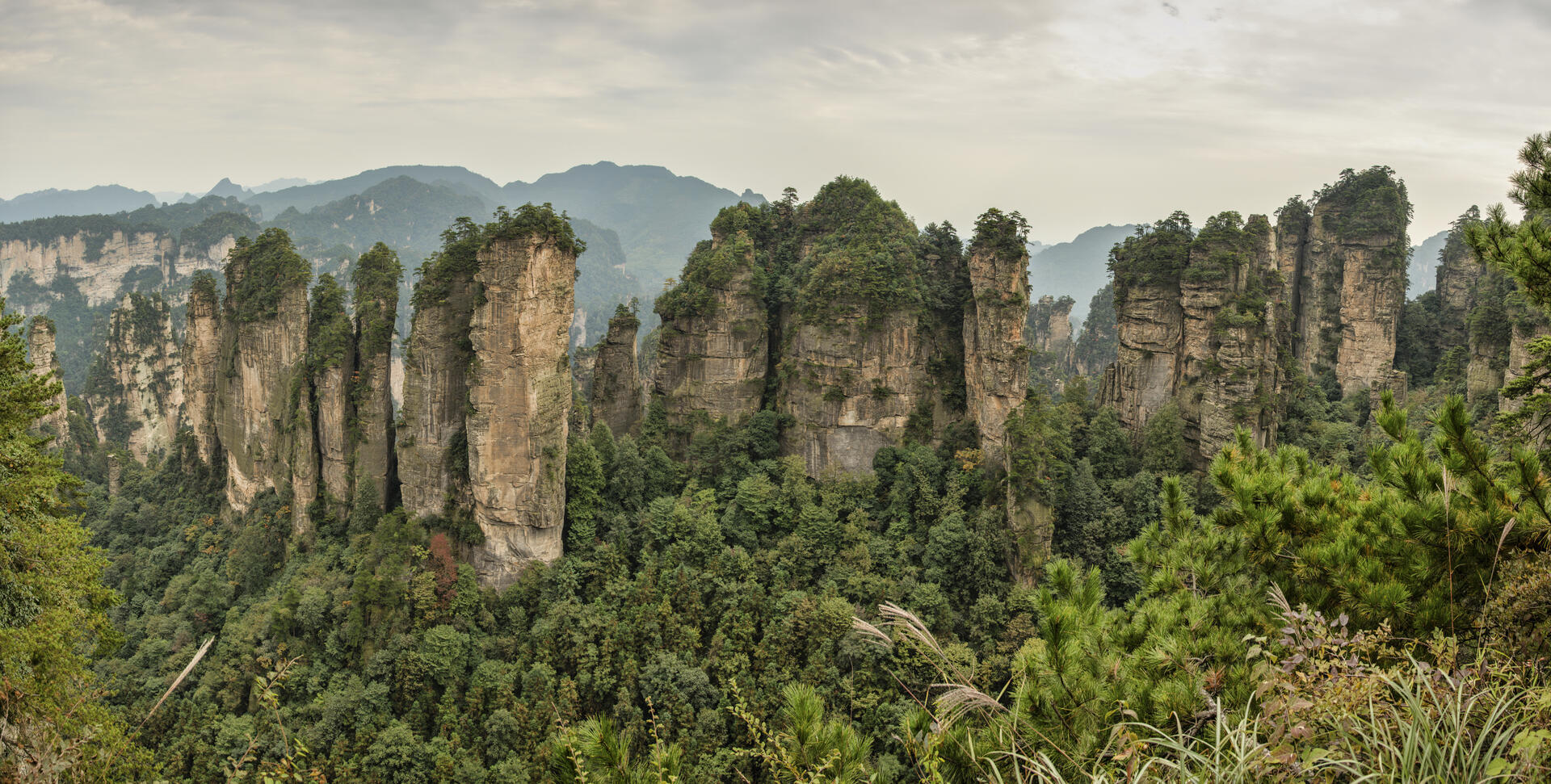
© chensiyuan, CC BY-SA 4.0 Resized from original. (This derivative is under the same CC BY-SA license.)
World Heritage Research
Discover scientific research and academic studies that deepen our understanding of Wulingyuan Scenic and Historic Interest Area from its history and significance to its conservation, management, and contemporary challenges.
-
Heritage as a development engine for people in nature: A case study of Wulingyuan Scenic and Historic Interest Area, China
A new management strategy for UNESCO World Heritage Sites, demonstrated at Wulingyuan Scenic and Historic Interest Area, successfully integrates heritage conservation with community development and sustainable tourism. By establishing the Traditional Eco-agricultural Heritage Zone, the approach fosters the coexistence of culture and nature while empowering local communities through initiatives like traditional handicraft revitalization and culinary innovation. This model not only enhances biodiversity protection but also aligns with the United Nations Sustainable Development Goals, offering a scalable framework for other Natural World Heritage Sites. The study highlights the importance of stakeholder engagement, conflict resolution, and capacity building in achieving long-term sustainability.
Han, F., & Li, J. (2024). Heritage as a development engine for people in nature: A case study of Wulingyuan Scenic and Historic Interest Area, China. Parks Stewardship Forum, 40(3). https://doi.org/10.5070/p5.35440
View Publication Record | Read Publication -
Temporal and Spatial Evolution of Carbon Emissions and Their Influencing Factors for Tourist Attractions at Heritage Tourist Destinations
Carbon emissions at heritage tourist destinations exhibit significant temporal and spatial variations, with differences observed both monthly and interannually. A study focusing on the Wulingyuan Scenic and Historic Interest Area (WSHIA) found that carbon emissions per visitor vary greatly across different types of tourism attractions, influenced by factors such as tourism seasonality, market growth, and heritage tourism trends. The spatial evolution of these emissions can be divided into three stages, primarily driven by functional zoning, environmental regulations, and the diversified development of tourist attractions. These findings provide valuable insights for low-carbon tourism strategies and sustainable development policies at heritage sites.
Tang, C., Wan, Z., Ng, P., Dai, X., Sheng, Q., & Chen, D. (2019). Temporal and Spatial Evolution of Carbon Emissions and Their Influencing Factors for Tourist Attractions at Heritage Tourist Destinations. Sustainability, 11(21), 5944. https://doi.org/10.3390/su11215944
View Publication Record | Read Publication -
Algorithm improvements and applications for biological conservation security patterns
A novel approach to biological conservation, leveraging gradient descent algorithms and utility formulas, identifies critical areas for ecological restoration within buffer zones. The study maps landscape security patterns for Macaca mulatta in the Wulingyuan Scenic and Historic Interest Area (WSA), pinpointing four core habitats and three potential source candidates while delineating key ecological corridors to enhance connectivity between populations. By categorizing regions based on resistance levels and proximity to suitable sources, the research provides a strategic framework for conservation efforts, emphasizing high-resistance areas within buffer zones as priority restoration targets. This method offers practical significance for preserving biodiversity, exemplified by its application to the Macaca mulatta population in WSA.
Chen, J., Zhou, N., & Tao, Z. (2018). Algorithm improvements and applications for biological conservation security patterns. Biodiversity Science, 26(1), 36–43. https://doi.org/10.17520/biods.2017124
View Publication Record | Read Publication -
Multi-agency management of a World Heritage Site: Wulingyuan Scenic and Historic Interest Area, China
Shared management among multiple agencies at heritage sites, while common in China, often leads to inefficiencies and inconsistencies. A study on the Wulingyuan Scenic and Historic Interest Area reveals that the current grid management system results in inefficient use of human and financial resources, as well as inconsistent application of management measures due to the lack of an effective coordination agency and collaboration mechanism. The research, based on semi-structured interviews with management staff, proposes a multi-agency management model that emphasizes the roles of a coordination agency and a robust collaboration framework to enhance management efficiency. This study highlights the need for improved coordination and collaboration in multi-agency management contexts to optimize heritage tourism management.
Su, M. M., Wall, G., Wang, Y., & Jin, M. (2016). Multi-agency management of a World Heritage Site: Wulingyuan Scenic and Historic Interest Area, China. Current Issues in Tourism, 20(12), 1290–1309. https://doi.org/10.1080/13683500.2016.1261810
View Publication Record | Read Publication