World Heritage Identification Number: 624
World Heritage since: 1993
Category: Cultural Heritage
WHE Type: Historic Cities & Urban Areas
Transboundary Heritage: No
Endangered Heritage: No
Country: 🇩🇪 Germany
Continent: Europe
UNESCO World Region: Europe and North America
Map
A Journey Through Time: The Town of Bamberg - A UNESCO World Heritage Site
The town of Bamberg, nestled in the heart of Upper Franconia in Bavaria, offers a captivating glimpse into the rich tapestry of European history. First mentioned in records in the 9th century, Bamberg rose to particular prominence in the early 11th century. Its name is believed to derive from Babenberch, possibly linked to the noble Babenberg dynasty associated with the region in its early medieval period. Today, the town has a population of around 80,000 inhabitants and is renowned for its exceptionally well-preserved historic center, which has been a UNESCO World Heritage Site since 1993.
Bamberg’s historical significance grew substantially under the rule of Henry II, who founded the Bishopric of Bamberg in 1007. The town became an important religious and political center of the Holy Roman Empire and served as a missionary base for efforts to Christianize Slavic peoples in regions to the east, including parts of present-day Poland and Pomerania. This strategic and spiritual role helped shape Bamberg’s cultural and architectural development over the centuries.
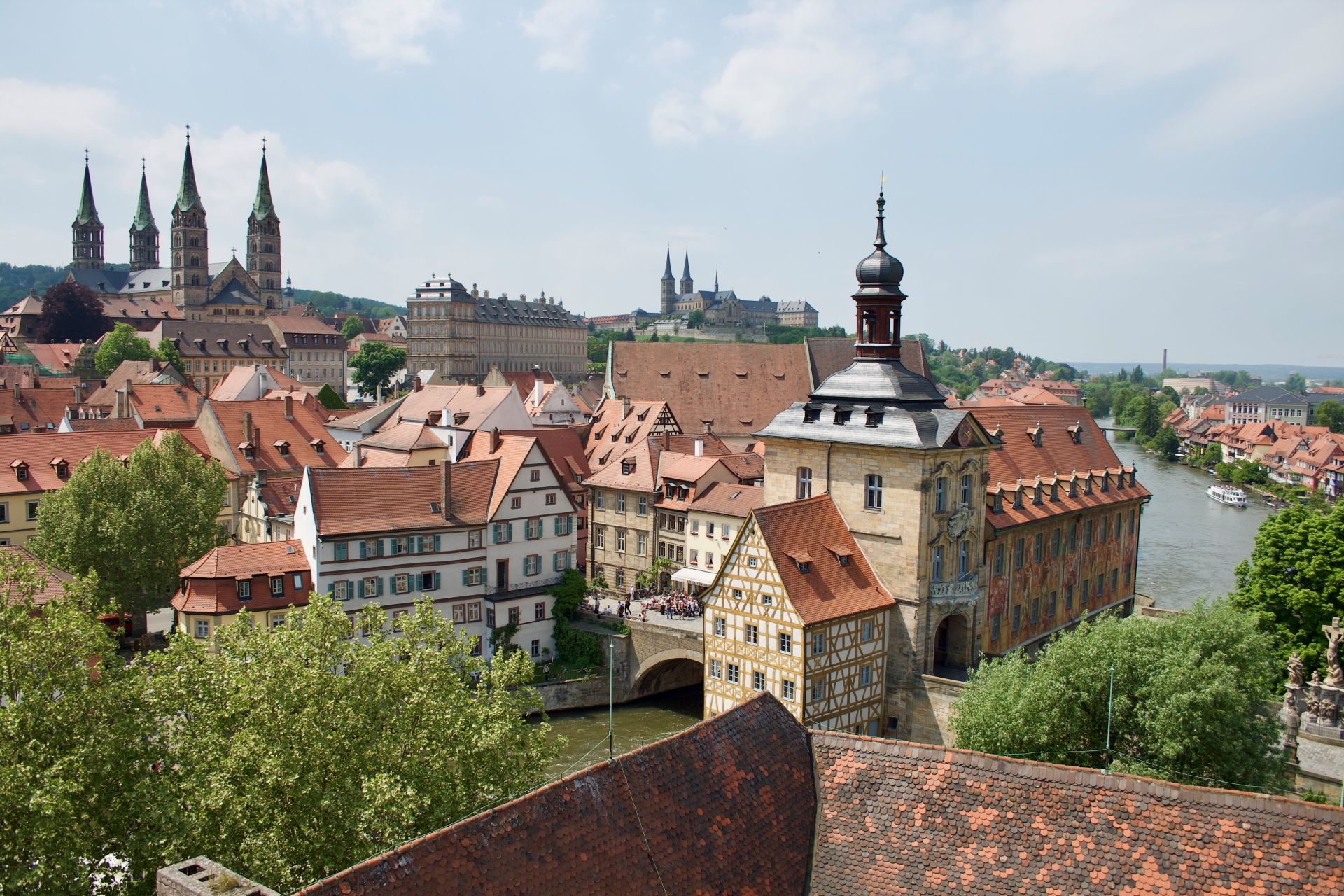
From the 12th century onward, Bamberg experienced sustained prosperity. Its urban layout—spanning the episcopal town on the hills, the island town in the Regnitz River, and the market gardeners’ district—remains remarkably intact. The town showcases an extraordinary blend of Romanesque, Gothic, Renaissance, and Baroque architecture in its churches, monasteries, palaces, and civic buildings.
Among its architectural treasures, Bamberg Cathedral stands out as a masterpiece of late Romanesque architecture, completed in the 13th century. It houses the tomb of Emperor Henry II and his wife, Cunigunde of Luxembourg, both later canonized. The cathedral is also famed for the enigmatic “Bamberg Horseman,” one of the most significant medieval equestrian statues in Europe. It holds a further unique distinction in ecclesiastical history as the burial place of Pope Clement II — the only papal tomb north of the Alps.
This spiritual link to Rome is mirrored in the city’s symbolic topography. Often referred to as the “Franconian Rome,” Bamberg developed across seven hills, several of which are crowned by prominent ecclesiastical buildings, reinforcing its identity as a sacred urban landscape.
For centuries, Bamberg was not merely a bishop’s seat but the center of an influential Prince-Bishopric within the Holy Roman Empire. Its prince-bishops exercised both spiritual and secular authority, shaping the city’s political life and architectural grandeur. In the 17th and 18th centuries, especially after the devastation of the Thirty Years’ War, they transformed Bamberg with ambitious Baroque building projects that added palaces, monasteries, and ornate churches to its already impressive skyline.
The long period of ecclesiastical rule came to an end in 1803, when secularization dissolved the Prince-Bishopric and Bamberg was incorporated into the Kingdom of Bavaria, marking a decisive shift in its political and administrative identity. Yet Bamberg’s history also bears darker chapters. In the early 17th century, during one of the most intense waves of witch persecutions in Europe, the city became a center of trials that led to hundreds of executions.
Today, Bamberg continues to enchant visitors with its picturesque Old Town, characterized by narrow, winding streets and a wealth of half-timbered buildings, many dating back to the Middle Ages and early modern period. Landmarks such as the Old Town Hall (Altes Rathaus Bamberg) dramatically positioned on a bridge over the Regnitz River further enhance its distinctive charm.
The preservation of this historic fabric is particularly remarkable, as the city remained largely untouched by the destruction of the Second World War. Its cultural depth is further enriched by its role as a haven for thinkers like Georg Wilhelm Friedrich Hegel and E.T.A. Hoffmann, and by the unique 'Gärtnerstadt', where centuries-old urban market gardening traditions continue to shape the city’s identity. Bamberg’s vibrant cultural life—encompassing traditional festivals, music, and its celebrated brewing heritage—adds to its enduring appeal.
Altogether, Bamberg offers a remarkable journey through time. Its rich ecclesiastical history, architectural splendor, and carefully preserved urban landscape make it one of Europe’s most outstanding historic towns and a compelling destination for anyone seeking to experience the legacy of the medieval Holy Roman Empire within a lively contemporary setting.
UNESCO Description of the World Heritage Site
From the 10th century onwards, this town became an important link with the Slav peoples, especially those of Poland and Pomerania. During its period of greatest prosperity, from the 12th century onwards, the architecture of Bamberg strongly influenced northern Germany and Hungary. In the late 18th century it was the centre of the Enlightenment in southern Germany, with eminent philosophers and writers such as Hegel and Hoffmann living there.
UNESCO Justification of the World Heritage Site
Criterion (ii): The layout and architecture of medieval and baroque Bamberg exerted a strong influence on urban form and evolution in the lands of central Europe from the 11th century onwards.
Criterion (iv): Bamberg is an outstanding and representative example of an early medieval town in central Europe, both in its plan and its surviving ecclesiastical and secular buildings.
Encyclopedia Record: Bamberg
Bamberg is a town in Upper Franconia, Bavaria, Germany, on the river Regnitz close to its confluence with the river Main. Bamberg had 79,000 inhabitants in 2022. The town dates back to the 9th century, when its name was derived from the nearby Babenberch castle. Cited as one of Germany's most beautiful towns, with medieval streets and buildings, the old town of Bamberg with around 2,400 timber houses has been a UNESCO World Heritage Site since 1993.Additional Site Details
Area: 142 hectares
Number of Components: 1
(iv) — Outstanding example of a type of building or landscape
Coordinates: 49.89166667 , 10.88888889