World Heritage Identification Number: 12
World Heritage since: 1980
Category: Cultural Heritage
WHE Type: Archaeological Sites
Transboundary Heritage: No
Endangered Heritage: No
Country: 🇪🇹 Ethiopia
Continent: Africa
UNESCO World Region: Africa
Map
Exploring the Enigmatic Landscape of Tiya: A Unique Archaeological Site in Ethiopia
The enigmatic landscape of Tiya, located in the Soddo region south of Addis Ababa, offers a fascinating glimpse into the rich cultural history of Ethiopia. This archaeological site, designated a UNESCO World Heritage Site in 1980, is one of the most significant discoveries made in the region, boasting 36 monuments that remain a captivating mystery to scholars worldwide.
More to come…UNESCO Description of the World Heritage Site
Tiya is among the most important of the roughly 160 archaeological sites discovered so far in the Soddo region, south of Addis Ababa. The site contains 36 monuments, including 32 carved stelae covered with symbols, most of which are difficult to decipher. They are the remains of an ancient Ethiopian culture whose age has not yet been precisely determined.
Encyclopedia Record: Tiya (archaeological site)
Tiya is an archaeological site in central Ethiopia. It is located in the Soddo woreda, in the Gurage Zone of the Southern Nations, Nationalities, and Peoples Region south of Addis Ababa. It is best known for its archaeological site its large stone pillars, many of which bear some form of decoration. The archeological site was designated a World Heritage Site in 1980, due to the unique nature of these monolithic monuments.Additional Site Details
Area: Not available
Number of Components: 1
(iv) — Outstanding example of a type of building or landscape
Coordinates: 8.43491 , 38.6121
Image
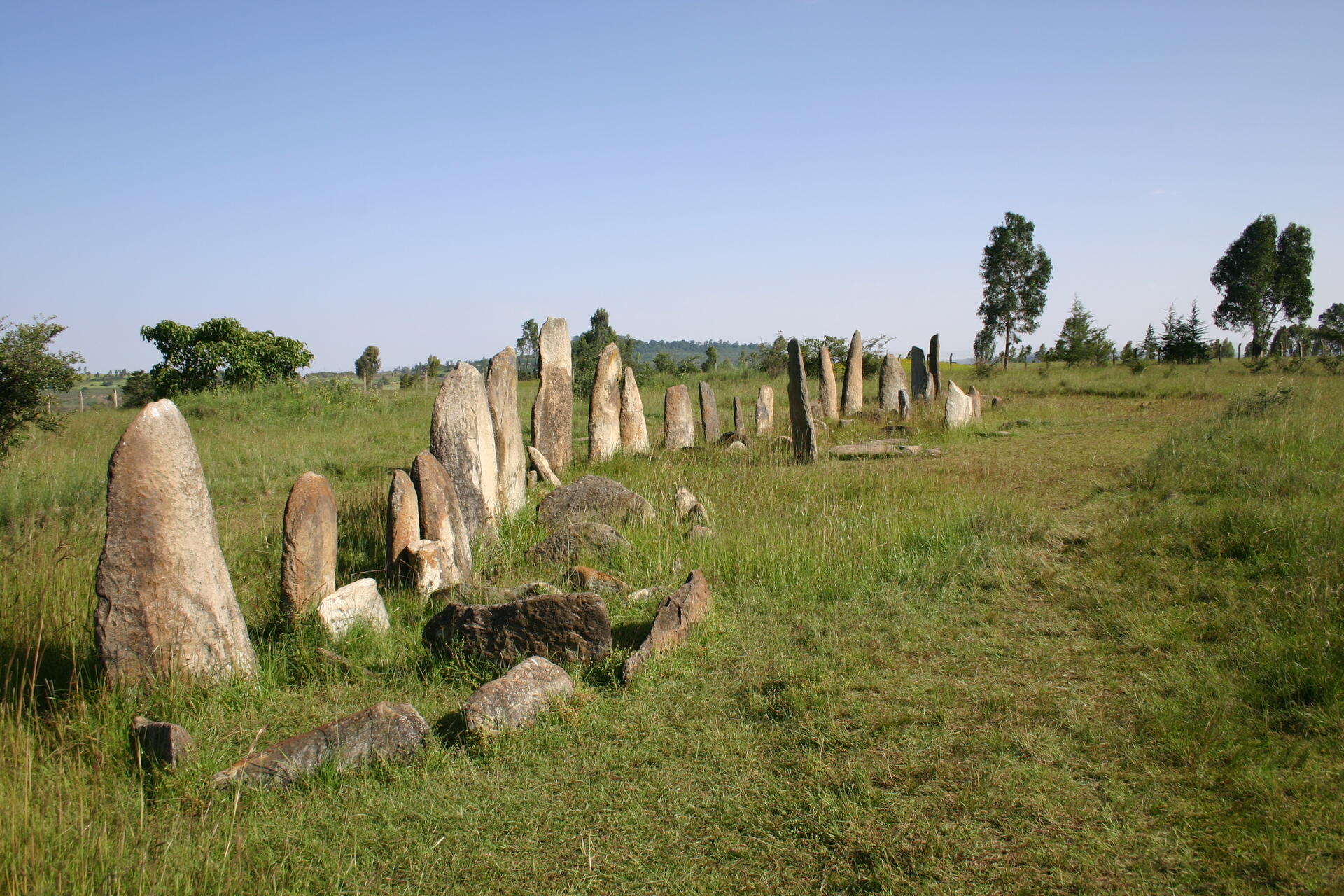
© Julien Demade, CC BY-SA 3.0 Resized from original. (This derivative is under the same CC BY-SA license.)
World Heritage Research
Discover scientific research and academic studies that deepen our understanding of Tiya from its history and significance to its conservation, management, and contemporary challenges.
-
African rock art and world heritage: context, safeguarding and prospects for the future
African rock art, a non-renewable cultural heritage, faces significant threats from both natural and human sources, with the latter being predominantly unintended but destructive. The study highlights that UNESCO's designation of these sites as World Heritage, starting with Tiya in Ethiopia (1980), has been instrumental in their recognition but insufficient to mitigate risks such as dust erosion, fires, vandalism, and looting. It also underscores the need for enhanced community engagement and resource allocation to improve safeguarding efforts. The research draws on expert insights, academic literature, and grey sources to analyze management challenges and propose future interventions.
Mazel, A. (2025). African rock art and world heritage: context, safeguarding and prospects for the future (Version 1). Newcastle University. https://doi.org/10.25405/NCL.34528878.V1
View Publication Record | Read Publication -
Non-market Valuation of Tiya Megalithic World Cultural Heritage of Ethiopia, Application of Travel Cost and Contingent Valuation Methods
Researchers estimate the total economic value of Tiya, Ethiopia's megalithic World Heritage site, at 9.6 million ETB annually through use and nonuse values. The study applies Travel Cost Method (TCM) to assess recreational demand, revealing key determinants like travel cost, income, and visitor characteristics, while Contingent Valuation Method (CVM) quantifies community willingness to pay for preservation. Using truncated Poisson regression for use value and bivariate probit modeling for nonuse value, the findings highlight Tiya's significant cultural and economic importance, advocating for targeted maintenance to sustain its benefits.
Mude, H., Belachew, A., & Bersisa, M. (2020). Non-market Valuation of Tiya Megalithic World Cultural Heritage of Ethiopia, Application of Travel Cost and Contingent Valuation Methods. American Journal of Environmental and Resource Economics, 5(3), 59. https://doi.org/10.11648/j.ajere.20200503.13
View Publication Record | Read Publication -
Divine Fertility
A groundbreaking archaeological and ethnographic study reveals the profound influence of indigenous Sky-God beliefs on the social fabric of Northeast Africa, predating Christianity and Islam. The research uncovers complex pre-Islamic institutions that fostered cultural exchange, tolerance, and peace through shared rituals, including pilgrimage practices at Saint Aw-Barkhadle—a 12th-century burial site linked to early Muslim dynasties—and the ritual hunt. It introduces a novel interpretational framework, the 'Ritual Set,' to analyze sacred landscapes and stelae traditions across sites like Tiya, Aksum, and Lalibela, providing a nuanced understanding of the region's multi-religious heritage. This study challenges dominant narratives by emphasizing indigenous continuity in belief systems and practices, offering invaluable insights for archaeologists, anthropologists, and policymakers.
Mire, S. (2020). Divine Fertility. https://doi.org/10.4324/9780429769252
View Publication Record | Read Publication