World Heritage Identification Number: 785
World Heritage since: 1998
Category: Cultural Heritage
WHE Type: Infrastructure & Industry
Transboundary Heritage: No
Endangered Heritage: No
Country: 🇦🇹 Austria
Continent: Europe
UNESCO World Region: Europe and North America
Map
The Pioneering Feat of Engineering: Semmering Railway
The Semmering Railway, a marvel of civil engineering, stretches over a distance of 41 kilometers through the heart of the Alps in Austria. Inscribed as a UNESCO World Heritage Site in 1998, this historic railway line stands as a testament to human ingenuity and perseverance.
Constructed between 1848 and 1854, the Semmering Railway was one of the earliest mountain railways in Europe, featuring a standard-gauge track. Its significance lies not only in its technical achievements but also in its role as a catalyst for the development of the region.
Central to the success of the Semmering Railway was its chief engineer, Carl Ritter von Ghega, whose visionary approach transformed contemporary railway engineering. At a time when steep gradients were thought impractical for conventional railways, von Ghega proved that a standard-gauge adhesion railway could safely operate in high mountain terrain.
The line incorporates gradients of up to 2.5 percent and tight curve radii as small as 190 meters, features that were unprecedented in the mid-19th century. By seamlessly integrating technical innovation with the natural Alpine landscape, the Semmering Railway set a new global standard for mountain rail construction and earned recognition as a decisive turning point in the history of transportation.
The railway line begins at Gloggnitz and climbs steadily toward the Semmering Pass, reaching its highest point at approximately 895 meters above sea level before descending toward Mürzzuschlag. This journey takes travelers through a breathtaking panorama of rugged mountains, verdant valleys, and picturesque villages. The railway's route was carefully planned to showcase these natural wonders while minimizing the impact on the environment.
One of the most striking features of the Semmering Railway is its impressive collection of engineering structures, including 14 tunnels and 16 major viaducts, as well as numerous bridges. These stone and iron constructions were meticulously engineered to overcome the challenges of steep gradients and tight curves, ensuring reliable railway operation through difficult mountainous terrain. Notable examples include the Kalte Rinne Viaduct, one of the most iconic structures along the route.
Beneath the engineering achievement of the Semmering Railway lay a significant human cost. Tens of thousands of workers labored in dangerous conditions, carving tunnels and building viaducts by hand in steep Alpine terrain. Accidents, illness, and exhaustion were common, and many lives were lost during construction, underscoring the physical toll behind this landmark of 19th-century engineering.
In addition to its engineering prowess, the Semmering Railway played a crucial role in the development of tourism in the region. As the railway opened up previously inaccessible areas, it attracted visitors seeking adventure and relaxation in the Alpine wilderness. To cater to these tourists, numerous hotels, villas, and spa resorts were built along the line, many of which still stand today as important examples of 19th-century resort architecture.
Today, the Semmering Railway remains an integral part of Austria’s Southern Railway network, operated by the Austrian Federal Railways (ÖBB). Despite its age, the railway continues to serve passenger and freight traffic, demonstrating the enduring value of this remarkable feat of engineering.
Overall, the Semmering Railway represents a significant milestone in the history of railway construction. Its innovative design, stunning landscapes, and rich cultural heritage make it a must-visit destination for anyone interested in the intersection of technology, nature, and human ambition.
UNESCO Description of the World Heritage Site
The Semmering Railway, built over 41 km of high mountains between 1848 and 1854, is one of the greatest feats of civil engineering from this pioneering phase of railway building. The high standard of the tunnels, viaducts and other works has ensured the continuous use of the line up to the present day. It runs through a spectacular mountain landscape and there are many fine buildings designed for leisure activities along the way, built when the area was opened up due to the advent of the railway.
UNESCO Justification of the World Heritage Site
Criterion (ii): The Semmering Railway represents an outstanding technological solution to a major physical problem in the construction of early railways.
Criterion (iv): With the construction of the Semmering Railway, areas of great natural beauty became more easily accessible and as a result these were developed for residential as well recreational use, creating a new form of landscape.
Encyclopedia Record: Semmering railway
The Semmering railway in Austria, which starts at Gloggnitz and leads over the Semmering to Mürzzuschlag, was the first mountain railway in Europe built with a standard gauge track. It is commonly referred to as the world's first true mountain railway, given the very difficult terrain and the considerable altitude difference that was mastered during its construction. It is still fully functional as a part of the Southern Railway which is operated by the Austrian Federal Railways.Additional Site Details
Area: 156.18 hectares
Number of Components: 1
(iv) — Outstanding example of a type of building or landscape
Coordinates: 47.64877778 , 15.82797222
Image
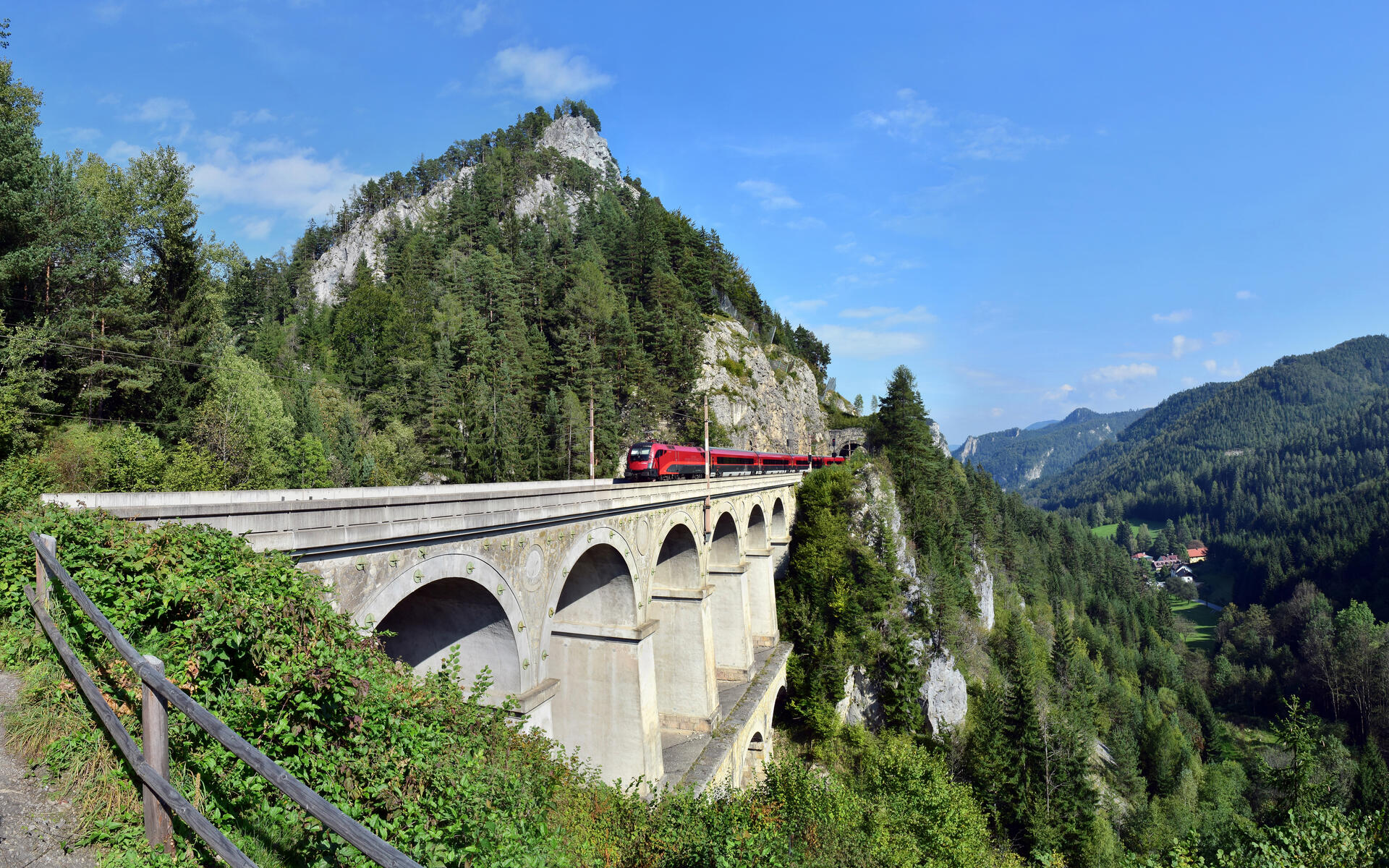
© Haeferl, CC BY-SA 3.0 at Resized from original. (This derivative is under the same CC BY-SA license.)
World Heritage Research
Discover scientific research and academic studies that deepen our understanding of Semmering Railway from its history and significance to its conservation, management, and contemporary challenges.
-
Alpine Landschaft per Bahn. Die Bergmenschen bei Peter Rosegger und Heimito von Doderer
The Semmering Railway, the world's first high mountain railway, revolutionized access to the Alps for urban society during industrialization. This study reveals that while it brought tourists closer to the mountains, locals likely always viewed them as urban intruders. Analysis of texts by Peter Rosegger and Heimito von Doderer shows Rosegger's critical stance on tourist development and his emphasis on observing nature from the train, contrasting with Doderer's depiction of travelers' fascination with the Alpine landscape. The research explores how these writers captured the changing relationship between people and the mountains, highlighting the railway's dual role in both connecting and alienating urban visitors from their surroundings.
Tusch, R. (2024). Alpine Landschaft per Bahn. Die Bergmenschen bei Peter Rosegger und Heimito von Doderer. Góry, Literatura, Kultura, 17, 11–22. https://doi.org/10.19195/2084-4107.17.3
View Publication Record | Read Publication -
MDB – Leistungsfähiges, flexibles und betriebsorientiertes Drainagespülen in Eisenbahntunneln
A novel, partially remote-controlled and automated long-distance flushing system (MDR) has been developed to enhance tunnel drainage maintenance for the Austrian Federal Railways (ÖBB Infrastruktur AG). This system, designed for use in the Granitztal Tunnel, Koralm Tunnel, and Semmering Base Tunnel along the Southern Railway Line, enables efficient cleaning of drainages over a 500-meter length without interrupting railway traffic. The MDR flushing box, transport module, and permanently installed components work together to ensure operational flexibility and effectiveness. By positioning the system on central flushing shafts in crossway areas, maintenance can be performed during breaks in operations, minimizing track closures. This innovation significantly improves the efficiency and safety of tunnel maintenance while maintaining operational continuity.
Heissenberger, R., Schneider, M., Wagner, H., Ferreira, C., & Schachinger, T. (2022). MDB – Leistungsfähiges, flexibles und betriebsorientiertes Drainagespülen in Eisenbahntunneln. Geomechanics and Tunnelling, 15(4), 414–423. Portico. https://doi.org/10.1002/geot.202200017
View Publication Record | Read Publication -
Long‐term monitoring of railway tunnels
Long-term monitoring of railway tunnels reveals critical insights into the structural behavior and longevity of geotechnical systems, particularly in challenging Alpine conditions. The study demonstrates that robust, reliable monitoring can detect unfavorable system behaviors early, enabling predictive maintenance to ensure tunnel availability over their 150-year service life. Researchers implemented long-term monitoring at the Koralm Tunnel and Granitztal Tunnel projects, focusing on ground-support interaction and fault zone characteristics under varying stress conditions. This approach allows for proactive measures to mitigate potential issues, ensuring high operational reliability. The findings highlight the importance of continuous observation even after tunnel completion, setting a precedent for future infrastructure projects like the Semmering Base Tunnel.
Moritz, B., Heissenberger, R., Schachinger, T., & Lienhart, W. (2021). Long‐term monitoring of railway tunnels. Geomechanics and Tunnelling, 14(1), 35–46. Portico. https://doi.org/10.1002/geot.202000049
View Publication Record | Read Publication -
„Hier ward der Sieg errungen über einen mächtigen, compacten Alpenzug“. Der Semmering in Reiseführern zwischen 1852 und 1873
Travel guides from the period of Semmering Railway construction (1852–1873) reveal a striking shift in landscape perception, celebrating humanity's triumph over nature rather than lamenting its destruction. The study analyzed seven key sources using qualitative content analysis, uncovering three distinct levels of description: poetic admiration for the railway's magnitude, critical reflections on altered landscapes, and progress narratives tracking construction milestones. This approach demonstrates how travel guides both documented and shaped public perception of industrial transformation in the Alps, offering a nuanced view of 19th-century landscape change.
Tusch, R. (2021). „Hier ward der Sieg errungen über einen mächtigen, compacten Alpenzug“. Der Semmering in Reiseführern zwischen 1852 und 1873. Góry, Literatura, Kultura, 14, 95–109. https://doi.org/10.19195/2084-4107.14.8
View Publication Record | Read Publication -
„Tu dokonało się zwycięstwo nad potężnym, zwartym łańcuchem Alp”. Semmering w przewodnikach między 1852 a 1873 rokiem
Travel guides from the mid-19th century reveal a striking shift in perception of the Semmering region, Austria, following the construction of the world's first high mountain railway. Initially depicted as a pristine Alpine landscape, the area was later celebrated for its transformation by human ingenuity and technology, reflecting a triumph over nature rather than lamentation for its destruction. The analysis of seven key travel guides—ranging from accounts during construction to those post-completion—shows how the Semmering Railway's progress was documented with poetic grandeur, highlighting both the project's magnificence and the evolving cultural significance of the region as it transitioned into a summer resort destination.
Tusch, R. (2021). „Tu dokonało się zwycięstwo nad potężnym, zwartym łańcuchem Alp”. Semmering w przewodnikach między 1852 a 1873 rokiem. Góry, Literatura, Kultura, 14, 110–120. https://doi.org/10.19195/2084-4107.14.9
View Publication Record | Read Publication -
Carl Ritter von Ghega – 2018 Surveyor of the Year
Carl Ritter von Ghega, an Austrian engineer of Albanian descent born in Venice, was honored as the 2018 Surveyor of the Year for his groundbreaking contributions to geodesy and engineering. His most notable achievement, the Semmering Railway—a project deemed impossible at the time—was later recognized by UNESCO as a World Heritage Site in 1998. This paper examines von Ghega's professional trajectory, educational background, and significant works, including the Borovnica Viaduct in Slovenia. Through historical analysis and technical documentation, it highlights his enduring impact on the engineering profession, cementing his legacy as a pioneer in railway and structural innovation.
Paar, R. (2019). Carl Ritter von Ghega – geodet godine 2018. Kartografija I Geoinformacije, 18(32), 64–78. https://doi.org/10.32909/kg.18.32.5
View Publication Record | Read Publication -
The railway station Mürzzuschlag in relation to the Semmering Base Tunnel
The Semmering Base Tunnel (SBT), set to open by 2026/27, will transform the Baltic-Adriatic railway axis from a mountain route to a flat trajectory, significantly enhancing its efficiency. This transformation will elevate the strategic importance of Mürzzuschlag station in Austria, serving as a critical hub for both passenger and freight traffic. The SBT is projected to reduce travel time for long-distance passengers by approximately 30 minutes due to improved connections with Vienna's metropolitan area. Additionally, rail freight traffic will benefit from the elimination of mountain crossings. Infrastructure upgrades at Mürzzuschlag station, including expanded park & ride facilities, better public transport links, and renovations to existing buildings, are expected to have lasting positive impacts on its functionality and accessibility.
Gobiet, G. (2017). The railway station Mürzzuschlag in relation to the Semmering Base Tunnel. Geomechanics and Tunnelling, 10(6), 660–667. Portico. https://doi.org/10.1002/geot.201700051
View Publication Record | Read Publication