World Heritage Identification Number: 1269
World Heritage since: 2009
Category: Cultural Heritage
WHE Type: Archaeological Sites
Transboundary Heritage: No
Endangered Heritage: No
Country: 🇵🇪 Peru
Continent: Americas
UNESCO World Region: Latin America and the Caribbean
Map
The Ancient Metropolis of Caral-Supe: A Preeminent Urban Center in the Americas
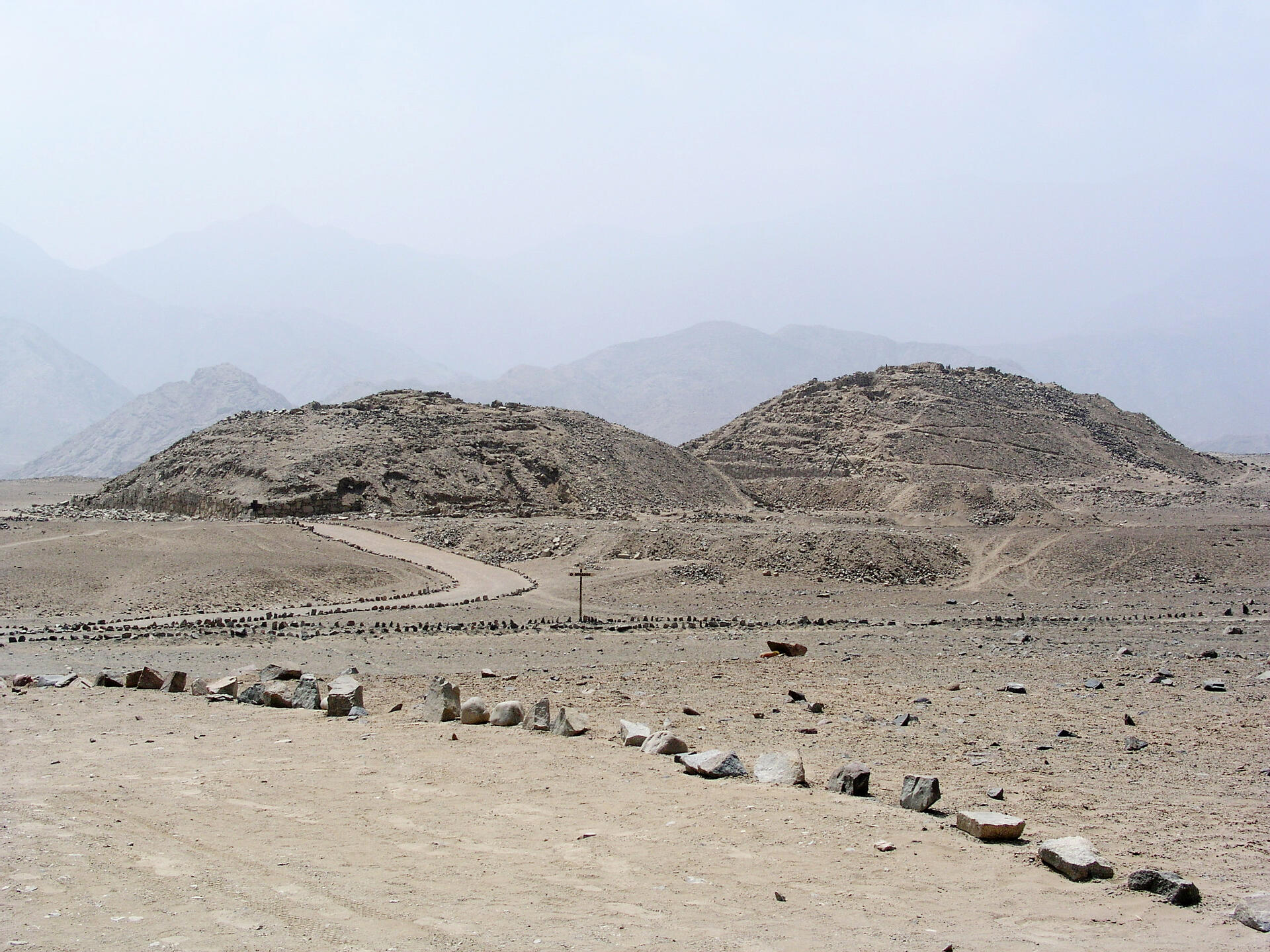
The Sacred City of Caral-Supe, nestled within the arid landscape of the Supe Valley in Peru, stands as a testament to the ingenuity and cultural sophistication of ancient civilizations. This 5,000-year-old metropolis, recognized as the oldest center of civilization in the Americas, was inscribed as a UNESCO World Heritage Site in 2009.
More to come…UNESCO Description of the World Heritage Site
The 5000-year-old 626-hectare archaeological site of The Sacred City of Caral-Supe is situated on a dry desert terrace overlooking the green valley of the Supe river. It dates back to the Late Archaic Period of the Central Andes and is the oldest centre of civilization in the Americas. Exceptionally well-preserved, the site is impressive in terms of its design and the complexity of its architectural, especially its monumental stone and earthen platform mounts and sunken circular courts. One of 18 urban settlements situated in the same area, Caral features complex and monumental architecture, including six large pyramidal structures. A quipu (the knot system used in Andean civilizations to record information) found on the site testifies to the development and complexity of Caral society. The city’s plan and some of its components, including pyramidal structures and residence of the elite, show clear evidence of ceremonial functions, signifying a powerful religious ideology.
UNESCO Justification of the World Heritage Site
Criterion (ii): Caral is the best representation of Late Archaic architecture and town planning in ancient Peruvian civilisation. The platform mounds, sunken circular courts, and urban plan, which developed over centuries, influenced nearby settlements and subsequently a large part of the Peruvian coast.
Criterion (iii): Within the Supe Valley, the earliest known manifestation of civilisation in the Americas, Caral is the most highly-developed and complex example of settlement within the civilisation’s formative period (the Late Archaic period).
Criterion (iv): Caral is impressive in terms of the design and complexity of its architectural and spatial elements, especially its monumental earthen platform mounds and sunken circular courts, features that were to dominate a large part of the Peruvian coast for many centuries.
Encyclopedia Record: Caral
The Sacred City of Caral-Supe, or simply Caral, is an archaeological site in Peru where the remains of the main city of the Caral civilization are found. It is located in the Supe valley of Peru, near the current town of Caral, 182 kilometres (113 mi) north of Lima, 23 kilometres (14 mi) from the coast and 350 metres above sea level. It is attributed an antiquity of 5,000 years and it is considered the oldest city in the Americas and one of the oldest in the world. No other site has been found with such a diversity of monumental buildings or different ceremonial and administrative functions in the Americas as early as Caral. It has been declared a Humanity Cultural Heritage site by UNESCO.Additional Site Details
Area: 626.36 hectares
Number of Components: 1
(iii) — Unique or exceptional testimony to a cultural tradition
(iv) — Outstanding example of a type of building or landscape
Coordinates: -10.8916666667 , -77.5213888889
World Heritage Research
Discover scientific research and academic studies that deepen our understanding of Sacred City of Caral-Supe from its history and significance to its conservation, management, and contemporary challenges.
-
Basic forms and types of social communications seven Andean cultures of Peru (the period from 35–40 million years BC to 700 AD)
A groundbreaking study reveals the convergence of spiritual-energetic and material-technological components across seven ancient Andean cultures spanning from 35–40 million years BC to 700 AD, including Paleolithic, lithic, Chavin, Karal, Nazca, and Vicus. This finding challenges traditional narratives by demonstrating a consistent pattern of social communication that persisted through millennia in Peru's history. The research utilized innovative methods such as quantum chronos analysis, social engineering modeling, and the theory of cumulative culture to decode and classify forms and types of social communication from archaeological artifacts. By applying a holistic approach, the study not only identified specific features unique to each culture but also established a model for future analyses of ancient communication systems.
Kholod, O. (2024). Basic forms and types of social communications seven Andean cultures of Peru (the period from 35–40 million years BC to 700 AD). Social Communications: Theory and Practice, 16(2), 10–59. https://doi.org/10.51423/2524-0471-2024-16-2-1
View Publication Record | Read Publication -
CFD Investigations of Water Supply and Distribution Systems of Ancient Old and New World Archaeological Sites to Recover Ancient Water Engineering Technologies
Advanced computational fluid dynamics (CFD) analysis has uncovered previously unknown depths of ancient water engineering knowledge at UNESCO World Heritage Sites, including the Sacred City of Caral-Supe. This groundbreaking approach, using FLOW-3D CFD software, reveals sophisticated hydraulic designs and operational techniques employed by ancient engineers—details that were not recognized in traditional archaeological studies. The research demonstrates that equivalent ancient technologies existed alongside modern methods, though their formats, texts, and origins remain to be discovered. By applying paleohydrology—a fusion of modern hydraulic engineering and computational analysis—to nine archaeological sites (several of which are World Heritage Sites), the study provides new revelations about ancient water systems, adding a critical dimension to our understanding of historical urban and agricultural water infrastructure.
Ortloff, C. R. (2023). CFD Investigations of Water Supply and Distribution Systems of Ancient Old and New World Archaeological Sites to Recover Ancient Water Engineering Technologies. Water, 15(7), 1363. https://doi.org/10.3390/w15071363
View Publication Record | Read Publication -
Analysis of starch grains trapped in human dental calculus in Áspero, Peru during the Initial Formative Period (3000–1800 BCE)
A groundbreaking analysis of starch grains trapped in human dental calculus from Áspero, Peru, during the Initial Formative Period (3000–1800 BCE), reveals that sweet potato, squash, and maize were prominent dietary components, with 100% ubiquity for sweet potato and maize, and 90% for squash. This challenges previous isotopic analysis suggesting maize was a marginal food, highlighting the complexity of inferring plant consumption frequency from starch grain abundance. The study, which also includes data from an individual in the Sacred City of Caral, underscores the importance of multi-proxy approaches to understanding ancient diets.
Yseki, M., Pezo-Lanfranco, L., Machacuay, M., Novoa, P., & Shady, R. (2023). Analysis of starch grains trapped in human dental calculus in Áspero, Peru during the Initial Formative Period (3000–1800 BCE). Scientific Reports, 13(1). https://doi.org/10.1038/s41598-023-41015-6
View Publication Record | Read Publication -
Aproximaciones al Horizonte Tardío en los valles de Supe y Huaura: Caral, Chimú Cápac y Acaray
A preliminary characterization of the Late Horizon in the Supe and Huaura valleys reveals significant cultural continuities and transformations among three iconic sites: Caral, Chimú Cápac, and Acaray. The study identifies distinct material culture elements, including architecture, funerary practices, ceramic styles, and occupation sequences associated with Inca, Chimú, and Chancay cultures. Using observational methodologies, field archaeology techniques, and cabinet analyses, researchers propose a nuanced sequence of cultural development in the region, shedding light on the complex interplay between these civilizations during the Late Horizon period.
Cornejo Guerrero, M. A., Bisetti Quito, C. D. A., Huarcaya Veliz, J. J., & Robles Abanto, C. E. (2023). Aproximaciones al Horizonte Tardío en los valles de Supe y Huaura: Caral, Chimú Cápac y Acaray. Arqueología Y Sociedad, (38), 155–181. https://doi.org/10.15381/arqueolsoc.2023n38.e24899
View Publication Record | Read Publication -
Analysis of microbiome diversity in coprolites from Caral, Peru
A groundbreaking analysis of ancient coprolites from the Sacred City of Caral, Peru—the oldest civilization in the Americas—reveals the microbial diversity of its inhabitants dating back 3000 to 1800 years BC. The study identified Firmicutes as the dominant bacterial phylum and Ascomycota and Basidiomycota among fungi, with Bacillus and Aspergillus emerging as the most abundant genera in all samples. To minimize contamination, DNA extraction was performed using a mobile ancient laboratory near the collection site, enabling rapid molecular processing. This innovative approach provides the first comprehensive microbiome profile of Caral, offering insights into the dietary habits and environmental interactions of its people.
Jaramillo-Valverde, L. (2022). Analysis of microbiome diversity in coprolites from Caral, Peru. Bioinformation, 18(12), 1159–1165. https://doi.org/10.6026/973206300181159
View Publication Record | Read Publication -
The River and the Sky: Astronomy and Topography in Caral Society, America's First Urban Centers
Research at the UNESCO World Heritage Site of Caral-Supe reveals that America's earliest urban centers were strategically oriented not only by the Supe River but also by significant astronomical events, particularly the southernmost moonrise and the June solstice sunrise. These orientations likely aligned with seasonal rains, river flooding, and agricultural cycles, suggesting a sophisticated understanding of celestial phenomena to inform societal practices. The study combines topographical analysis with astronomical modeling to demonstrate an unprecedented integration of landscape and skyscape in pre-Columbian cultures, marking one of the first instances of such interaction in the Americas.
González-García, A. C., Crispín, A., Solís, R. S., Ricra, J., Criado-Boado, F., & Belmonte, J. A. (2021). The River and the Sky: Astronomy and Topography in Caral Society, America’s First Urban Centers. Latin American Antiquity, 32(1), 154–172. https://doi.org/10.1017/laq.2020.88
View Publication Record | Read Publication -
A New Model to Explain the Alignment of Certain Ancient Sites
A new model proposes that the alignment of certain ancient sites, including pyramids and temples worldwide, can be explained by shifts in Earth's geographic poles. The study found that over 80% of previously unexplained sites—such as Mesoamerican structures, megalithic buildings in Peru’s Sacred Valley, and Egyptian pyramids—reference four locations near the North Pole, consistent with Charles Hapgood’s hypothesis of crustal displacement. These alignments would have been precise if built relative to former poles but appear misaligned today due to subsequent pole shifts.
Carlotto, M. (2020). A New Model to Explain the Alignment of Certain Ancient Sites. Journal of Scientific Exploration, 34(2), 209–232. https://doi.org/10.31275/20201619
View Publication Record | Read Publication