World Heritage Identification Number: 163
World Heritage since: 1981
Category: Cultural Heritage
WHE Type: Archaeological Sites
Transboundary Heritage: No
Endangered Heritage: No
Country: 🇫🇷 France
Continent: Europe
UNESCO World Region: Europe and North America
Map
Roman Theatre and Triumphal Arch of Orange: Architectural Marvels in Southern France
The Roman Theatre and its Surroundings, along with the "Triumphal Arch" of Orange, are two remarkable architectural relics that stand as testaments to the grandeur and cultural influence of the Roman Empire. Located in the picturesque Rhone Valley, these structures have been designated as a UNESCO World Heritage Site since 1981.
More to come…UNESCO Description of the World Heritage Site
Situated in the Rhone valley, the ancient theatre of Orange, with its 103-m-long facade, is one of the best preserved of all the great Roman theatres. Built between A.D. 10 and 25, the Roman arch is one of the most beautiful and interesting surviving examples of a provincial triumphal arch from the reign of Augustus. It is decorated with low reliefs commemorating the establishment of the Pax Romana.
UNESCO Justification of the World Heritage Site
Criterion (iii): From the Augustan Age, the ancient Theatre of Orange is an exceptional example in the typology of Roman theatres.
Criterion (vi): The events referred to in the low reliefs carved on the north face of the Triumphal Arch of Orange (war against the Barbarians and establishment of the Pax Romana) are of universal significance.
Encyclopedia Record: Roman Theatre of Orange
The Roman Theatre of Orange is a Roman theatre in Orange, Vaucluse, France. It was built early in the 1st century AD. The structure is owned by the municipality of Orange and is the home of the summer opera festival, the Chorégies d'Orange.Additional Site Details
Area: 9.45 hectares
Number of Components: 2
(vi) — Directly associated with events or living traditions
Coordinates: 44.13572222 , 4.808416667
Image
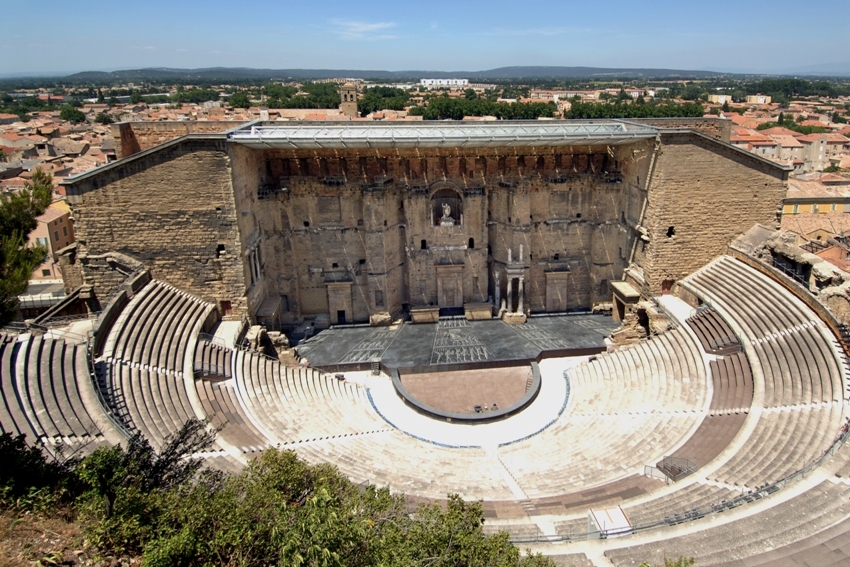
© Gromelle Grand Angle, CC BY-SA 3.0 Resized from original. (This derivative is under the same CC BY-SA license.)
World Heritage Research
Discover scientific research and academic studies that deepen our understanding of Roman Theatre and its Surroundings and the "Triumphal Arch" of Orange from its history and significance to its conservation, management, and contemporary challenges.
-
Orange’s Antique Theatre: Ongoing Research on Medieval and Modern Woods
Ongoing research at the UNESCO-listed Roman Theatre of Orange reveals that 511 wooden elements, previously hidden within stone blocks, were integral to the structure and its medieval and modern adaptations. Radiocarbon dating of these woods has uncovered undocumented phases of development in the 13th, 15th, and 16th centuries, shedding light on periods poorly recorded in historical texts. The study employed a collaborative protocol integrating restoration work with archaeological analysis, while dendrochronological methods yielded no dates, suggesting complex timber sourcing from diverse environments. Future research will leverage Historic Building Information Modelling to further explore the theatre's adaptive reuse and preservation.
Shindo, L., Borel-Dubourg, S., Cenzon-Salvayre, C., & Badie, A. (2025). Orange’s Antique Theatre: Ongoing Research on Medieval and Modern Woods. International Journal of Wood Culture, 5(1-3), 63–80. https://doi.org/10.1163/27723194-bja10046
View Publication Record | Read Publication -
Folk Art, Faith, and Nationalism: Popular Theatre in the Provinces
A new perspective on the resilience of French provincial theatre during the Third Republic reveals its flourishing role against state-led initiatives. Popular theatre, rooted in local folklore, Catholic mystery plays, and patriotic neo-Classicism, thrived in regions like Brittany, Orange, the Vosges, and Poitou. The study highlights tensions between regionalism and nationalism, showing how some playwrights preferred Parisian life while others relied on its support. Key figures include Anatole Le Braz, Joseph Le Bayon, Maurice Pottecher, and Pierre Corneille Saint-Marc, whose works were staged at significant sites like the Roman amphitheatre of Orange.
Wardhaugh, J. (2017). Folk Art, Faith, and Nationalism: Popular Theatre in the Provinces. Popular Theatre and Political Utopia in France, 1870—1940, 71–152. https://doi.org/10.1057/978-1-137-59855-4_3
View Publication Record | Read Publication -
Art, Architecture and Engineering
Roman architecture and art were not static but dynamically adapted to local conditions, cultures, and climates across the vast Roman Empire. Unlike the common perception of Roman architectural continuity, this study reveals how structures like colonnaded streets in Near Eastern cities or rainwater cisterns in North Africa reflected practical adaptations rather than rigid traditions. Even freestanding theatres often utilized natural terrain, such as hills or excavated ground, showcasing a flexible approach to design. This adaptability was crucial in the acceptance and transmission of Roman architecture globally, demonstrating its resilience and versatility in diverse environments.
(Ed.). (2014). Art, Architecture and Engineering. The Romans, 209–228. https://doi.org/10.4324/9781315739922-18
View Publication Record | Read Publication