World Heritage Identification Number: 714
World Heritage since: 1993
Category: Cultural Heritage
WHE Type: Archaeological Sites
Transboundary Heritage: No
Endangered Heritage: No
Country: 🇲🇽 Mexico
Continent: Americas
UNESCO World Region: Latin America and the Caribbean
Map
Unveiling the Mysteries of the Rock Paintings of Sierra de San Francisco
The Rock Paintings of Sierra de San Francisco, located within the El Vizcaíno Biosphere Reserve in Baja California Sur, Mexico, stand as a testament to the rich cultural heritage of a vanished civilization. Inscribed as a UNESCO World Heritage Site in 1993, these remarkable rock artworks offer insights into the lives, beliefs, and artistic traditions of the ancient inhabitants who once called this remote region home.
More to come…UNESCO Description of the World Heritage Site
From c. 100 B.C. to A.D. 1300, the Sierra de San Francisco (in the El Vizcaino reserve, in Baja California) was home to a people who have now disappeared but who left one of the most outstanding collections of rock paintings in the world. They are remarkably well-preserved because of the dry climate and the inaccessibility of the site. Showing human figures and many animal species and illustrating the relationship between humans and their environment, the paintings reveal a highly sophisticated culture. Their composition and size, as well as the precision of the outlines and the variety of colours, but especially the number of sites, make this an impressive testimony to a unique artistic tradition.
UNESCO Justification of the World Heritage Site
Criterion (i): The rock art of the Sierra de San Francisco region of Baja California is one of the most outstanding concentrations of prehistoric art in the world and a dramatic example of the highest manifestations of this human cultural expression.
Criterion (iii): The Sierra de San Francisco complex is illustrative of a strong human cultural group that existed in the harsh climatic region of the Baja California peninsula, but which disappeared rapidly after contact with European settlers for a variety of causes.
Encyclopedia Record: Rock Paintings of Sierra de San Francisco
The Rock Paintings of Sierra de San Francisco are prehistoric rock art pictographs found in the Sierra de San Francisco mountain range in Mulegé Municipality of the northern region of Baja California Sur state, in Mexico.Additional Site Details
Area: 182,600 hectares
Number of Components: 1
(iii) — Unique or exceptional testimony to a cultural tradition
Coordinates: 27.626963 , -113.020427
Image
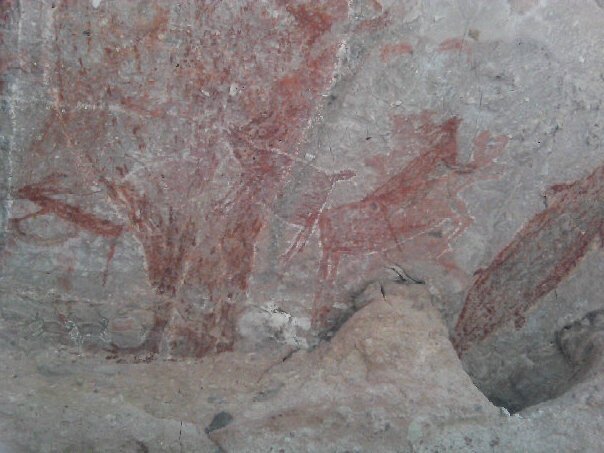
© Netzai, CC BY-SA 3.0 Resized from original. (This derivative is under the same CC BY-SA license.)
World Heritage Research
Discover scientific research and academic studies that deepen our understanding of Rock Paintings of the Sierra de San Francisco from its history and significance to its conservation, management, and contemporary challenges.
-
Digital Analysis of Rock Art in Santa Olaya Canyon: Integrating Cultural Landscape and UAV Technologies for Conservation
A high-precision digital documentation of open-air rock art in Santa Olaya Canyon, Tamaulipas, Mexico, reveals the cultural and symbolic significance of these sites within their natural landscape. Using UAV (drone) technology and 3D photoreconstruction techniques, researchers captured detailed orthomosaics and point clouds of a vertical rock face, providing a non-invasive method for conservation and analysis. This approach addresses gaps in institutional protection and highlights the vulnerability of rock art collections in the Sierra de San Carlos region, where theft and vandalism pose risks. The study underscores the potential of digital tools to preserve archaeological heritage in remote, inaccessible areas, creating a lasting digital legacy for future research.
Yépez-Rincón, F. D., Requena Lara, G. N., Aguilar Treviño, C. C., Treviño-Carreón, J., Calvillo-Villacaña, Ma. E., Cerda-Luque, P. A., & Morales-Pacheco, J. F. (2026). Digital Analysis of Rock Art in Santa Olaya Canyon: Integrating Cultural Landscape and UAV Technologies for Conservation. The International Archives of the Photogrammetry, Remote Sensing and Spatial Information Sciences, XLIX-B2-2026, 917–922. https://doi.org/10.5194/isprs-archives-xlix-b2-2026-917-2026
View Publication Record | Read Publication -
Las figuras de artrópodos en el arte rupestre de Coahuila, México
Arthropods, though less represented in the rock art of Coahuila, Mexico, offer valuable insights into the environmental and ecological contexts of ancient hunter-gatherer societies. This preliminary study identifies and analyzes arthropod figures within the Sierra de San Francisco rock paintings, suggesting their potential role in reflecting habitat conditions and human interactions with these organisms. By integrating ethnological and historical sources, researchers aim to unravel the functional significance of these rare depictions, contributing to a broader understanding of prehistoric cultural practices and ecological relationships.
Casado López, M. d. P., & Flores Ventura, J. (2025). Las figuras de artrópodos en el arte rupestre de Coahuila, México. Revista Cuadernos de Arte Prehistorico, (19), 66–107. https://doi.org/10.58210/rcdap180
View Publication Record | Read Publication -
Impact of Microbiological Activity and Moisture on the Surface pH of Rock Art Sites: Cueva del Ratón, Baja California Sur, Mexico and Other Sites
Research at Cueva del Ratón, a UNESCO World Heritage Site in Mexico's Sierra de San Francisco, reveals that nitrate and sulfate concentrations significantly influence the surface pH of rock art, driven by moisture diffusion and microbiological activity. Atypical weather events, including rain and mist—uncommon in this arid region—triggered the formation of silica skins on some surfaces, a rare phenomenon in such environments. The study found that water availability, particularly through drip lines, enhances microbial metabolism (yeasts, molds, bacteria), leading to surface acidification that interacts with both the host rock and pigments. This process is exacerbated by climate change-induced weather shifts, such as increased hurricanes in Baja California. A novel, budget-friendly method using disposable test strips was employed to assess anion impacts on decay mechanisms, providing semi-quantitative insights into preservation challenges.
MacLeod, I. D., & Magar, V. (2025). Impact of Microbiological Activity and Moisture on the Surface pH of Rock Art Sites: Cueva del Ratón, Baja California Sur, Mexico and Other Sites. Heritage, 8(9), 371. https://doi.org/10.3390/heritage8090371
View Publication Record | Read Publication -
Documentación, microfotografía y caracterización multianalítica de pigmentos de la Cueva de los Machines, Oaxaca, México
A comprehensive analysis of pigment composition in the Cueva de los Machines, part of Oaxaca's UNESCO-listed Rock Paintings of the Sierra de San Francisco, reveals a rich palette of mineral-based materials used by prehistoric artists. The study employed advanced techniques such as microphotography, photogrammetry, Raman spectroscopy, and X-ray fluorescence to characterize pigments, providing unprecedented insights into the technical sophistication of ancient rock art production. Findings indicate the use of diverse mineral sources, including iron oxides, suggesting complex trade or resource procurement strategies during the region's early human occupation, spanning from the Pleistocene-Holocene transition to the Postclassic period.
Viramontes Anzures, J. C., Jiménez Mu, C. J., Medina Villalobos, J. E., Argote Espino, D., & Mondragón, A. (2025). Documentación, microfotografía y caracterización multianalítica de pigmentos de la Cueva de los Machines, Oaxaca, México. Península, 97–138. https://doi.org/10.22201/cephcis.25942743e.2026.91036
View Publication Record | Read Publication -
What Were Rock Art Sites Like in the Past? Reconstructing the Shapes of Sites as Cultural Settings
Rock art research often overlooks the significance of the site's spatial context, yet understanding the past landscape configuration is crucial to interpreting cultural meanings. This study demonstrates that reconstructing four dimensions—past landforms, palaeo-entrances, palaeo-landmarks and pathways, and rock surfaces—provides new insights into the physical structure and cultural significance of rock art sites. By focusing on these aspects, archaeologists can better grasp how past landscapes shaped human engagement with art, enhancing our comprehension of its role in ancient cultures.
Delannoy, J.-J., David, B., & Genuite, K. (2024). What Were Rock Art Sites Like in the Past? Reconstructing the Shapes of Sites as Cultural Settings. Deep-Time Images in the Age of Globalization, 147–163. https://doi.org/10.1007/978-3-031-54638-9_10
View Publication Record | Read Publication -
Ancient Rock Paintings at Region del Cabo-BCS, Mexico: An Analytical Study
A groundbreaking analysis of ancient rock paintings in the Sierra de San Francisco, Mexico, reveals that iron and calcium compounds form the primary constituents of the pictorial layers. Fourier-transform infrared spectroscopy further suggests the use of a flora-based composite as the binding agent. Researchers employed scanning electron microscopy-energy dispersive X-ray spectroscopy to analyze samples from six panels and one solitary figure across four archaeological sites in the Sierra de las Cacachilas, identifying intrusive igneous rocks in the supports. These findings are crucial for the conservation efforts of this UNESCO World Heritage Site, providing insights into the materials and techniques used by ancient artists.
Méndez-Mejía, Ú., Tenorio, M. D., Jiménez-Reyes, M., & Rodríguez-Tomp, R. (2023). Ancient Rock Paintings at Region del Cabo-BCS, Mexico: An Analytical Study. Brazilian Journal of Analytical Chemistry. https://doi.org/10.30744/brjac.2179-3425.ar-16-2023
View Publication Record | Read Publication -
El tiempo en el arte rupestre. De los grupos cazadores recolectores a etnias vigentes de México
Rock art in Mexico's Sierra de San Francisco reveals a dynamic interplay between time and space, offering insights into the enduring transmission of memory from ancient hunter-gatherer groups to contemporary indigenous communities. The study highlights five temporal dimensions—preliminary, iconographic, chronological, pervivence, and abandonment—that shape the interpretation of this art form. By analyzing these layers, researchers uncover how rock paintings serve as a medium for cultural continuity, bridging millennia and connecting past practices with present-day ethnic identities.
Casado, M. P. (2022). El tiempo en el arte rupestre. De los grupos cazadores recolectores a etnias vigentes de México. Salduie, (22), 7–19. https://doi.org/10.26754/ojs_salduie/sald.2022227313
View Publication Record | Read Publication