
World Heritage Identification Number: 1760
World Heritage since: 2026
Category: Cultural Heritage
WHE Type: Religious Sites & Sacred Architecture
Transboundary Heritage: No
Endangered Heritage: No
Country: 🇰🇿 Kazakhstan
Continent: Asia
UNESCO World Region: Asia and the Pacific
Map
Rock Mosques and Associated Sacred Sites of Mangystau: A Spiritual Journey through Time
The Rock Mosques and Associated Sacred Sites of Mangystau, inscribed as a UNESCO World Heritage Site in 2026, offer a unique blend of Islamic Sufi spirituality and ancient practices rooted in the nomadic culture of the Mangystau and Ustyurt plateaus. Located on the Mangystau Peninsula, these sacred sites border the Caspian Sea and span over five centuries, from the 12th to the 18th century.
More to come…UNESCO Description of the World Heritage Site
The serial property, located on the Mangystau Peninsula bordering the Caspian Sea, consists of five sacred sites carved into the rock along with adjacent extensive burial grounds. Beket-Ata, Shopan-Ata, Karaman-Ata, Shakpak-Ata and Sultan-Epe, each associated with a Sufi master, date from the 12th to the 18th centuries. The complexes, known locally as “underground mosques”, are a particular type of structure created in natural caves, carved into steep rocks or dug into the ground in the semi-desert landscape. Originating in the nomadic environment of the Mangystau and Ustyurt plateaus, the component parts represent a culture that is the result of the evolution of sacred practices in which Islamic Sufi spirituality organically continued and transformed more ancient practices related to ancestor worship, the sacredness of the landscape and the role of spiritual leaders. They have been important pilgrimage destinations throughout the centuries. The rock-carved sacred sites range from smaller structures to more complex spaces. They have different architectural layouts and organisation, including prayer halls, mihrabs, rooms for contemplation and self-reflection, multifunctional spaces and tombs of saints. The complexes comprise courtyards, water sources, sacred trees, paths and cemeteries, the latter dating from the 10th to the 20th centuries.Encyclopedia Record: Mangyshlak Peninsula
Mangyshlak or Mangghyshlaq Peninsula is a large peninsula located in western Kazakhstan. It borders on the Caspian Sea in the west and with the Buzachi Peninsula, a marshy sub-feature of the main peninsula, in the northeast. The Tyuleniy Archipelago lies off the northern shores of the peninsula.Additional Site Details
Area: 91.88 hectares
Number of Components: 5
(iii) — Unique or exceptional testimony to a cultural tradition
(vi) — Directly associated with events or living traditions
Coordinates: 43.8997777777 , 51.8749444445
Image
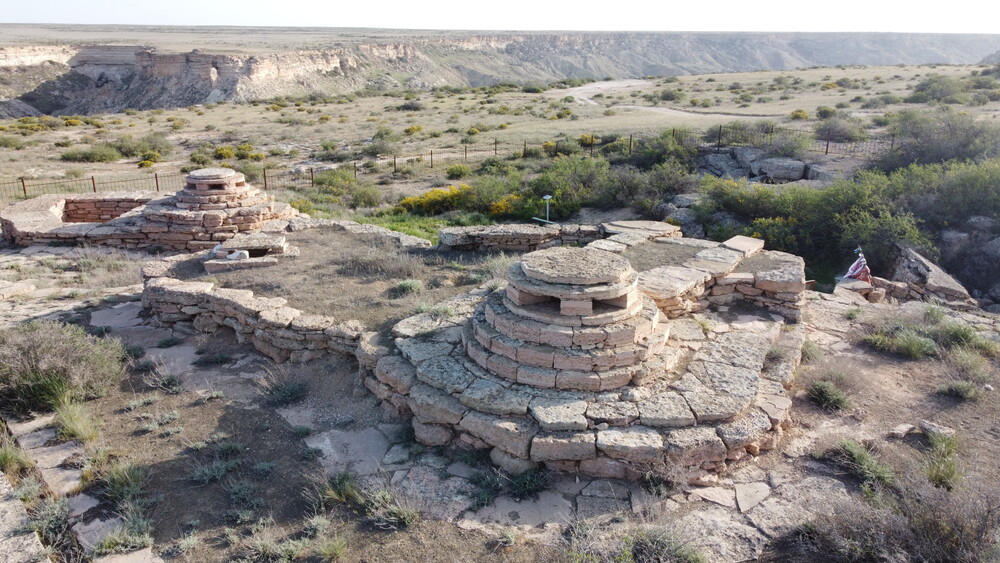
© RSE Kazrestavratsiya MKI RK. Used with permission.
World Heritage Research
Discover scientific research and academic studies that deepen our understanding of Rock Mosques and Associated Sacred Sites of Mangystau from its history and significance to its conservation, management, and contemporary challenges.
-
Field Studies of Karst Origin Tourist Sites in Mangystau Region
Research in the Mangystau region reveals significant subsurface features beneath key karst tourist sites, including suspected cavities at depths of 10-40 meters under Baskaragan and Otebay caves, and zones of anomalous electrical resistance linked to rock decompression on slopes in Tamshyly and Saura valleys. The study employed advanced geodetic measurements, remote sensing via UAV, terrestrial laser scanning, and geophysical methods—electrical resistivity tomography and ground-penetrating radar—to generate high-resolution spatial data, including orthophotomaps, digital elevation models, textured 3D models, and geophysical sections. These findings advance the methodology for studying karst processes in arid environments and provide critical insights for sustainable geotourism management.
Bektursynova, А. А., Temirbayeva, R. K., Khen, A. P., Azhirov, N. А., & Sharapkhanova, Z. M. (2026). FIELD STUDIES OF KARST ORIGIN TOURIST SITES IN MANGYSTAU REGION. Geography and Water Resources, (2), 136–148. https://doi.org/10.55764/2957-9856/2026-2-136-148.26
View Publication Record | Read Publication -
Underground Mosques of Mangistau: Continuity of Sufi Path of Islam
Underground mosques in Mangystau, Kazakhstan, represent a unique blend of Sufi spiritual practice and architectural innovation, serving as vital religious and cultural hubs. These structures, often associated with dervish lodges (khanakas), integrate Islamic principles with local folklore, reflecting the region's rich heritage. Unlike traditional aboveground mosques, these subterranean spaces were built for practical reasons—such as protection or secrecy—and continue to function similarly today. The study highlights their historical and spiritual significance, drawing parallels with similar sites in Spain, Turkey, Jordan, and Crimea. By analyzing medieval underground mosques and modern khanakas, the research underscores Mangystau's role as a cultural landscape preserving Sufi traditions through architecture.
Söylemez, O., Nurdauletova, B., & Ateş, Ö. F. (2024). UNDERGROUND MOSQUES OF MANGISTAU: CONTINUITY OF SUFI PATH OF ISLAM. Türk Kültürü Ve Hacı Bektaş Veli Araştırma Dergisi, (111), 285–302. https://doi.org/10.60163/tkhcbva.1495868
View Publication Record | Read Publication -
Local Communities’ Participation in Sustainable Tourism Development: Mangystau Region Case Study
Active engagement by local communities in Kazakhstan's Mangystau region significantly enhances the authenticity of tourism experiences, supports cultural heritage preservation, and ensures equitable economic benefits. A SWOT analysis revealed that while community participation offers substantial advantages, it also faces challenges such as inadequate infrastructure, limited marketing capabilities, and a shortage of tourism-related skills among residents. Strategic planning, capacity building, and collaboration among government agencies, local communities, and private entities are crucial for advancing sustainable tourism in the region. This approach balances economic growth with environmental and cultural conservation, positioning Mangystau as a leading destination for sustainable and cultural tourism in Central Asia.
Pazylkhaiyr, B. M. (2024). LOCAL COMMUNITIES’ PARTICIPATION IN SUSTAINABLE TOURISM DEVELOPMENT: MANGYSTAU REGION CASE STUDY. КазУТБ, 3(24). https://doi.org/10.58805/kazutb.v.3.24-526
View Publication Record | Read Publication -
The Sacred Space of Mangystau: the Content of Unusual Epitaphs
Research on epitaphs from the Rock Mosques and Associated Sacred Sites of Mangystau reveals their deep connection to Sufi Islam, local poetry, and cultural worldview. By comparing newly translated inscriptions with previous studies, adjustments were made, highlighting the religious and literary significance of these texts. The study emphasizes the importance of a fundamental approach to religious principles in understanding Eastern epitaphs, particularly those linked to Islam. Semantic analysis identified key themes and predicted the purpose behind the inscriptions, offering insights into the enduring sacredness of Mangystau's space. This work proposes new scientific angles for studying elementary concepts, bridging literary studies with religious context.
Shokhayev, M. T., Nurdauletova, B. I.,. (2022). The Sacred Space of Mangystau: the Content of Unusual Epitaphs. Iasaýı Ýnıversıtetіnіń Habarshysy, 125(3), 79–94. https://doi.org/10.47526/2022-3/2664-0686.07
View Publication Record | Read Publication -
Landscape of the Mangystau Region in Kazakhstan as a Geomorphotourism Destination: A Geographical Review
The Mangystau region in Kazakhstan exhibits significant potential for geomorphotourism, offering diverse landscapes with natural, cultural, and historical values. A geographical review highlights that the region's geomorphic landforms could serve as key attractions for ecotourism and geomorphotourism, provided there is adequate management and investment. The study emphasizes the importance of preserving the natural environment and sustaining tourism resources through initiatives like the UNESCO Geoparks development program. This approach aligns with global trends in geomorphotourism, which are more advanced in industrialized nations but underdeveloped in Kazakhstan due to limited information and infrastructure.
КOSHIM, A. G., SERGEYEVA, A. M., BEXEITOVA, R. T., AKTYMBAYEVA, A. S.,. (2020). LANDSCAPE OF THE MANGYSTAU REGION IN KAZAKHSTAN AS A GEOMORPHOTOURISM DESTINATION: A GEOGRAPHICAL REVIEW. GeoJournal of Tourism and Geosites, 29(2), 385–397. https://doi.org/10.30892/gtg.29201-476
View Publication Record | Read Publication -
Underground Mosques of Mangystau as the Objects of Religious Tourism
Mangystau's underground mosques, dating back to the X-XIII centuries, emerge as pivotal sites for religious tourism development. These unique rock-carved structures, analyzed through dialectical, retrospective, systemic, and logical methods, showcase distinct historical and architectural significance. The study underscores their potential to boost Kazakhstan's tourism sector by integrating them into new tour programs, leveraging a rich resource base of religious heritage. This approach aims to enhance the region's appeal for diverse forms of religious tourism, offering both academic insights and practical strategies for sustainable development.
КOSHIM, A. G., SERGEYEVA, A. M., SAPAROV, K. T., BERDYBAEVA, S. K., ASSYLBEKOVA, A. A.,. (2020). UNDERGROUND MOSQUES OF MANGYSTAU AS THE OBJECTS OF RELIGIOUS TOURISM. GeoJournal of Tourism and Geosites, 34(1), 33–41. https://doi.org/10.30892/gtg.34105-616
View Publication Record | Read Publication
