World Heritage Identification Number: 1453
World Heritage since: 2014
Category: Cultural Heritage
WHE Type: Archaeological Sites
Transboundary Heritage: No
Endangered Heritage: No
Country: 🇨🇷 Costa Rica
Continent: Americas
UNESCO World Region: Latin America and the Caribbean
Map
Precolumbian Chiefdom Settlements with Stone Spheres of the Diquís: A Unique Archaeological Puzzle in Southern Costa Rica
The Precolumbian Chiefdom Settlements with Stone Spheres of the Diquís, inscribed as a UNESCO World Heritage Site in 2014, offer a captivating glimpse into the rich cultural history of pre-Columbian societies in southern Costa Rica. This archaeological ensemble comprises four significant sites situated within the Diquís Delta, providing valuable insights into the intricate social, economic, and political structures that thrived during the period spanning AD 500 to 1500.
More to come…UNESCO Description of the World Heritage Site
The property includes four archaeological sites located in the Diquís Delta in southern Costa Rica, which are considered unique examples of the complex social, economic and political systems of the period AD 500–1500. They contain artificial mounds, paved areas, burial sites and, most significantly, a collection of stone spheres, between 0.7 m and 2.57 m in diameter, whose meaning, use and production remain largely a mystery. The spheres are distinctive for their perfection, number, size and density, and placement in original locations. Their preservation from the looting that befell the vast majority of archaeological sites in Costa Rica has been attributed to the thick layers of sediment that kept them buried for centuries.
UNESCO Justification of the World Heritage Site
Criterion (iii): The Precolumbian Chiefdom Settlements with Stone Spheres of the Diquís illustrate the physical evidence of the complex political, social and productive structures of the Precolumbian hierarchical societies. The chiefdoms which inhabited the Diquís Delta created hierarchical settlements expressing the division of different levels of power centres, presented by the different serial components. Likewise, the exceptional stone spheres, which continue to leave researchers speculating about the method and tools of their production, represent an exceptional testimony to the artistic traditions and craft capabilities of these Precolumbian societies.
Encyclopedia Record: Stone spheres of Costa Rica
The stone spheres of Costa Rica are an assortment of over 300 petrospheres in Costa Rica, on the Diquís Delta and on Isla del Caño. Locally, they are also known as bolas de piedra. The spheres are commonly attributed to the extinct Diquís culture, and they are sometimes referred to as the Diquís spheres. They are the best-known stone sculptures of the Isthmo-Colombian area.Additional Site Details
Area: 24.73 hectares
Number of Components: 4
Coordinates: 8.938453 , -83.502539
Image
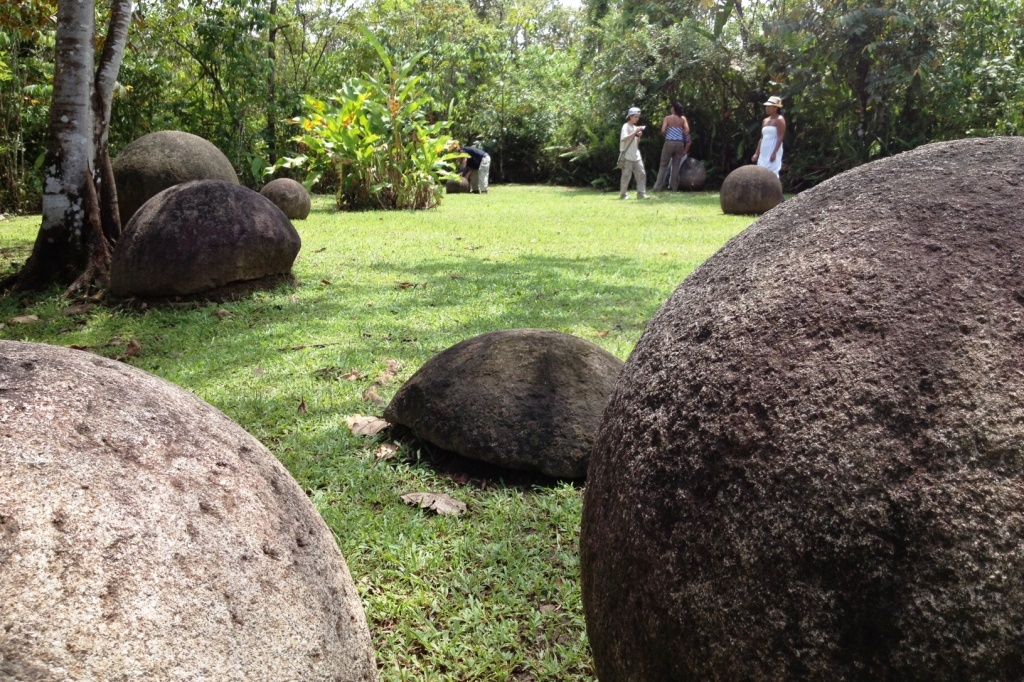
© Axxis10, CC BY-SA 3.0 Resized from original. (This derivative is under the same CC BY-SA license.)
World Heritage Research
Discover scientific research and academic studies that deepen our understanding of Precolumbian Chiefdom Settlements with Stone Spheres of the Diquís from its history and significance to its conservation, management, and contemporary challenges.
-
Arquitectura demostrativa y asamblearia en el contexto paisajístico del sitio arqueológico Guastomatal, Mansión de Nicoya, Costa Rica
Research at the Guastomatal archaeological site in Costa Rica reveals a unique residential and assembly architecture, featuring two elevated foundations and a U-shaped plaza bounded by stone walls. These structures share similarities with sites in the Central Caribbean region of Costa Rica, suggesting a common pattern of chieftain status-related administrative and religious activities. The site also exhibits landscape attributes such as formalized roads, earthen ridges likely used for palisades, and deposits from a chipped-stone workshop and midden. Preliminary dating places Guastomatal between 600-900 C.E., based on ceramic and architectural correlations. This study highlights the significance of limited monumentality sites with strong landscape symbolism in understanding pre-Columbian chiefdom settlements.
Vázquez, R. (2026). Demonstrative and assembly architecture in the landscape context of the Guastomatal archaeological site, Mansión of Nicoya, Costa Rica. Cuadernos de Antropología, 33(2), 1–21. https://doi.org/10.15517/cat.v33i2.54498
View Publication Record | Read Publication -
Patterns of Disease and Culture in Ancient Panama
A study of human skeletal remains from Cerro Juan Díaz, a pre-Columbian site in coastal Panama, reveals that age was the primary determinant of mortuary adornments during A.D. 30–650, challenging previous assumptions about regional value systems. Analysis of oral pathologies and dental wear indicates a diet rich in cariogenic foods like maize and habitual use of teeth as tools, possibly for processing manioc tubers. The research also identifies high frequencies of artificial cranial modification as an identity marker, evidence of male-dominated aquatic activities through external auditory exostoses, and a prevalent systemic infection consistent with Treponema pallidum. These findings were derived from a bioarchaeological examination of early mortuary contexts uncovered during a decade-long excavation campaign (1992–2001).
Smith-Guzmán, N., Sánchez Herrera, L., & Cooke, R. (2021). Patterns of Disease and Culture in Ancient Panama. Bioarchaeology International. https://doi.org/10.5744/bi.2021.1004
View Publication Record | Read Publication