World Heritage Identification Number: 1117
World Heritage since: 2004
Category: Cultural Heritage
WHE Type: Agriculture Landscapes, Parks & Gardens
Transboundary Heritage: No
Endangered Heritage: No
Country: 🇵🇹 Portugal
Continent: Europe
UNESCO World Region: Europe and North America
Map
The Landscape of the Pico Island Vineyard Culture: A Unique Cultural Landscape in the Azores Archipelago
The Landscape of the Pico Island Vineyard Culture, inscribed as a UNESCO World Heritage Site in 2004, offers a unique insight into the rich cultural history of the Azores archipelago, located in the North Atlantic Ocean. This remarkable human-made landscape, covering an area of approximately 987 hectares, is situated on the volcanic island of Pico, the second largest island in the archipelago.
The distinctive feature of this cultural landscape is the intricate network of basalt stone walls, known locally as "muros" which crisscross the island. These walls serve a dual purpose: they protect the thousands of small, contiguous, mostly rectangular plots, or "currais," from the harsh winds and salty sea air, while also demarcating individual vineyard parcels. These currais are often remarkably small, sometimes measuring only a few square meters, and are meticulously oriented to maximize sunlight exposure while trapping heat within the volcanic stone.
The origins of the vineyard culture on Pico Island can be traced back to the 15th century, making it one of the oldest continuous viticultural practices on the Atlantic islands. The practice reached its height during the 19th century, a period reflected in the construction of grand manor houses, or "casas senhoriais." These structures, along with traditional wine cellars known as "adegas", served as symbols of the flourishing wine trade that once supplied the tables of European monarchs and international markets.
The extraordinary value of the human-made landscape of the site lies not only in its architectural elements but also in its integration with the natural environment. The currais are interspersed with houses, early 19th-century manor houses, wine cellars, churches, and ports, all harmoniously blending into the rugged volcanic terrain. The result is a breathtaking tableau that showcases human ingenuity in shaping a hostile environment to meet agricultural needs.
One of the most striking aspects of the Landscape of the Pico Island Vineyard Culture is the continued use of traditional techniques in wine production. The grape variety Verdelho, introduced to the island in the 15th century, has historically played a central role in Pico’s wine production and continues to be cultivated today, alongside native varieties like Arinto dos Açores and Terrantez do Pico. While modern techniques are now widely employed, elements of traditional vineyard management and harvesting remain an important part of the site’s cultural identity, contributing to Pico wine’s distinctive mineral-rich, high-acidity character shaped by volcanic soils.
In summary, the Landscape of the Pico Island Vineyard Culture stands as a testament to the resilience of the Azorean people. Its unique network of basalt walls and currais offers a captivating glimpse into a sustainable, centuries-old relationship between humans and nature, preserving an exceptional cultural landscape for future generations.
UNESCO Description of the World Heritage Site
The 987-ha site on the volcanic island of Pico, the second largest in the Azores archipelago, consists of a remarkable pattern of spaced-out, long linear walls running inland from, and parallel to, the rocky shore. The walls were built to protect the thousands of small, contiguous, rectangular plots (currais) from wind and seawater. Evidence of this viniculture, whose origins date back to the 15th century, is manifest in the extraordinary assembly of the fields, in houses and early 19th-century manor houses, in wine-cellars, churches and ports. The extraordinarily beautiful man-made landscape of the site is the best remaining area of a once much more widespread practice.
UNESCO Justification of the World Heritage Site
Criterion (iii): The Pico Island landscape reflects a unique response to viniculture on a small volcanic island that has been evolving since the arrival of the first settlers in the 15th century.
Criterion (v): The extraordinarily beautiful human-made landscape of small, stone walled fields is a testimony to generations of small-scale farmers who, in a hostile environment, created a sustainable living and much-valued wine.
Encyclopedia Record: Landscape of the Pico Island Vineyard Culture
The Landscape of the Pico Island Vineyard Culture is a Unesco World Heritage Site on Pico Island, part of the archipelago of the Azores, Portugal. The landscape is known for the network of basalt stone walls and vines planted in rectangular enclosures known as currais. Wine has been produced in the area since the late 15th century, and traditional techniques continue to be used.Additional Site Details
Area: 987 hectares
Number of Components: 3
(v) — Outstanding example of traditional human settlement
Coordinates: 38.51344444 , -28.54116667
Image
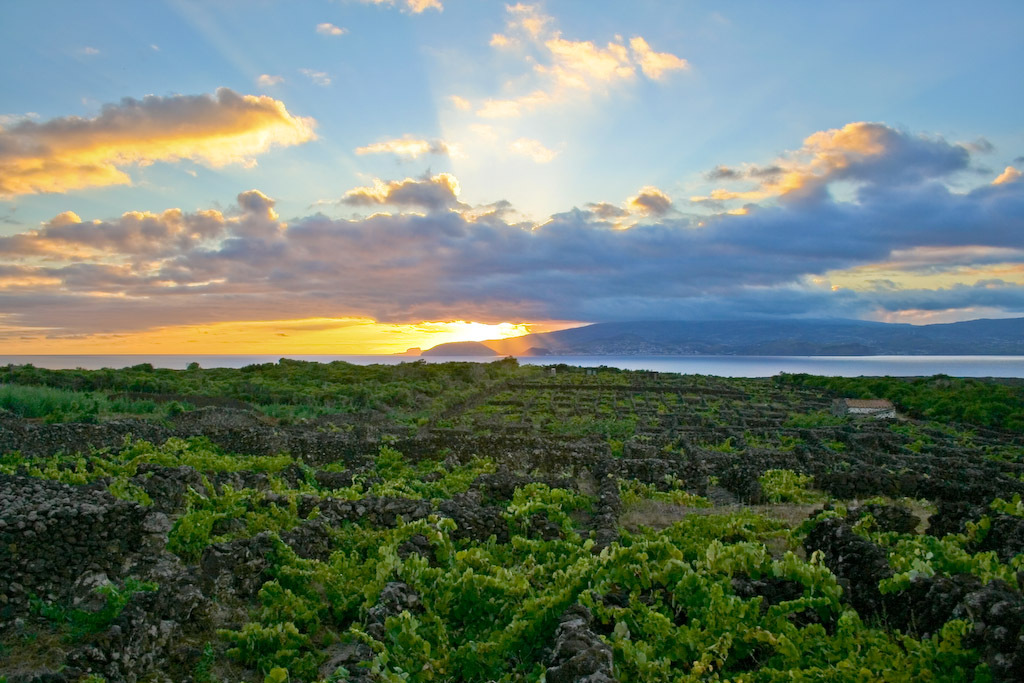
© The original uploader was Ulrich Thumult at English Wikipedia. (Original text: Ulrich Thumult), CC BY-SA 2.0 Resized from original. (This derivative is under the same CC BY-SA license.)