World Heritage Identification Number: 908
World Heritage since: 2000
Category: Natural Heritage
WHE Type: Natural Landscapes & Geographic Features
Transboundary Heritage: No
Endangered Heritage: No
Country: 🇮🇹 Italy
Continent: Europe
UNESCO World Region: Europe and North America
Map
The Aeolian Islands: A Volcanic Archipelago in the Tyrrhenian Sea
The Aeolian Islands, officially known as Isole Eolie and sometimes referred to as the Lipari Islands or Lipari group, are a captivating volcanic archipelago located in the Tyrrhenian Sea north of Sicily. Named after Aeolus, the mythical ruler of the winds, these islands have been a subject of fascination for centuries due to their unique geological features and rich history.
Comprising seven main islands, along with numerous smaller islets and submerged volcanic structures, the Aeolian Islands form part of the Aeolian volcanic arc, created by the subduction of the African Plate beneath the Eurasian Plate. The archipelago was inscribed as a UNESCO World Heritage Site in 2000, acknowledging its outstanding value for the study of volcanology.
The islands have provided scientists with valuable insights into volcanism, particularly the Strombolian and Vulcanian types of eruptions. These eruption styles are named after Stromboli and Vulcano, respectively, and are defined by distinct eruptive behaviours: Strombolian activity is generally persistent and mildly explosive, producing regular bursts of lava and gas, while Vulcanian eruptions are shorter, more violent, and highly explosive. The Aeolian Islands offer classic examples of both, contributing significantly to the understanding of volcanic processes.
Among the seven main islands, Stromboli, Vulcano, Lipari, Salina, Panarea, Filicudi, and Alicudi each exhibit distinct geological characteristics. Stromboli is home to one of the world’s most active volcanoes, which has been in near-continuous activity for at least 2,000 years. Its persistent eruptive behaviour makes it both a natural laboratory for volcanologists and a well-known destination for visitors.
A defining feature of Stromboli’s unique geology is the Sciara del Fuoco (Stream of Fire). This striking, steep horseshoe-shaped depression scars the northwestern flank of the volcano. Formed by structural collapses thousands of years ago, it acts as a natural chute, allowing incandescent lava, ash, and volcanic boulders ejected from the summit craters to tumble harmlessly down into the deep waters of the Tyrrhenian Sea, creating a spectacular nighttime display for observers from both land and sea.
Vulcano, the third largest island, is dominated by the Gran Cratere (La Fossa), whose fumarolic activity, sulfur deposits, and geothermal manifestations provide clear evidence of ongoing volcanic processes. Named by the ancient Romans after Vulcan, their mythological god of fire, it is this specific island's namesake that gave rise to the word "volcano" in the English language. The island is also known for its hot springs and mud baths, reflecting the intensity of its hydrothermal system.
Lipari, the largest island and administrative center of the archipelago, features a landscape shaped by past volcanic activity, including obsidian deposits, pumice quarries, and dramatic volcanic cliffs. Here, visitors can explore ancient Roman and Greek ruins, and charming villages while marveling at the island's volcanic features, including steam vents and solidified lava flows.
Beyond their Roman and Greek ruins, the Aeolian Islands—particularly Lipari and Filicudi—hold immense prehistoric significance. During the Neolithic era, starting around 5000 BCE, the islands became the center of a thriving Mediterranean trade network due to their vast deposits of obsidian. This volcanic glass was highly prized for making sharp tools and weapons before the advent of metallurgy.
Salina, known for its production of Malvasia wine, showcases a more tranquil side of the Aeolian Islands, with verdant vineyards and picturesque towns nestled among rolling hills. Panarea, the smallest inhabited island, is known for its whitewashed villages, clear waters, and nearby islets surrounded by underwater fumarolic activity. Filicudi and Alicudi, the westernmost islands, remain the most remote and least developed, preserving a quieter and more traditional way of life.
The geological wonders of the archipelago extend far beneath the waves. The waters surrounding the islands, particularly around Panarea, are home to complex systems of underwater hydrothermal vents and submarine fumaroles. These vents release gases and mineral-rich fluids directly into the sea, creating unique extreme environments. Scientists study these areas to understand underwater volcanic ecosystems and the rare, extremophile microorganisms that thrive there, adding a rich layer of marine biology to the islands' scientific legacy.
In addition to their scientific and geological importance, the Aeolian Islands are a popular tourist destination, attracting hundreds of thousands of visitors annually. With their striking landscapes, ongoing volcanic activity, and long history of scientific study, the Aeolian Islands continue to play a central role in the understanding of volcanic processes and Mediterranean natural heritage.
UNESCO Description of the World Heritage Site
The Aeolian Islands provide an outstanding record of volcanic island-building and destruction, and ongoing volcanic phenomena. Studied since at least the 18th century, the islands have provided the science of vulcanology with examples of two types of eruption (Vulcanian and Strombolian) and thus have featured prominently in the education of geologists for more than 200 years. The site continues to enrich the field of vulcanology.
UNESCO Justification of the World Heritage Site
Criterion (viii): The islands' volcanic landforms represent classic features in the continuing study of volcanology world-wide. With their scientific study from at least the 18th Century, the islands have provided two of the types of eruptions (Vulcanian and Strombolian) to vulcanology and geology textbooks and so have featured prominently in the education of all geoscientists for over 200 years. They continue to provide a rich field for volcanological studies of on-going geological processes in the development of landforms.
Encyclopedia Record: Aeolian Islands
The Aeolian Islands, sometimes referred to as the Lipari Islands or Lipari group after their largest island, are a volcanic archipelago in the Tyrrhenian Sea north of Sicily, said to be named after Aeolus, the mythical ruler of the winds. The islands' inhabitants are known as Aeolians. The islands had a permanent population of 14,224 at the 2011 census; the latest official estimate is 15,419 as of 1 January 2019. The Aeolian Islands are a popular tourist destination in the summer and attract up to 600,000 visitors annually.Additional Site Details
Area: 1,216 hectares
Number of Components: 1
Coordinates: 38.48786111 , 14.94558333
IUCN World Heritage Outlook
The 2025 Conservation Outlook on Isole Eolie (Aeolian Islands) reports the following assessment:
Source: International Union for Conservation of Nature (IUCN) · View assessment
Image
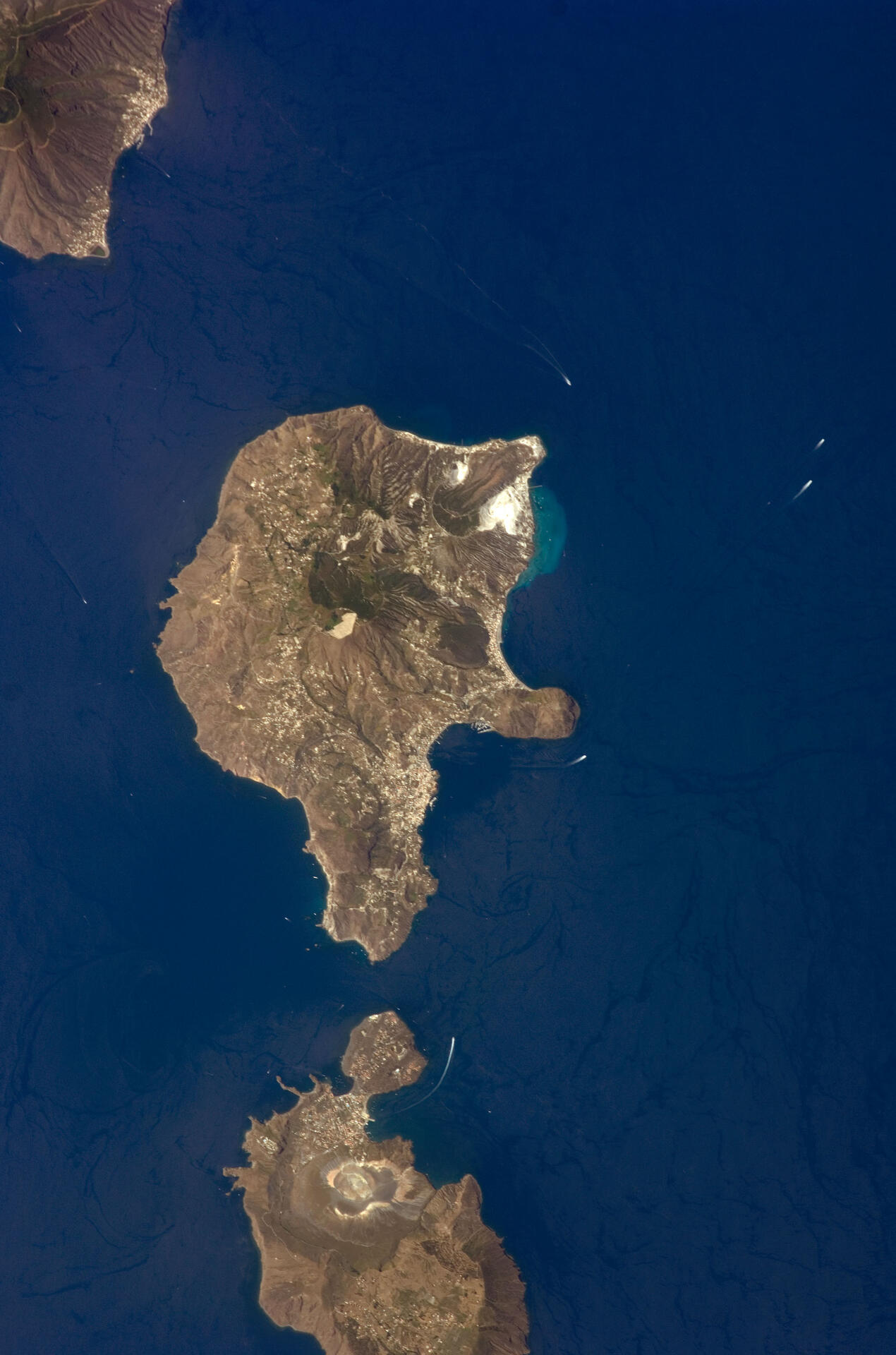
This image was taken by the NASA Expedition 17 crew., Public domain