World Heritage Identification Number: 1110
World Heritage since: 2005
Category: Cultural Heritage
WHE Type: Historic Cities & Urban Areas
Transboundary Heritage: No
Endangered Heritage: No
Country: 🇨🇳 China
Continent: Asia
UNESCO World Region: Asia and the Pacific
Map
The Historic Centre of Macao: A Unique Testimony to Cultural Fusion
The Historic Centre of Macao, inscribed as a UNESCO World Heritage Site in 2005, stands as a testament to the rich history and cultural fusion that has shaped this unique enclave. Situated on the south coast of China, Macao offers a captivating blend of Eastern and Western influences, reflected in its architecture, religion, and urban landscape.
Macao's strategic location made it a significant player in international trade since the mid-16th century. The Portuguese established a permanent settlement there in 1557, and the territory remained under Portuguese administration for more than four centuries, until 20 December 1999, when sovereignty reverted to the People’s Republic of China. During its height, Macao served as a crucial intermediary in trade between China, Japan, Southeast Asia, and Europe, attracting merchants and missionaries from around the globe.
This vibrant cultural exchange left an indelible mark on the city, which can still be seen today in its diverse architectural styles. One of the most striking features of the Historic Centre of Macao is its harmonious blend of Portuguese and Chinese structures. The streets of the old town are lined with traditional Chinese shophouses, adorned with carved woodwork and decorative tiles, standing alongside European-style churches and civic buildings.
Among the most iconic landmarks is the Ruins of St. Paul's, the surviving façade of the early 17th-century Church of Mater Dei, originally part of a Jesuit complex that included St. Paul’s College. Nearby stands the Monte Fortress, constructed between 1617 and 1626 as a defensive stronghold to protect the settlement. Together, these monuments illustrate Macao’s importance as a religious and trading center in East Asia.
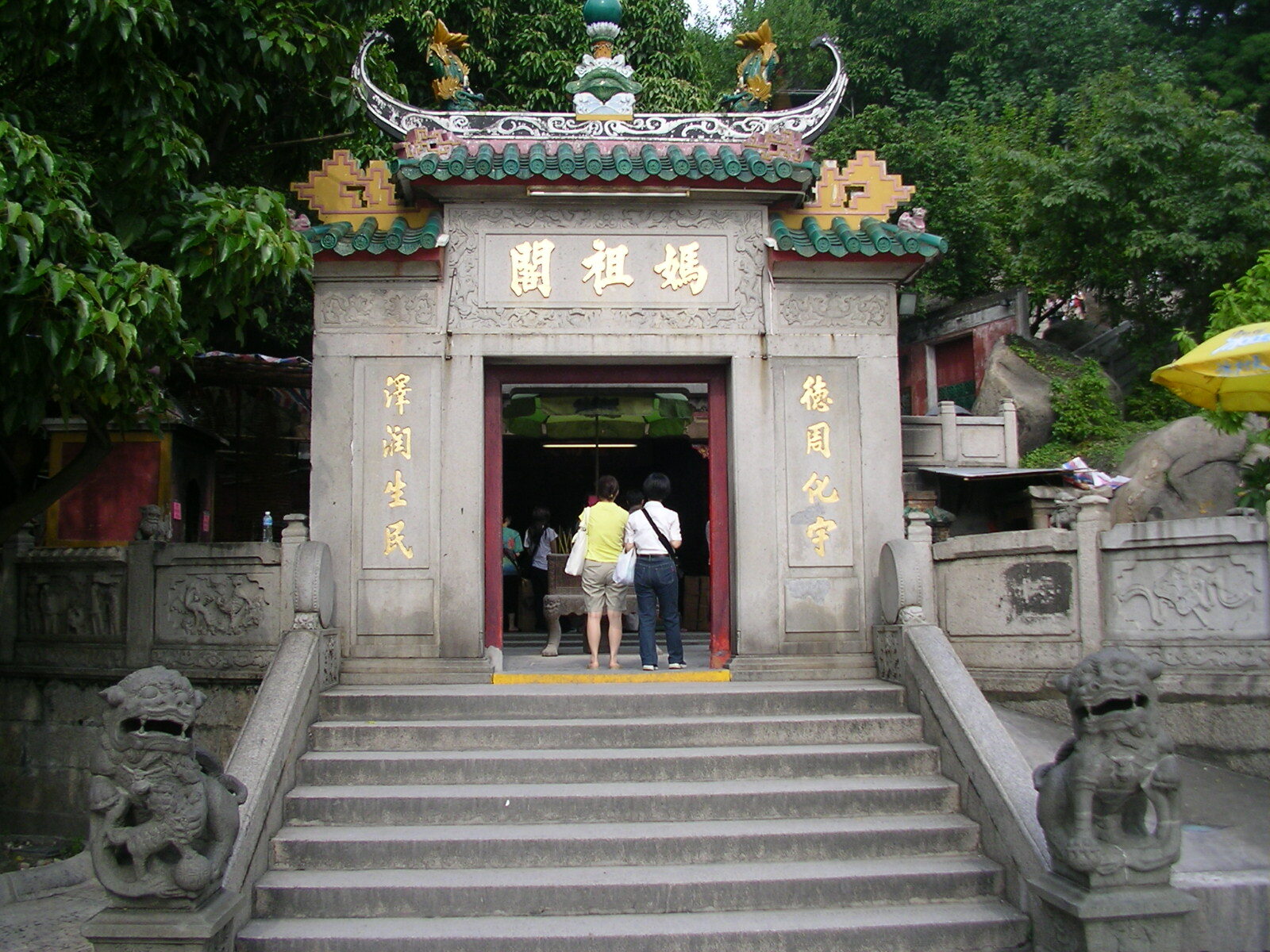
Religious buildings play a crucial role in understanding the cultural tapestry of Macao. The A-Ma Temple, built in 1488, is considered one of the oldest temples in the city and is believed to have given the settlement its name. Dedicated to the Chinese sea-goddess Mazu, the temple showcases the syncretism between Taoist, Buddhist, and Confucian beliefs. Other notable religious sites within the Historic Centre include the Church of St. Lawrence, the Cathedral of the Nativity of Our Lady (Sé Cathedral), and the Sam Kai Vui Kun (Kuan Tai Temple).
In addition to its architectural and religious treasures, the Historic Centre of Macao includes several significant defensive and maritime landmarks. The Monte Fortress today houses the Macao Museum, where artifacts and exhibitions trace the city’s multicultural history. Another important site is the Guia Lighthouse, built between 1864 and 1865. Recognized as the oldest modern lighthouse on the China coast, it played a vital role in guiding ships through the waters surrounding Macao and stands as a symbol of the city’s maritime heritage and its significance as a hub for international trade.
In summary, the Historic Centre of Macao offers a unique and compelling glimpse into the long history of cultural exchange between China and the West. By preserving its architectural, religious, and historical landmarks, Macao continues to bear witness to one of the earliest and most enduring encounters between European and Chinese civilizations. As a UNESCO World Heritage Site, the Historic Centre of Macao stands as a powerful testament to the enduring legacy of international trade, missionary activity, and cross-cultural dialogue, and the beauty that arises from such encounters.
UNESCO Description of the World Heritage Site
Macao, a lucrative port of strategic importance in the development of international trade, was under Portuguese administration from the mid-16th century until 1999, when it came under Chinese sovereignty. With its historic street, residential, religious and public Portuguese and Chinese buildings, the historic centre of Macao provides a unique testimony to the meeting of aesthetic, cultural, architectural and technological influences from East and West. The site also contains a fortress and a lighthouse, the oldest in China. It bears witness to one of the earliest and longest-lasting encounters between China and the West, based on the vibrancy of international trade.
UNESCO Justification of the World Heritage Site
Criterion (ii): The strategic location of Macao on the Chinese territory, and the special relationship established between the Chinese and Portuguese authorities favoured an important interchange of human values in the various fields of culture, sciences, technology, art and architecture over several centuries.
Criterion (iii): Macao bears a unique testimony to the first and longest-lasting encounter between the West and China. From the 16th to the 20th centuries, it was the focal point for traders and missionaries, and the different fields of learning. The impact of this encounter can be traced in the fusion of different cultures that characterise the historic core zone of Macao.
Criterion (iv): Macao represents an outstanding example of an architectural ensemble that illustrates the development of the encounter between the Western and Chinese civilisations over some four and half centuries, represented in the historical route, with a series of urban spaces and architectural ensembles, that links the ancient Chinese port with the Portuguese city.
Criterion (vi): Macao has been associated with the exchange of a variety of cultural, spiritual, scientific and technical influences between the Western and Chinese civilisations. These ideas directly motivated the introduction of crucial changes in China, ultimately ending the era of imperial feudal system and establishing the modern republic.
Encyclopedia Record: A-Ma Temple
The A-Má Temple is a temple to the Chinese sea-goddess Mazu located in São Lourenço, Macau, China. Built in 1488, the temple is one of the oldest in Macau and thought to be the settlement's namesake.Additional Site Details
Area: 16.1678 hectares
Number of Components: 2
(iii) — Unique or exceptional testimony to a cultural tradition
(iv) — Outstanding example of a type of building or landscape
(vi) — Directly associated with events or living traditions
Coordinates: 22.1912919444 , 113.5364611111
Image
Unknown, Public domain