World Heritage Identification Number: 250
World Heritage since: 1987
Category: Cultural Heritage
WHE Type: Religious Sites & Sacred Architecture
Transboundary Heritage: No
Endangered Heritage: No
Country: 🇮🇳 India
Continent: Asia
UNESCO World Region: Asia and the Pacific
Map
The Great Living Chola Temples: A Testament to Ancient South Indian Architectural Brilliance
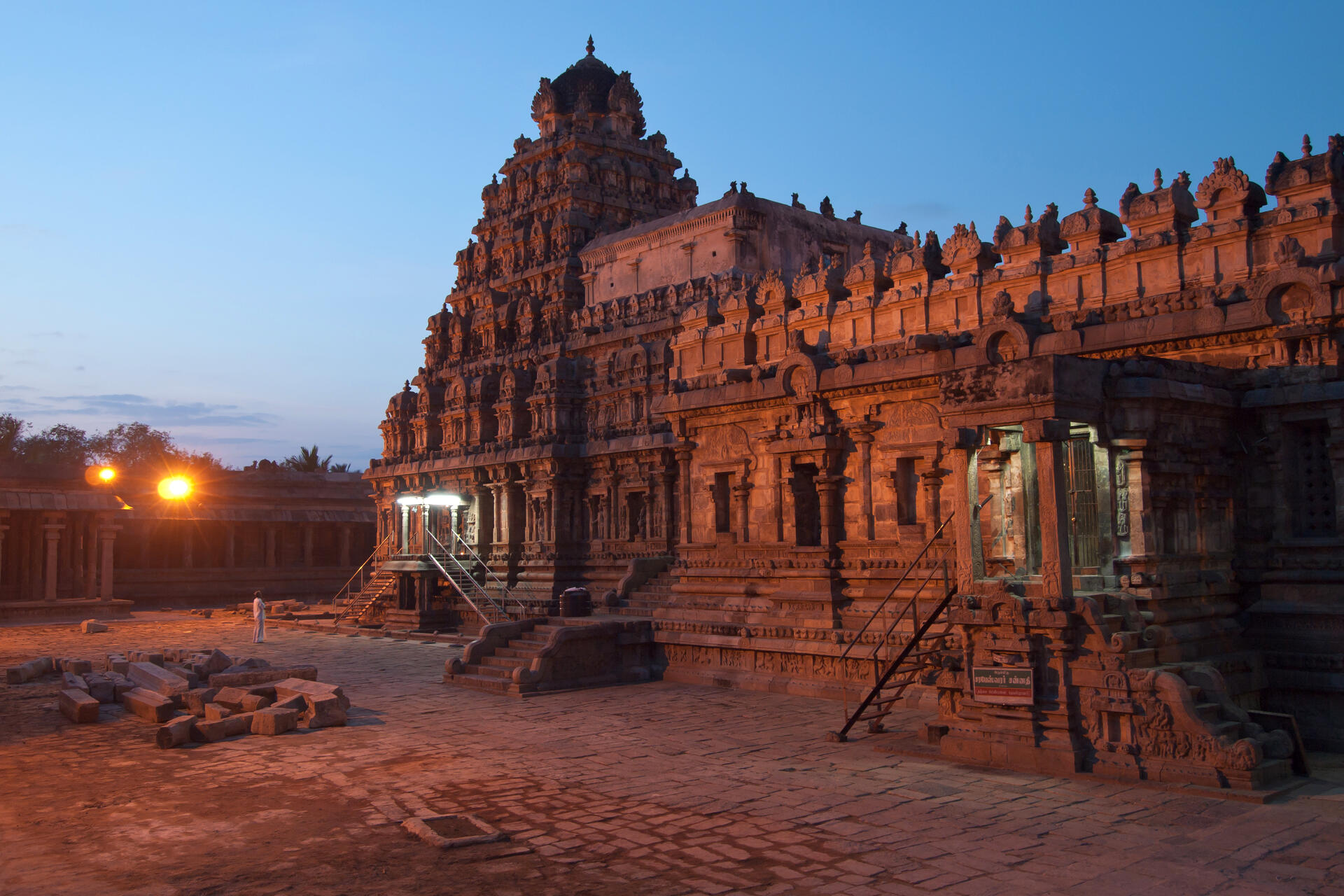
The Great Living Chola Temples, inscribed as a UNESCO World Heritage Site in 1987, represent a remarkable collection of architectural marvels from the Chola Dynasty, which once ruled vast territories across southern India and neighboring islands. This designation encompasses three significant 11th- and 12th-century temples: the Brihadisvara Temple at Thanjavur, the Brihadisvara Temple at Gangaikondacholisvaram, and the Airavatesvara Temple at Darasuram.
More to come…UNESCO Description of the World Heritage Site
The Great Living Chola Temples were built by kings of the Chola Empire, which stretched over all of south India and the neighbouring islands. The site includes three great 11th- and 12th-century Temples: the Brihadisvara Temple at Thanjavur, the Brihadisvara Temple at Gangaikondacholisvaram and the Airavatesvara Temple at Darasuram. The Temple of Gangaikondacholisvaram, built by Rajendra I, was completed in 1035. Its 53-m vimana (sanctum tower) has recessed corners and a graceful upward curving movement, contrasting with the straight and severe tower at Thanjavur. The Airavatesvara temple complex, built by Rajaraja II, at Darasuram features a 24-m vimana and a stone image of Shiva. The temples testify to the brilliant achievements of the Chola in architecture, sculpture, painting and bronze casting.
UNESCO Justification of the World Heritage Site
Criterion (i): The three Chola temples of Southern India represent an outstanding creative achievement in the architectural conception of the pure form of the dravida type of temple.
Criterion (ii): The Brihadisvara Temple at Thanjavur became the first great example of the Chola temples, followed by a development of which the other two properties also bear witness.
Criterion (iii): The three Great Chola Temples are an exceptional and the most outstanding testimony to the development of the architecture of the Chola Empire and the Tamil civilisation in Southern India.
Criterion (iv): The Great Chola temples at Thanjavur, at Gangaikondacholapuram and Darasuram are outstanding examples of the architecture and the representation of the Chola ideology.
Encyclopedia Record: Great Living Chola Temples
The Great Living Chola Temples is a UNESCO World Heritage Site designation for a group of three Chola dynasty era Hindu temples in the Indian state of Tamil Nadu. The temple at Thanjavur was added in the list in 1987, while the other two temples were added in 2004.Additional Site Details
Area: 21.74 hectares
Number of Components: 3
(iii) — Unique or exceptional testimony to a cultural tradition
Coordinates: 10.78305556 , 79.1325
World Heritage Research
Discover scientific research and academic studies that deepen our understanding of Great Living Chola Temples from its history and significance to its conservation, management, and contemporary challenges.
-
A Study on the Heritage of Temple Arts and Cultural Exchange in Kumbakonam
Kumbakonam, known as the 'Temple Town' of South India, serves as a vibrant cultural hub where over a hundred ancient temples blend religious devotion with artistic innovation. These temples, shaped by the architectural brilliance of the Cholas, the artistic contributions of the Nayaks, and the patronage of the Marathas, preserve diverse art forms such as sculptures, bronze casting, mural paintings, and decorative motifs. They also sustain performing traditions like Carnatic music and Bharatanatyam, with festivals like Mahamaham illustrating their role in fostering cultural dialogue. The study highlights Kumbakonam's evolution into a cosmopolitan center through the harmonization of dynastic influences, regional traditions, and artisan networks, emphasizing its enduring significance for heritage conservation, cultural tourism, and the revival of classical arts.
(Ed.). (2026). A Study on the Heritage of Temple Arts and Cultural Exchange in Kumbakonam. Iconic Research and Engineering Journals, 9(12). https://doi.org/10.64388/irev9i12-1718529
View Publication Record | Read Publication -
Navigating Tourism Development Constraints in Living Heritage Environments: Institutional, Spatial, and Sustainability Challenges at the Airavatesvara Temple, India
A comprehensive framework for conservation-centred tourism development is proposed to address the interconnected challenges facing UNESCO World Heritage Sites, exemplified by the Airavatesvara Temple in India. The study identifies seven key constraints—institutional fragmentation, infrastructural and accessibility issues, conservation pressures, interpretive limitations, socio-cultural dynamics, environmental stress, and destination branding—that collectively hinder sustainable tourism growth at living heritage environments. By analyzing qualitative and secondary data from UNESCO reports, ASI records, policy documents, and scholarly literature, the research reveals that these constraints are deeply embedded within broader governance and spatial systems rather than isolated operational failures. The proposed framework emphasizes integrated governance, smart interpretation systems, community participation, heritage-sensitive infrastructure, and sustainable visitor management, offering a practical solution to balance tourism growth with the preservation of living religious heritage.
Kumar, K. S., & Thangaraju, S. (2026). Navigating Tourism Development Constraints in Living Heritage Environments: Institutional, Spatial, and Sustainability Challenges at the Airavatesvara Temple, India. Journal of Arts, Humanities and Social Science, 3(2), 438–447. https://doi.org/10.69739/jahss.v3i2.2045
View Publication Record | Read Publication -
Socio-economic impacts of a UNESCO world heritage site on local communities: A study of Airavatesvara Temple, Darasuram
UNESCO World Heritage Site (WHS) designation enhances local visibility and tourism but its benefits are unevenly distributed. A study of the Airavatesvara Temple, Darasuram—a 2004-listed site in India’s Great Living Chola Temples—reveals that while WHS status boosts informal tourism jobs and sustains traditional crafts, challenges like inadequate infrastructure, weak market linkages for artisans, and poor governance coordination hinder equitable development. The research combines secondary data (government reports, ASI publications) with field observations and local stakeholder interviews, showing that cultural pride and historical awareness have grown but structural gaps persist. Integrated planning and community engagement are critical to unlocking WHS potential for inclusive growth.
Kumar, K. S., & S, T. (2026). Socio-economic impacts of a UNESCO world heritage site on local communities: A study of Airavatesvara Temple, Darasuram. International Journal of Tourism and Hotel Management, 8(7), 01–03. https://doi.org/10.22271/27069583.2026.v8.i7a.237
View Publication Record | Read Publication -
Architectural Historiography of the Airavatesvara Temple: Revisiting Chola Heritage through Epigraphic and Cultural Narratives
The Airavatesvara Temple at Darasuram is revealed as more than just a static monument—it was a dynamic cultural institution that integrated religion, administration, economy, literature, music, sculpture, and social life during the Chola period (12th century CE). This study challenges traditional historiography by shifting focus from monumental architecture to ritual continuity, sacred geography, inscriptional traditions, and cultural memory. Through epigraphic analysis, iconographic interpretation, and mythological friezes, researchers Kumar and Thangaraju demonstrate that Darasuram reflects the maturity of Chola artistic traditions and religious patronage while contributing to broader debates on Tamil heritage, sacred kingship, and UNESCO heritage discourse.
Kumar, K. S., & Thangaraju, Dr. S. (2026). Architectural Historiography of the Airavatesvara Temple: Revisiting Chola Heritage through Epigraphic and Cultural Narratives. International Journal of Arts Architecture & Design, 4(2), 40–57. https://doi.org/10.62030/2026julypaper3
View Publication Record | Read Publication -
History and Heritage of Saivite Temples in the Kumbakonam Region
The Saivite temples of Kumbakonam, Tamil Nadu, stand as monumental testaments to the enduring legacy of South Indian religious and cultural traditions. These ancient structures, built under successive dynasties including the Cholas, Pandyas, Nayaks, and Marathas, reveal a rich tapestry of Dravidian architecture, intricate sculptures, inscriptions, bronze icons, sacred tanks, and vibrant festival traditions that have shaped Tamil society for centuries. Beyond their religious significance, these temples functioned as pivotal centers for education, music, dance, literature, and local administration, playing a crucial role in preserving the spiritual and cultural identity of the region. A comprehensive study analyzing literary sources, inscriptions, archaeological evidence, and historical records highlights the temples' dual role as both custodians of heritage and active contributors to regional development. The research underscores the urgent need for their conservation to safeguard this invaluable legacy for future generations.
M. Amirthavalli, & A. Karkuzhali. (2026). History and Heritage of Saivite Temples in the Kumbakonam Region. International Journal of Economic Practices and Theories, 2026, 5786–5791. https://doi.org/10.52783/ijept.836
View Publication Record | Read Publication -
Applying Butler\\\'s Tourism Area Life Cycle (TALC) Model To A Living Heritage Destination: The Case Of Thanjavur, Tamil Nadu
A modified Tourism Area Life Cycle (TALC) model, termed 'Living Heritage TALC' (LH-TALC), is proposed to better fit destinations like Thanjavur, where heritage is sustained by community practices independent of visitor volume. Unlike Butler's classical S-shaped curve, Thanjavur's tourism trajectory shows shallower downturns and more resilient rejuvenation due to its deep-rooted cultural and institutional processes. The study analyzed secondary data from UNESCO, ASI, TTDC, and heritage-tourism literature to reconstruct Thanjavur's six-phase evolution, highlighting the need for a framework that incorporates intangible heritage and community resilience. Policy recommendations focus on balancing conservation, livelihoods, and visitor management in developing-economy living heritage sites.
Aakash Aravinth R. (2026). Applying Butler\\\'s Tourism Area Life Cycle (TALC) Model To A Living Heritage Destination: The Case Of Thanjavur, Tamil Nadu. Zenodo. https://doi.org/10.5281/ZENODO.22056540
View Publication Record | Read Publication -
Sacred Heritage of Konerirajapuram: Patronage, Architecture, and Ritual at the Uma Maheswarar Temple, Thirunallam
The Uma Maheswarar temple at Konerirajapuram, erected between 971–974 CE by Chola queen Sembiyan Mahadevi, represents a pivotal moment in Chola art and architecture. Unlike being merely a predecessor to the Brihadisvara temple, this granite monument demonstrates how queenship, Shaiva devotionalism, and artistic innovation converged through its unique royal portrait sculptures and early monumental bronze Nataraja. The study reveals that the temple functioned as an active institution for land management, ritual endowment, and local administration for over two centuries, supported by epigraphical evidence. Researchers used interpretive-historical analysis of the temple's tenth-century inscription alongside architectural surveys to highlight its independent significance in religious, historical, and art-historical contexts.
Chandramohan, S., & Vivekanandam, V. (2026). Sacred Heritage of Konerirajapuram: Patronage, Architecture, and Ritual at the Uma Maheswarar Temple, Thirunallam. Journal of Arts, Humanities and Social Science, 3(3), 95–103. https://doi.org/10.69739/jahss.v3i3.2361
View Publication Record | Read Publication