World Heritage Identification Number: 915
World Heritage since: 1999
Category: Cultural Heritage
WHE Type: Archaeological Sites
Transboundary Heritage: No
Endangered Heritage: No
Country: 🇿🇦 South Africa
Continent: Africa
UNESCO World Region: Africa
Map
Unraveling Human Evolution: A Journey Through the Fossil Hominid Sites of South Africa
The Fossil Hominid Sites of South Africa, inscribed as a UNESCO World Heritage Site in 1999, offer a captivating glimpse into the origins and evolution of humanity. This serial paleoanthropological site, collectively known as the Cradle of Humankind, comprises a group of fossil-bearing localities primarily located about 50 kilometers northwest of Johannesburg, spanning parts of Gauteng and North West provinces. The core area covers approximately 47,000 hectares and contains one of the most significant concentrations of early human ancestral remains discovered anywhere in the world.
The sites preserve an extraordinary fossil record dating back millions of years, providing crucial insights into the biological and behavioral evolution of early hominins. Among the most important components of the World Heritage Site is the Taung Skull Fossil Site, renowned for the discovery of the celebrated Taung Skull in 1924. This fossil, classified as Australopithecus africanus, played a pivotal role in reshaping scientific understanding of human evolution by demonstrating that early human ancestors originated in Africa.
Another important extension of the World Heritage Site is Makapan Valley, located in present-day Limpopo Province. This area contains a series of archaeological and fossil-bearing caves with evidence of hominin activity dating back approximately 3.3 million years. Fossils recovered from Makapan and other sites within the broader World Heritage property include remains of early hominins such as Australopithecus and Paranthropus robustus, which inhabited southern Africa between roughly 2.8 million and 1.2 million years ago.
One of the most intriguing discoveries associated with the Fossil Hominid Sites concerns the early controlled use of fire by our ancestors. Evidence from caves such as Swartkrans suggests that early hominins began domesticating fire between approximately 1.8 million and 1 million years ago. This development had profound implications for survival, enabling warmth, protection from predators, and the cooking of food, which in turn influenced biological and cultural evolution.
In addition to these landmark discoveries, the Fossil Hominid Sites of South Africa continue to provide researchers with exceptional opportunities to uncover new insights into human evolution. The region’s vast network of limestone caves—including well-known sites such as Sterkfontein, Swartkrans, Kromdraai, and Drimolen—remains the focus of ongoing scientific excavation and study.
In recent years, the discovery of the Rising Star Cave System has added a startling new chapter to this narrative. It led to the identification of Homo naledi, a species with a unique mix of primitive and modern features. Rsearchers have suggested that this small-brained hominin may have practiced intentional burials and created rock art as early as 240,000 to 335,000 years ago. These interpretations remain the subject of active scientific debate, as they challenge long-held assumptions about the relationship between brain size and cultural behavior.
In summary, the Fossil Hominid Sites of South Africa stand as a powerful testament to humanity’s deep and complex past. Through the preservation of these precious sites and continued scientific research, we can further illuminate the mysteries of our evolutionary journey and the processes that shaped modern humans from their early hominin ancestors.
UNESCO Description of the World Heritage Site
The Taung Skull Fossil Site, part of the extension to the site inscribed in 1999, is the place where in 1924 the celebrated Taung Skull – a specimen of the species Australopithecus africanus – was found. Makapan Valley, also in the site, features in its many archaeological caves traces of human occupation and evolution dating back some 3.3 million years. The area contains essential elements that define the origin and evolution of humanity. Fossils found there have enabled the identification of several specimens of early hominids, more particularly of Paranthropus, dating back between 4.5 million and 2.5 million years, as well as evidence of the domestication of fire 1.8 million to 1 million years ago.
UNESCO Justification of the World Heritage Site
Criterion (iii): The nominated serial site bears exceptional testimony to some of the most important Australopithecine specimens dating back more than 3.5 million years. This therefore throws light on to the origins and then the evolution of humankind, through the hominisation process.
Criterion (vi): The serially nominated sites are situated in unique natural settings that have created a suitable environment for the capture and preservation of human and animal remains that have allowed scientists a window into the past. Thus, this site constitutes a vast reserve of scientific data of universal scope and considerable potential, linked to the history of the most ancient periods of humankind.
Encyclopedia Record: Cradle of Humankind
The Cradle of Humankind is a paleoanthropological site that is located about 50 km (31 mi) northwest of Johannesburg, South Africa, in the Gauteng province. Declared a World Heritage Site by UNESCO in 1999, the site is home to the largest known concentration of human ancestral remains anywhere in the world. The site currently occupies 47,000 hectares and contains a complex system of limestone caves. The registered name of the site in the list of World Heritage Sites is Fossil Hominid Sites of South Africa.Additional Site Details
Area: Not available
Number of Components: 3
(vi) — Directly associated with events or living traditions
Coordinates: -24.15861 , 29.17694
Image
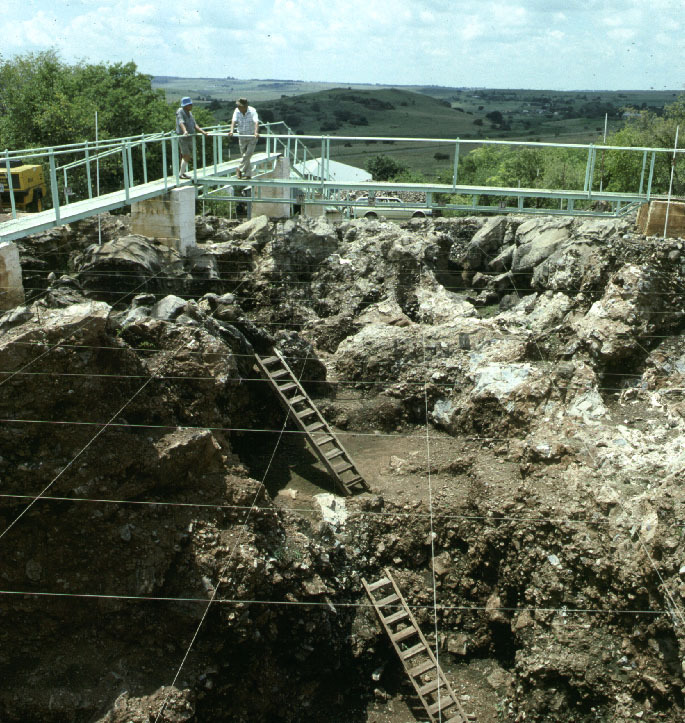
© english Wikipedia user, CC BY-SA 3.0 Resized from original. (This derivative is under the same CC BY-SA license.)