World Heritage Identification Number: 278
World Heritage since: 2019
Category: Cultural Heritage
WHE Type: Archaeological Sites
Transboundary Heritage: No
Endangered Heritage: No
Country: 🇮🇶 Iraq
Continent: Asia
UNESCO World Region: Arab States
Map
Babylon: The Ancient City that Influenced Empires
Babylon, situated approximately 85 kilometers (55 miles) south of Baghdad, is a significant archaeological site that offers a unique glimpse into one of the most influential cities of the ancient world. Inscribed as a UNESCO World Heritage Site in 2019, the property encompasses the remnants of the city across multiple historical periods, including its role as the capital of the Neo-Babylonian Empire (626–539 BCE).
The city of Babylon was strategically positioned along the lower Euphrates River in southern Mesopotamia, within modern-day Hillah, Iraq. It emerged as the primary cultural and political center of the Akkadian-speaking region of Babylonia. The city's rich history spans over two millennia, with its rulers establishing two important empires: the Old Babylonian Empire (19th–16th century BCE) and the Neo-Babylonian Empire (7th–6th century BCE).
Founded as a small settlement along the Euphrates, Babylon gradually emerged as a regional power during the Old Babylonian period, particularly during the reign of Hammurabi (r. c. 1792–1750 BCE), who expanded Babylon’s control over much of Mesopotamia through military campaigns and diplomacy. Even after its political decline following the Hittite sack in the sixteenth century BCE, the city endured as a significant religious and cultural center, laying the foundations for its later resurgence under the Neo-Babylonian kings.
The Neo-Babylonian Empire reached its zenith under the rule of Nebuchadnezzar II (605–562 BCE), who expanded Babylon's territories and undertook extensive construction projects. One of his most notable achievements was the rebuilding of the Ishtar Gate, a magnificent entrance adorned with glazed brick reliefs depicting mythical creatures such as mušḫuššu dragons and bulls. Another iconic structure from this era is the Etemenanki, a ziggurat dedicated to the god Marduk, the patron deity of Babylon.
Beyond its political power, Babylon was the religious heart of Mesopotamia. The city was home to the Esagila temple complex dedicated to the god Marduk, whose cult rose to prominence alongside Babylon’s political ascent. Each year, the New Year (Akitu) festival reaffirmed the king’s divine mandate and symbolically renewed cosmic order, reinforcing Babylon’s spiritual authority across the region. In 539 BCE, the city fell to Cyrus the Great, founder of the Achaemenid Empire. The transition appears to have been relatively peaceful, and Babylon continued to function as an important administrative and cultural center under Persian rule.
Babylon's association with one of the Seven Wonders of the Ancient World—the Hanging Gardens—has further solidified its place in history. This architectural marvel has inspired artistic, popular, and religious culture on a global scale. Although their historical existence and precise location remain uncertain, they were traditionally described as a lush, terraced oasis filled with exotic plants and trees, designed to mimic the hills and forests of a queen’s homeland. Some modern scholars suggest the gardens may have been located in Nineveh rather than Babylon.
In addition to its impressive architecture, Babylon played a crucial role in the development of law, literature, mathematics, and astronomy. The Code of Hammurabi, an ancient law code inscribed on a stele, provides insights into the legal system of the time. The Epic of Gilgamesh, one of the earliest known works of literature, originated in earlier Sumerian traditions and was later transmitted and edited in Akkadian by Babylonian and other Mesopotamian scribes.
Babylon's influence extended beyond its own borders, as it became a regional capital for various empires, including the Achaemenid Empire. Alexander the Great conquered Babylon in 331 BCE, marking the beginning of the Hellenistic period. Despite its decline during this period, Babylon remained an important center of trade and learning.
Following the destruction of Jerusalem in 586 BCE, segments of the Judean population were deported to Babylon in what became known as the Babylonian Exile, a formative period in Jewish history that profoundly shaped biblical literature and theology. At the same time, Babylonian scholars made enduring contributions to mathematics and astronomy, developing a sophisticated base-60 numerical system and astronomical observations that later influenced Greek science. Through these cultural and intellectual achievements, Babylon’s legacy extended far beyond its political lifespan.
Today, the ruins of Babylon continue to captivate visitors with their grandeur and historical significance. The remains include outer and inner city walls, gates, palaces, and temples, offering a tangible connection to one of the most powerful empires in history. As a UNESCO World Heritage Site, Babylon serves as a testament to the creativity and ingenuity of its successive civilizations—particularly the Neo-Babylonian Empire at its peak—and continues to inspire awe and curiosity among scholars and tourists alike
UNESCO Description of the World Heritage Site
Situated 85 km south of Baghdad, the property includes the ruins of the city which, between 626 and 539 BCE, was the capital of the Neo-Babylonian Empire. It includes villages and agricultural areas surrounding the ancient city. Its remains, outer and inner city walls, gates, palaces and temples, are a unique testimony to one of the most influential empires of the ancient world. Seat of successive empires, under rulers such as Hammurabi and Nebuchadnezzar, Babylon represents the expression of the creativity of the Neo-Babylonian Empire at its height. The city's association with one of the seven wonders of the ancient world—the Hanging Gardens—has also inspired artistic, popular and religious culture on a global scale.UNESCO Justification of the World Heritage Site
Criterion (iii): Babylon dates back to the third millennium BCE and was the seat of successive powerful empires under such famous rulers as Hammurabi and Nebuchadnezzar. As the capital of the Neo-Babylonian Empire (626-539 BCE), it is the most exceptional testimony of this culture at its height and represents the expression of this civilization’s creativity during this highly productive phase in architectural and urban creation. Babylon’s cultural legacy was enhanced by previous Akkadian and Sumerian cultural achievements, which included the cuneiform writing system, a significant tool for today’s knowledge of the history and evolution of the region in general and Babylon in particular. In turn, Babylon exerted considerable political, scientific, technological, architectural and artistic influence upon other human settlements in the region, and on successive historic periods of Antiquity.
Criterion (vi): Babylon functioned as a model, parable and symbol of ancient power for over two thousand years and inspires artistic, popular and religious culture on a global scale. The tales of Babel find reference in the religious texts of the three Abrahamic religions. In the works of Greek historians, Babylon was distant, exotic and incredible. Classical texts attribute one of the seven wonders of the world to Babylon: the Hanging Gardens; and other texts speak of the wondrous Tower of Babel. Both are iconic but have their origins in real ancient structures of which archaeological traces are still preserved: the ziggurat Etemenanki and Nebuchadnezzar’s palatial complex.
Encyclopedia Record: Babylon
Babylon is an ancient city located on the lower Euphrates river in southern Mesopotamia, within modern-day Hillah, Iraq, about 85 kilometres south of modern-day Baghdad. Babylon functioned as the main cultural and political centre of the Akkadian-speaking region of Babylonia. Its rulers established two important empires in antiquity, the 19th–16th century BC Old Babylonian Empire, and the 7th–6th century BC Neo-Babylonian Empire. Babylon was also used as a regional capital of other empires, such as the Achaemenid Empire. Babylon was one of the most important urban centres of the ancient Near East, until its decline during the Hellenistic period. Nearby ancient sites include Kish, Borsippa, Dilbat, and Kutha.Additional Site Details
Area: 1,054.3 hectares
Number of Components: 1
(vi) — Directly associated with events or living traditions
Coordinates: 32.5419694444 , 44.4208333333
Image
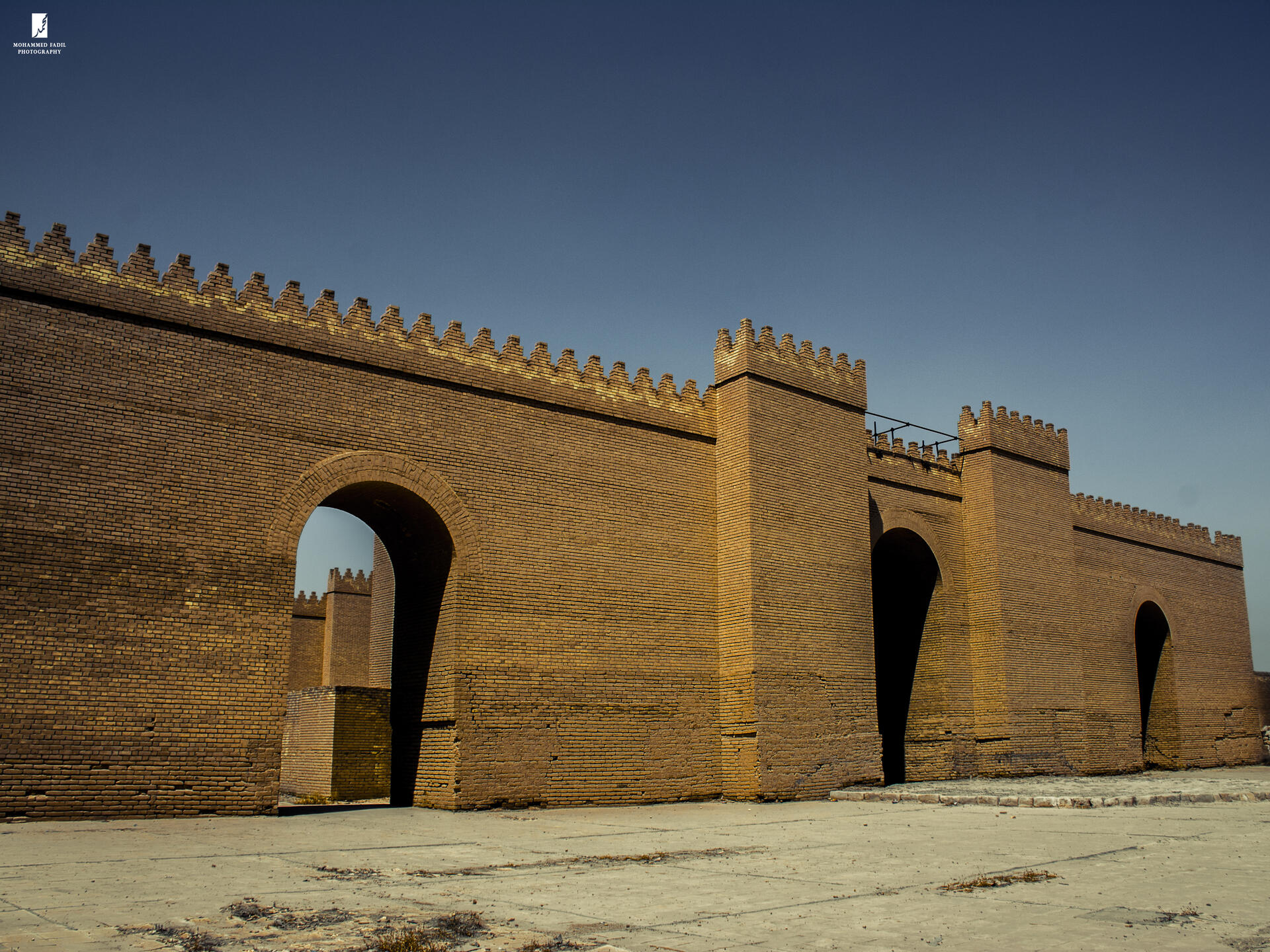
© Mohamm3dfadil, CC BY-SA 4.0 Resized from original. (This derivative is under the same CC BY-SA license.)