World Heritage Identification Number: 87
World Heritage since: 1979
Category: Cultural Heritage
WHE Type: Archaeological Sites
Transboundary Heritage: No
Endangered Heritage: No
Country: 🇪🇬 Egypt
Continent: Africa
UNESCO World Region: Arab States
Map
Ancient Thebes with its Necropolis: A Testament to Egyptian Civilization at its Height
Ancient Thebes, known in antiquity as Waset, stands as one of the most significant archaeological sites in Egypt. It served as the capital of the Egyptian state during much of the Middle Kingdom and again during the New Kingdom, periods in which the city reached the height of its political, religious, and artistic influence. In recognition of its outstanding universal value, Ancient Thebes with its Necropolis was inscribed as a UNESCO World Heritage Site in 1979.
Located approximately 600 kilometers south of the Mediterranean Sea—some 800 kilometers by road— Thebes lies within the modern city of Luxor. Its location near Egypt’s southern frontier, just north of Nubia and adjacent to the Eastern Desert, afforded access to important trade routes and valuable mineral resources. Thebes' strategic position played a crucial role in its development as a religious and political center.
Thebes functioned as the capital during extended phases of the Middle Kingdom, particularly under the Eleventh Dynasty, and again during the New Kingdom. During these eras, it became the most venerated city in Egypt, serving as the seat of power for some of the most renowned pharaohs, including Hatshepsut and Thutmose III. Although Akhenaten initially ruled from the traditional centers of power, he later abandoned Thebes in favor of a newly established capital at Akhetaten, marking a notable departure from Theban religious authority.
One of the most notable features of Thebes is the complex of temples and palaces at Karnak and Luxor. These vast architectural ensembles were primarily dedicated to the god Amun, who rose to prominence as the chief deity of the Egyptian pantheon during the New Kingdom. The Karnak Temple Complex, built and expanded over a period spanning more than a thousand years, ranks among the largest religious structures ever constructed. Meanwhile, the Luxor Temple, with its impressive colonnades and hieroglyphs, showcases the architectural sophistication of the ancient Egyptians.
In addition to its urban center, Thebes boasts two extensive necropolises: the Valley of the Kings and the Valley of the Queens. These burial sites served as the final resting places for numerous pharaohs, their queens, and other members of the royal family, including Tutankhamun, Ramses II, and Nefertari. The tombs in these valleys are renowned for their intricate decorations, which provide insights into the beliefs, customs, and artistic styles of ancient Egyptian society.
The Valley of the Kings, in particular, has yielded some of the most remarkable discoveries in archaeology. This site contains over sixty known tombs, including the famous tomb of Tutankhamun, whose largely intact burial was discovered in 1922 by the archaeologist Howard Carter. The treasures recovered from this tomb—gold artifacts, jewelry, and ceremonial objects—offer unparalleled insight into the wealth and beliefs of ancient Egyptian royalty. The Valley of the Queens likewise preserves elaborately decorated tombs, including that of Queen Nefertari, celebrated for its artistic excellence.
Central to the organization of Thebes was the symbolic division of the city by the Nile River, which shaped both its physical layout and religious meaning. The east bank of the Nile was associated with life, renewal, and daily activity, and housed the city’s principal temples, administrative buildings, and residential areas. The west bank, by contrast, was identified with death and the afterlife, serving as the location for royal tombs, mortuary temples, and extensive funerary landscapes.
Beyond the royal tombs, the Theban west bank was also home to some of Egypt’s most impressive mortuary temples, including the terraced temple of Hatshepsut at Deir el-Bahri, the Ramesseum of Ramses II, and the extensively preserved temple complex of Ramses III at Medinet Habu. These structures functioned as centers of royal cult worship, where rituals were performed to sustain the divine essence of deceased kings and to reinforce royal authority among the living
The grandeur of Thebes was sustained by the labor of thousands of workers, artisans, and administrators whose lives were bound to the demands of the state and the gods. Craftsmen, stonecutters, painters, and scribes worked for decades on temples and tombs, often under harsh conditions in the desert heat. Communities such as Deir el-Medina, home to the royal tomb workers, reveal both the skill and discipline required to create these monuments, as well as the physical strain, injuries, and economic pressures endured by those who built them.
This immense concentration of wealth and labor came at a significant human cost. Resources were drawn heavily toward royal and religious construction, reinforcing social hierarchies and placing considerable burdens on the non-elite population. While Thebes symbolized divine order and eternal kingship, it was also a city shaped by obligation, controlled labor, and inequality—reminding us that its enduring splendor was achieved through the lives and labor of countless individuals whose names rarely survived alongside the monuments they created.
Together, the temples, palaces, and funerary landscapes of Ancient Thebes testify not only to the artistic and religious achievements of ancient Egyptian civilization, but also to the immense concentration of power and labor that sustained them. As a UNESCO World Heritage Site, Thebes invites critical reflection on how political authority, religious ideology, and human effort combined to produce monuments of extraordinary scale and endurance, shaping one of the most influential cultures of the ancient world.
UNESCO Description of the World Heritage Site
Thebes, the city of the god Amon, was the capital of Egypt during the period of the Middle and New Kingdoms. With the temples and palaces at Karnak and Luxor, and the necropolises of the Valley of the Kings and the Valley of the Queens, Thebes is a striking testimony to Egyptian civilization at its height.
UNESCO Justification of the World Heritage Site
Criterion (i): Thebes, the city of the god Amun, is renowned for its temples whose imposing ruins are the glory of Karnak and Luxor. These truly colossal complexes, which have been enlarged numerous times, comprise some of the most fascinating realisations of Antiquity: the ‘Hypostyle Hall’ of Karnak begun by Seti I and completed by Ramses II (measuring 102 metres in width and 53 metres in depth, covers a surface area of 5,000 square metres; its roof is supported by 134 columns, those of the central nave measuring 20.4 metres with a diameter of 3.4 metres); the temple of Amenophis III at Luxor, one of the most refined masterpieces of Egyptian architecture (14th century BCE). The Theban necropolis relinquishes nothing in importance or beauty to these monuments: it suffices to note the tombs of the Valley of the Kings (1500 – 1000 BCE), among which is that of Tutankhamun, those of the Valley of the Queens, where, among others Nephertari, wife of Ramses II, and her mother Tui are entombed; and finally at Deir El Bahari (Thebes west) the funerary temple of Queen Hatshepsut with its immense porticos, its superimposed terraces flanking the mountain, and its frescoes which trace her journey to the country of Punt.
Criterion (iii): The few examples which remain among these splendid monuments serve to attest to the antiquity, the uniqueness and unequalled character of the monumental Theban ensembles.
Criterion (vi): The monumental and archaeological complex of Thebes with its temples, tombs, and royal palaces; its villages of artisans and artists; its inscriptions; its innumerable figurative representations, as valuable from an aesthetic as from a documentary point of view, constitute the material witness of the aggregate history of the Egyptian civilization from the Middle Kingdom to the beginning of the Christian era. Moreover, the texts and the paintings are the source of information concerning the people and cultures of neighbouring countries: Nubia, the country of Punt, Libya, as well as Syria and the Hittite and Aegean civilisations.
Encyclopedia Record: Thebes, Egypt
Thebes, known to the ancient Egyptians as Waset, was an ancient Egyptian city located along the Nile about 800 kilometers (500 mi) south of the Mediterranean. Its ruins lie within the modern Egyptian city of Luxor. Thebes was the main city of the fourth Upper Egyptian nome and was the capital of Egypt for long periods during the Middle Kingdom and New Kingdom eras. It was close to Nubia and the Eastern Desert, with its valuable mineral resources and trade routes. It was a religious center and the most venerated city during many periods of ancient Egyptian history.Additional Site Details
Area: 7,390.16 hectares
Number of Components: 3
(iii) — Unique or exceptional testimony to a cultural tradition
(vi) — Directly associated with events or living traditions
Coordinates: 25.73333 , 32.6
Image
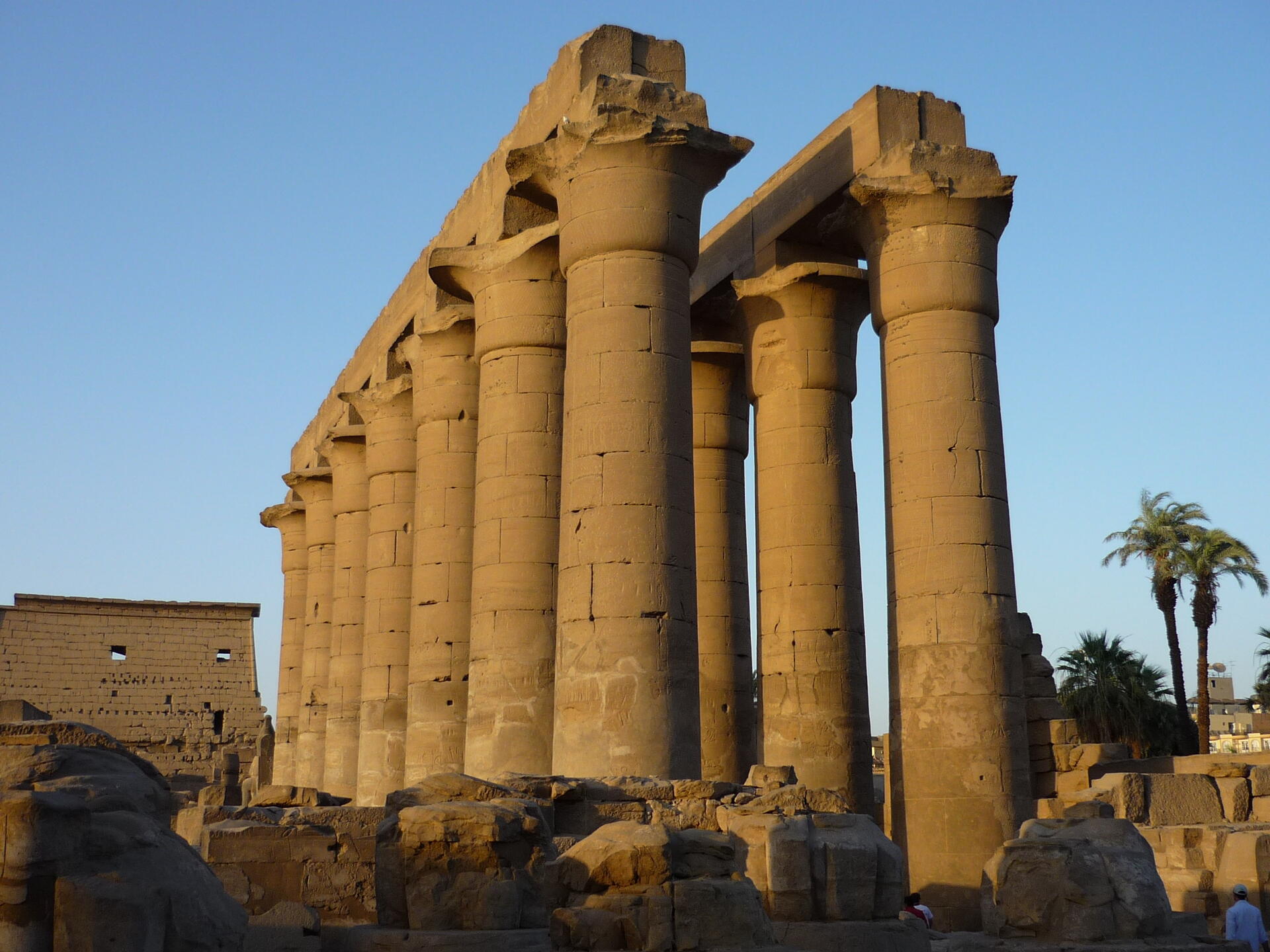
© Rémih, CC BY-SA 3.0 Resized from original. (This derivative is under the same CC BY-SA license.)