World Heritage Identification Number: 545
World Heritage since: 1990
Category: Cultural Heritage
WHE Type: Buildings & Architectural Ensembles
Transboundary Heritage: No
Endangered Heritage: No
Country: 🇷🇺 Russian Federation
Continent: Europe
UNESCO World Region: Europe and North America
Map
The Kremlin and Red Square: A Historical and Cultural Landmark in Moscow
The Kremlin and Red Square, located in the heart of the Russian capital Moscow, stand as enduring symbols of the historical, cultural, and political development of Russia. Designated as a UNESCO World Heritage Site in 1990, this iconic ensemble has been the backdrop for some of the most crucial events in Russian history since the medieval period.
The Moscow Kremlin, often simply referred to as the Kremlin, is a fortified complex whose earliest fortifications date back to the 12th century, while most of the existing structures were built between the late 15th and 17th centuries. Constructed by a blend of Russian and foreign architects—particularly Italian masters—it served as the residence of the Grand Princes and later the Tsars of Russia, as well as an important religious center. The Kremlin's architecture reflects a mixture of traditional Russian styles and Italian Renaissance influences, making it a unique architectural ensemble.
The Moscow Kremlin has long served as the principal seat of political authority in Russia. From the time of the grand princes of Moscow, it functioned as the residence and administrative center of the rulers of the emerging Russian state. The complex later became the official residence of the tsars of the Tsardom of Russia and remained a symbol of national power during the era of the Soviet Union. Today, the Kremlin continues to play a central role in Russian political life as the seat of the President of Russia, reflecting the site’s enduring importance in the governance of the country.
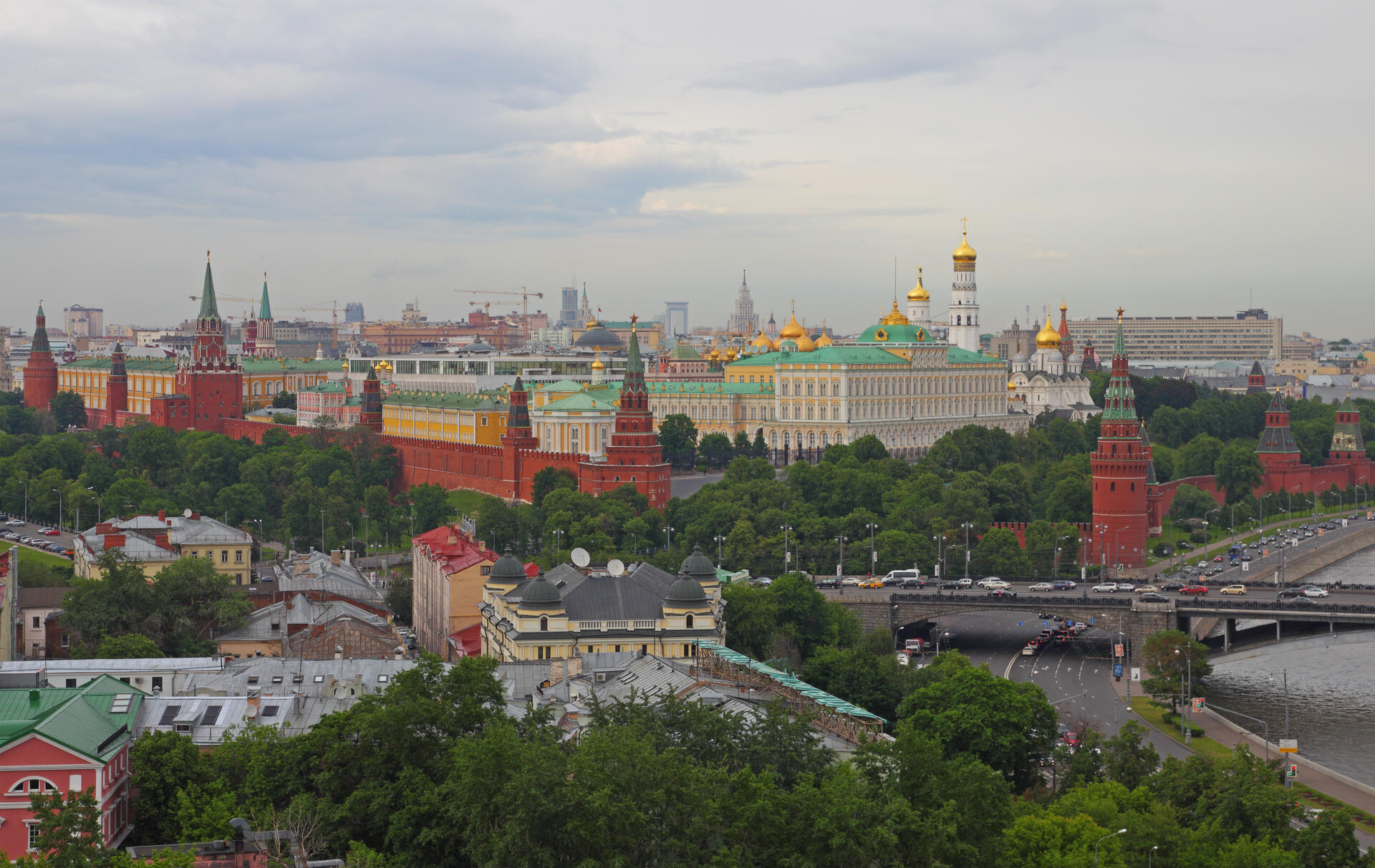
Within the Kremlin walls lie several palaces, multiple historic churches and cathedrals, and the encompassing Kremlin Wall adorned with towers. Among these structures, the Grand Kremlin Palace stands out as a former royal residence of the Russian tsars. Today, it is primarily used for official state ceremonies, while parts of the Kremlin complex serve as the working residence of the President of Russia. The Kremlin overlooks the Moskva River to the south, Saint Basil's Cathedral and Red Square to the east, and the Alexander Garden to the west.
Within the Kremlin complex are several of Russia’s most important religious monuments. The Cathedral of the Dormition served as the traditional coronation church of Russian rulers, while the Cathedral of the Archangel contains the tombs of many early princes and tsars. The Cathedral of the Annunciation functioned as the private chapel of the royal family. Together, these churches illustrate the close relationship between political authority and the Russian Orthodox Church throughout much of the country’s history.
Saint Basil's Cathedral, situated at the southern end of Red Square, is another architectural gem that complements the Kremlin. This colorful and intricate structure, completed in 1561 during the reign of Ivan IV of Russia, is considered one of the most distinctive examples of Russian architecture. Its nine chapels, each crowned with a uniquely shaped dome, create a striking visual impact that has captivated visitors for centuries.
Red Square, whose name derives from the old Russian word krasnaya, meaning “beautiful,” lies along the eastern wall of the Kremlin. Throughout history, Red Square has served as a marketplace, a ceremonial and parade ground, and occasionally as a site of public proclamations and executions. Today, it remains a symbol of Russia's historical and cultural heritage, hosting notable buildings such as the State Historical Museum, the GUM department store, and the Lenin Mausoleum.
In the twentieth century, Red Square gained global prominence as the ceremonial center of the Soviet state. The Lenin Mausoleum, which houses the preserved body of Vladimir Lenin, became a focal point for Soviet political rituals. From the square, leaders observed military parades and national celebrations, including commemorations of victory in World War II. These events reinforced Red Square’s role as one of the most recognizable political stages in the world.
The Kremlin and Red Square together form a microcosm of Russian history, politics, and culture. Their enduring presence continues to inspire awe and fascination among locals and tourists alike, offering a glimpse into the heart and soul of Russia. As a UNESCO World Heritage Site, they serve as a reminder of the importance of preserving cultural heritage for future generations.
UNESCO Description of the World Heritage Site
Inextricably linked to all the most important historical and political events in Russia since the 13th century, the Kremlin (built between the 14th and 17th centuries by outstanding Russian and foreign architects) was the residence of the Great Prince and also a religious centre. At the foot of its ramparts, on Red Square, St Basil's Basilica is one of the most beautiful Russian Orthodox monuments.
UNESCO Justification of the World Heritage Site
Criterion (i): The Kremlin contains within its walls a unique series of masterpieces of architecture and the plastic arts. There are religious monuments of exceptional beauty such as the Church of the Annunciation, the Cathedral of the Dormition, the Church of the Archangel and the bell tower of Ivan Veliki; there are palaces such as the Great Palace of the Kremlin, which comprises within its walls the Church of the Nativity of the Virgin and the Teremnoi Palace. On Red Square is Saint Basil the Blessed, still a major edifice of Russian Orthodox art.
Criterion (ii): Throughout its history, Russian architecture has clearly been affected many times by influences emanating from the Kremlin. A particular example was the Italian Renaissance. The influence of the style was clearly felt when Rudolfo Aristotele Fioravanti built the Cathedral of the Dormition (1475-79) and grew stronger with the construction of the Granovitaya Palace (Hall of the Facets, 1487-91) by Marco Fryazin and Pietro Antonio Solario. Italian Renaissance also influenced the towers of the fortified enceinte, built during the same period by Solario, using principles established by Milanese engineers (the Nikolskaya and the Spasskaya Towers both date from 1491). The Renaissance expression was even more present in the classic capitals and shells of the Church of the Archangel, reconstructed from 1505 to 1509 by Alevisio Novi.
Criterion (iv): With its triangular enceinte pierced by four gates and reinforced with 20 towers, the Moscow Kremlin preserves the memory of the wooden fortifications erected by Yuri Dolgoruki around 1156 on the hill at the confluence of the Moskova and Neglinnaya rivers (the Alexander Garden now covers the latter). By its layout and its history of transformations (in the 14th century Dimitri Donskoi had an enceinte of logs built, then the first stone wall), the Moscow Kremlin is the prototype of a Kremlin - the citadel at the centre of Old Russian towns such as Pskov, Tula, Kazan or Smolensk.
Criterion (vi): From the 13th century to the founding of St Petersburg, the Moscow Kremlin was directly and tangibly associated with every major event in Russian history. A 200-year period of obscurity ended in 1918 when it became the seat of government again. The Mausoleum of Lenin on Red Square is the Soviet Union’s prime example of symbolic monumental architecture. To proclaim the universal significance of the Russian revolution, the funerary urns of heroes of the revolution were incorporated into the Kremlin’s walls between the Nikolskaya and Spasskaya towers. The site thus combines in an exceptional manner the preserved vestiges of bygone days with present-day signs of one of the greatest events in modern history.
Encyclopedia Record: Kremlin
The Moscow Kremlin, commonly known as the Kremlin, is a fortified complex (kremlin) in Moscow, Russia. Located in the historic centre of the country's capital city, the Kremlin comprises five palaces, four cathedrals, and an enclosing wall along with numerous towers. Within the complex is the Grand Kremlin Palace, which was one of the royal residences of the Tsar of Russia, and is now the residence of the president of the Russian Federation. The Kremlin overlooks the Moskva River to the south, Red Square to the east, and Alexander Garden to the west.Additional Site Details
Area: 42.1 hectares
Number of Components: 1
(ii) — Significant interchange of human values
(iv) — Outstanding example of a type of building or landscape
(vi) — Directly associated with events or living traditions
Coordinates: 55.7540277778 , 37.6204166667
Image
Svetlana Tikhonova, Public domain
World Heritage Research
Discover scientific research and academic studies that deepen our understanding of Kremlin and Red Square, Moscow from its history and significance to its conservation, management, and contemporary challenges.
-
Urban design in underground public spaces: lessons from Moscow Metro
Moscow Metro stations near the Kremlin and Red Square exemplify how underground public spaces can serve dual purposes: enhancing urban transit while revitalizing city centers. Unlike Western counterparts, these stations incorporate innovative design principles—such as 'soft edge' and 'triangulation props'—that foster social activity in platform halls and escalators, regardless of original intent. The study highlights three stations (Okhotny Ryad, Tverskaya, Ploshchad Revolyutsii) as case studies for architects and planners, demonstrating how thoughtful design can transform underground environments into vibrant public spaces.
Lee, J. M. (2021). Urban design in underground public spaces: lessons from Moscow Metro. Journal of Asian Architecture and Building Engineering, 21(4), 1590–1605. https://doi.org/10.1080/13467581.2021.1941978
View Publication Record | Read Publication -
Precedent toponym as a political symbol
The toponym 'Red Square' embodies 16 distinct semantic meanings, serving as both a political symbol and a cultural marker in Russian discourse. This study reveals its layered significance—ranging from denotative to connotative and associative—highlighting how its interpretation varies between native and non-native speakers of Russian. Using continuous sampling from the Russian National Corpus, fiction, oral speech, and internet resources, researchers applied semantic analysis to identify its core meanings (semes). The findings underscore Red Square's role as a precedent toponym, deeply rooted in Russian cultural competence, while also functioning as a global symbol of state power for foreign language learners. This research bridges linguistic analysis with political symbolism, offering insights into how place names evolve in meaning across cultures.
Bugaeva, I. V. (2018). Precedent toponym as a political symbol. RUDN Journal of Language Studies, Semiotics and Semantics, 9(1), 124–135. https://doi.org/10.22363/2313-2299-2018-9-1-124-135
View Publication Record | Read Publication