
World Heritage Identification Number: 1533
World Heritage since: 2017
Category: Cultural Heritage
WHE Type: Buildings & Architectural Ensembles
Transboundary Heritage: Yes
Endangered Heritage: No
Country: Croatia, Italy, Montenegro
Continent: Europe
UNESCO World Region: Europe and North America
Map
Venetian Works of Defence between the 16th and 17th Centuries: Stato da Terra - Western Stato da Mar
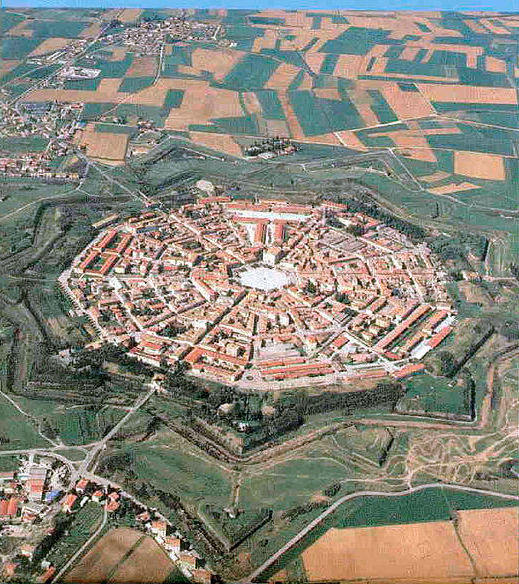
The Venetian Works of Defence between the 16th and 17th Centuries: Stato da Terra - Western Stato da Mar is a UNESCO World Heritage Site encompassing six bastion forts built by the Republic of Venice across its mainland territories and maritime domains. These defensive structures served as crucial bulwarks against potential threats from neighboring European powers and safeguarded the Republic's trade routes and strategic positions.
More to come…UNESCO Description of the World Heritage Site
This property consists of 6 components of defence works in Italy, Croatia and Montenegro, spanning more than 1,000 km between the Lombard region of Italy and the eastern Adriatic Coast. The fortifications throughout the Stato da Terra protected the Republic of Venice from other European powers to the northwest and those of the Stato da Mar protected the sea routes and ports in the Adriatic Sea to the Levant. They were necessary to support the expansion and authority of the Serenissima. The introduction of gunpowder led to significant shifts in military techniques and architecture that are reflected in the design of so-called alla moderna / bastioned, fortifications, which were to spread throughout Europe.
UNESCO Justification of the World Heritage Site
Criterion (iii): The Venetian Works of Defence provide an exceptional testimony of the alla moderna military culture, which evolved within the Republic of Venice in the 16th and 17th centuries, involving vast territories and interactions. Together the components demonstrate a defensive network or system for the Stato da Terra and the western Stato da Mar centred in the Adriatic Sea or Golfo di Venezia, which had civil, military, urban dimensions that extended further, traversing the Mediterranean region to the Levant.
Criterion (iv): The Venetian Works of Defence present the characteristics of the alla moderna fortified system (bastioned system) built by the Republic of Venice following changes that were introduced following the increased use of firearms. Together the six components demonstrate in an exceptional way the characteristics of the alla moderna system including its technical and logistic abilities, modern fighting strategies and new architectural requirements within the Stato da Terra and the western portions of the Stato da Mar.
Encyclopedia Record: Venetian Works of Defence between the 16th and 17th centuries: Stato da Terra – Western Stato da Mar
Venetian Works of Defence between the 16th and 17th Centuries: Stato da Terra – Western Stato da Mar is a UNESCO World Heritage Site comprising six bastion forts constructed by the Republic of Venice in its mainland territories and maritime domains.Additional Site Details
Area: 378.37 hectares
Number of Components: 6
(iv) — Outstanding example of a type of building or landscape
Coordinates: 45.7033333333 , 9.6636111111
World Heritage Research
Discover scientific research and academic studies that deepen our understanding of Venetian Works of Defence between the 16th and 17th Centuries: Stato da Terra – Western Stato da Mar from its history and significance to its conservation, management, and contemporary challenges.
-
Venice, an Archipelago of Art and Ecologies
Venice serves as a unique case study for addressing the dual challenges of cultural preservation and ecological fragility. This volume highlights Venice's role as an 'archipelago of art and ecologies,' demonstrating how artistic and curatorial practices can contribute to both ecological transition and cultural regeneration. It brings together interdisciplinary perspectives from scholars, artists, museum professionals, and curators to explore innovative solutions for mitigating the impacts of climate change and overtourism. The research approach combines socio-ecological analysis with creative interventions, offering a model for balancing heritage conservation with sustainable development in vulnerable urban environments.
Hainzl, C., Baldacci, C., Praschl-Bichler, A., & Hainzl, C. (Eds.). (2025). Venice, an Archipelago of Art and Ecologies. Zwischenräume – Reflexionen Zukünftiger Un/Ordnungen. https://doi.org/10.14361/9783839474402
View Publication Record | Read Publication -
Multi-Analytical Study of Lime-Based Mortars from the 16th-Century Venetian Fortress of Bergamo (Italy)
A multi-analytical study of lime-based mortars from the 16th-century Venetian Fortress of Bergamo reveals that these mortars possess hydraulic properties, likely due to interactions between lime and reactive silicate aggregates. The research, employing X-ray diffraction (XRD), inductively coupled plasma optical emission spectrophotometry (ICP-OES), optical microscopy (OM), differential scanning calorimetry (DSC), and thermogravimetric analysis (TG), identified a range of compounds including calcite, hydrocalumite, hydrotalcite-type phases, brucite, aragonite, plombierite, and significant amorphous content (14–27 wt%). The mortars are notably magnesium-rich, containing 4–5 wt% brucite, with no evidence of magnesite or hydromagnesite. The CO₂/H₂O bound ratio further supports the hydraulic nature of these mortars, suggesting advanced construction techniques used in Renaissance-era Venetian fortifications.
Pelosato, R., Natali-Sora, I., Nannei, V. M., & Mirabella Roberti, G. (2025). Multi-Analytical Study of Lime-Based Mortars from the 16th-Century Venetian Fortress of Bergamo (Italy). Heritage, 8(10), 400. https://doi.org/10.3390/heritage8100400
View Publication Record | Read Publication -
Venice flooding and sea level: past evolution, present issues, and future projections (introduction to the special issue)
Venice faces increasing flooding threats due to rising relative sea levels and extreme water heights. Research indicates that these hazards will likely worsen and accelerate throughout the 21st century, potentially rendering current defense strategies inadequate under high-emission scenarios. The study highlights the challenges posed by compound events, which complicate flood forecasting and the operation of mobile barriers like MoSE. Future research must focus on reducing uncertainty in sea level rise projections while developing adaptive planning strategies to address these challenges effectively.
Lionello, P., Nicholls, R. J., Umgiesser, G., & Zanchettin, D. (2021). Venice flooding and sea level: past evolution, present issues, and future projections (introduction to the special issue). Natural Hazards and Earth System Sciences, 21(8), 2633–2641. https://doi.org/10.5194/nhess-21-2633-2021
View Publication Record | Read Publication -
Introduction to the special issue Venice flooding and sea level: past evolution, present issues and future projections
Venice, a UNESCO World Heritage Site of immense historical and cultural value, faces increasing flooding risks due to rising sea levels. A recent special issue highlights that the frequency of extreme sea-level events is accelerating, posing significant challenges for flood prediction and management, particularly with the operation of the MoSE mobile barriers. The research emphasizes the need for adaptive planning strategies to address uncertainties in future relative sea level changes, which are influenced by anthropogenic emissions and structural model features. While uncertainty may not be substantially reduced soon, understanding compound events is crucial for effective flood forecasting.
Lionello, P., Nicholls, R. J., Umgiesser, G., & Zanchettin, D. (2020). Introduction to the special issue Venice flooding and sea level: past evolution, present issues and future projections. https://doi.org/10.5194/nhess-2020-367
View Publication Record | Read Publication -
Ricostruire la memoria dello Stato da Mar attraverso un percorso di conoscenza, documentazione e disegno
A digital archive of Venetian military architecture in the Dalmatia and Montenegro regions reveals the enduring legacy of the Stato da Mar, a coastal defense system established by the Republic of Venice. This study demonstrates how advanced documentation techniques, including 3D modeling and digital mapping, can reconstruct historical connections between fortified structures, construction methods, and their strategic significance. The research highlights the potential for such archives to support international conservation efforts and promote awareness of this UNESCO-listed heritage. By analyzing the Bocche di Cattaro, a key Venetian stronghold, the team developed methodologies for data collection that could be applied globally to similar sites.
Sandro Parrinello, & Silvia La Placa. (2020). Ricostruire la memoria dello Stato da Mar attraverso un percorso di conoscenza, documentazione e disegno. Connettere - Un Disegno per Annodare E Tessere · Connecting - Drawing for Weaving Relationships. https://doi.org/10.3280/oa-548.139
View Publication Record | Read Publication